Event submissions
Published
This submission belongs to the session S7. Novel Methods and Technologies for Research and Treatment of the event The 5th International Electronic Conference on Cancers
Published date
05 Jun, 2026
Academic Editor
'%3e%3cpath%20d='M12.6657%2010.9104C12.4185%2010.325%2012.0599%209.79327%2011.6097%209.34482C11.1609%208.89508%2010.6293%208.5365%2010.0442%208.28888C10.0389%208.28626%2010.0337%208.28495%2010.0285%208.28233C10.8446%207.69279%2011.3752%206.73249%2011.3752%205.64904C11.3752%203.8542%209.92103%202.39999%208.1262%202.39999C6.33136%202.39999%204.87715%203.8542%204.87715%205.64904C4.87715%206.73249%205.40774%207.69279%206.22393%208.28364C6.21869%208.28626%206.21345%208.28757%206.20821%208.29019C5.62129%208.5378%205.09463%208.89284%204.64265%209.34613C4.1929%209.79493%203.83432%2010.3266%203.58671%2010.9117C3.34345%2011.4845%203.21226%2012.0987%203.20023%2012.7209C3.19988%2012.7349%203.20233%2012.7488%203.20744%2012.7619C3.21255%2012.7749%203.22022%2012.7867%203.22998%2012.7968C3.23975%2012.8068%203.25142%2012.8147%203.26431%2012.8202C3.2772%2012.8256%203.29105%2012.8284%203.30504%2012.8284H4.09109C4.14874%2012.8284%204.19459%2012.7825%204.1959%2012.7262C4.2221%2011.7148%204.62823%2010.7676%205.34617%2010.0497C6.08899%209.30683%207.0755%208.89808%208.1262%208.89808C9.17689%208.89808%2010.1634%209.30683%2010.9062%2010.0497C11.6242%2010.7676%2012.0303%2011.7148%2012.0565%2012.7262C12.0578%2012.7838%2012.1037%2012.8284%2012.1613%2012.8284H12.9474C12.9613%2012.8284%2012.9752%2012.8256%2012.9881%2012.8202C13.001%2012.8147%2013.0126%2012.8068%2013.0224%2012.7968C13.0322%2012.7867%2013.0398%2012.7749%2013.0449%2012.7619C13.0501%2012.7488%2013.0525%2012.7349%2013.0522%2012.7209C13.0391%2012.0947%2012.9094%2011.4855%2012.6657%2010.9104ZM8.1262%207.9024C7.52486%207.9024%206.9589%207.6679%206.53312%207.24211C6.10733%206.81633%205.87283%206.25037%205.87283%205.64904C5.87283%205.0477%206.10733%204.48174%206.53312%204.05596C6.9589%203.63018%207.52486%203.39567%208.1262%203.39567C8.72753%203.39567%209.29349%203.63018%209.71927%204.05596C10.1451%204.48174%2010.3796%205.0477%2010.3796%205.64904C10.3796%206.25037%2010.1451%206.81633%209.71927%207.24211C9.29349%207.6679%208.72753%207.9024%208.1262%207.9024Z'%20fill='%235D1EE1'/%3e%3c/g%3e%3c/svg%3e) Andrew A. Gumbs
Andrew A. GumbsCitation
Moontasir Ahmed, Jannat Ara Tina, Shadman Newaz, Rashid Shahriar Sazal, Lamia Ashraf, Md Rubaiyat Tasfin Talukder, Faiyaz Saqif Khan, Anika Tahsin Orpa, Arthi Roy, Immune Checkpoint Inhibitor-Associated Myocarditis in Cancer Patients: A Systematic Review of Clinical Presentation, Management, and Outcomes, in Proceedings of The 5th International Electronic Conference on Cancers, 10 June–12 June 2026, MDPI: Basel, Switzerland
Share
Email
Facebook
Twitter
LinkedIn
Immune Checkpoint Inhibitor-Associated Myocarditis in Cancer Patients: A Systematic Review of Clinical Presentation, Management, and Outcomes

Moontasir Ahmed 1
'%3e%3cpath%20d='M12.6647%2010.9104C12.4176%2010.325%2012.0589%209.7933%2011.6088%209.34485C11.16%208.89511%2010.6283%208.53653%2010.0432%208.28891C10.038%208.28629%2010.0327%208.28498%2010.0275%208.28236C10.8437%207.69282%2011.3743%206.73252%2011.3743%205.64907C11.3743%203.85423%209.92005%202.40002%208.12522%202.40002C6.33038%202.40002%204.87618%203.85423%204.87618%205.64907C4.87618%206.73252%205.40677%207.69282%206.22296%208.28367C6.21772%208.28629%206.21248%208.2876%206.20724%208.29022C5.62031%208.53783%205.09365%208.89287%204.64167%209.34616C4.19192%209.79496%203.83334%2010.3266%203.58573%2010.9117C3.34247%2011.4846%203.21128%2012.0987%203.19925%2012.721C3.1989%2012.735%203.20135%2012.7489%203.20646%2012.7619C3.21157%2012.7749%203.21924%2012.7868%203.22901%2012.7968C3.23877%2012.8068%203.25045%2012.8148%203.26334%2012.8202C3.27623%2012.8256%203.29007%2012.8284%203.30406%2012.8284H4.09012C4.14776%2012.8284%204.19362%2012.7825%204.19493%2012.7262C4.22113%2011.7148%204.62726%2010.7676%205.34519%2010.0497C6.08802%209.30686%207.07452%208.89811%208.12522%208.89811C9.17592%208.89811%2010.1624%209.30686%2010.9052%2010.0497C11.6232%2010.7676%2012.0293%2011.7148%2012.0555%2012.7262C12.0568%2012.7839%2012.1027%2012.8284%2012.1603%2012.8284H12.9464C12.9604%2012.8284%2012.9742%2012.8256%2012.9871%2012.8202C13%2012.8148%2013.0117%2012.8068%2013.0214%2012.7968C13.0312%2012.7868%2013.0389%2012.7749%2013.044%2012.7619C13.0491%2012.7489%2013.0515%2012.735%2013.0512%2012.721C13.0381%2012.0947%2012.9084%2011.4856%2012.6647%2010.9104ZM8.12522%207.90243C7.52388%207.90243%206.95792%207.66793%206.53214%207.24215C6.10636%206.81636%205.87185%206.2504%205.87185%205.64907C5.87185%205.04773%206.10636%204.48177%206.53214%204.05599C6.95792%203.63021%207.52388%203.3957%208.12522%203.3957C8.72655%203.3957%209.29252%203.63021%209.7183%204.05599C10.1441%204.48177%2010.3786%205.04773%2010.3786%205.64907C10.3786%206.2504%2010.1441%206.81636%209.7183%207.24215C9.29252%207.66793%208.72655%207.90243%208.12522%207.90243Z'%20fill='%235D1EE1'/%3e%3c/g%3e%3c/svg%3e)
Jannat Ara Tina 1
Shadman Newaz 1
Rashid Shahriar Sazal 2
Lamia Ashraf 1
Md Rubaiyat Tasfin Talukder 3
Faiyaz Saqif Khan 4
Anika Tahsin Orpa 5

Arthi Roy 6
1. Department of Internal Medicine, Tangail Medical College Hospital, Tangail – 1900, Bangladesh
2. Department of Internal Medicine, Bangladesh Medical University, Dhaka – 1000, Bangladesh
3. Department of Internal Medicine, Mymensingh Medical College Hospital, Mymensingh – 2200, Bangladesh
4. Department of Internal Medicine, Green Life Medical College and Hospital, Dhaka – 1205, Bangladesh
5. Department of Internal Medicine, Sylhet MAG Osmani Medical College Hospital, Sylhet – 3100, Bangladesh
6. Department of Internal Medicine, Pabna Medical College Hospital, Pabna – 6600, Bangladesh
Abstract
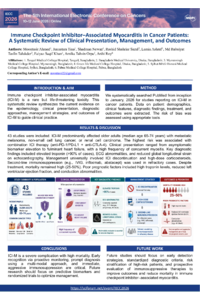
Background: Immune checkpoint inhibitor-associated myocarditis (ICI-M) is a rare but life-threatening toxicity. This systematic review synthesizes the current evidence on the epidemiology, clinical presentation, diagnostic approaches, management strategies, and outcomes of ICI-M to guide clinical practice.
Methods: We systematically searched PubMed from inception to December 2025 for studies reporting on ICI-M in cancer patients. Data on patient demographics, clinical features, diagnostic findings, treatment, and outcomes were extracted. The risk of bias was assessed using appropriate tools.
Results: In total, 43 studies were included. ICI-M predominantly affected older adults (median age 65-74 years) with metastatic melanoma, non-small cell lung cancer, or renal cell carcinoma. The highest risk was associated with combination ICI therapy (anti-PD-1/PD-L1 + anti-CTLA-4). Clinical presentation ranged from asymptomatic biomarker elevation to fulminant heart failure, with a high frequency of concurrent myositis. Key diagnostic findings included elevated troponin (>90% of cases), ECG abnormalities, and reduced global longitudinal strain on echocardiography. Management universally involved ICI discontinuation and high-dose corticosteroids. Second-line immunosuppression (e.g., IVIG, infliximab, abatacept) was used in refractory cases. Despite treatment, mortality remained high (25-50%). Poor prognostic factors included high troponin levels, reduced left ventricular ejection fraction, and conduction abnormalities.
Conclusion: ICI-M is a severe complication with high mortality. Early recognition via proactive monitoring, prompt diagnosis using a multi-modal approach, and immediate, aggressive immunosuppression are critical. Future research should focus on predictive biomarkers and randomized trials to optimize management.
Keywords
Immune checkpoint inhibitors
Myocarditis
Cardio-oncology
Immunotherapy
Immune-related adverse events
Systematic review.
Poster
sciforum_171739_S7_slides_3.pdf
The Link Between Malignancy and Arterial Thrombotic Events: A Systematic Review Across Cancer Types
The correlation between estrogen level and microbial interaction in breast cancer