Event submissions
Published
This submission belongs to the session S3. Drug Resistance and Anti-cancer Drug Development and Screening of the event The 5th International Electronic Conference on Cancers
Published date
05 Jun, 2026
Academic Editor
'%3e%3cpath%20d='M12.6657%2010.9104C12.4185%2010.325%2012.0599%209.79327%2011.6097%209.34482C11.1609%208.89508%2010.6293%208.5365%2010.0442%208.28888C10.0389%208.28626%2010.0337%208.28495%2010.0285%208.28233C10.8446%207.69279%2011.3752%206.73249%2011.3752%205.64904C11.3752%203.8542%209.92103%202.39999%208.1262%202.39999C6.33136%202.39999%204.87715%203.8542%204.87715%205.64904C4.87715%206.73249%205.40774%207.69279%206.22393%208.28364C6.21869%208.28626%206.21345%208.28757%206.20821%208.29019C5.62129%208.5378%205.09463%208.89284%204.64265%209.34613C4.1929%209.79493%203.83432%2010.3266%203.58671%2010.9117C3.34345%2011.4845%203.21226%2012.0987%203.20023%2012.7209C3.19988%2012.7349%203.20233%2012.7488%203.20744%2012.7619C3.21255%2012.7749%203.22022%2012.7867%203.22998%2012.7968C3.23975%2012.8068%203.25142%2012.8147%203.26431%2012.8202C3.2772%2012.8256%203.29105%2012.8284%203.30504%2012.8284H4.09109C4.14874%2012.8284%204.19459%2012.7825%204.1959%2012.7262C4.2221%2011.7148%204.62823%2010.7676%205.34617%2010.0497C6.08899%209.30683%207.0755%208.89808%208.1262%208.89808C9.17689%208.89808%2010.1634%209.30683%2010.9062%2010.0497C11.6242%2010.7676%2012.0303%2011.7148%2012.0565%2012.7262C12.0578%2012.7838%2012.1037%2012.8284%2012.1613%2012.8284H12.9474C12.9613%2012.8284%2012.9752%2012.8256%2012.9881%2012.8202C13.001%2012.8147%2013.0126%2012.8068%2013.0224%2012.7968C13.0322%2012.7867%2013.0398%2012.7749%2013.0449%2012.7619C13.0501%2012.7488%2013.0525%2012.7349%2013.0522%2012.7209C13.0391%2012.0947%2012.9094%2011.4855%2012.6657%2010.9104ZM8.1262%207.9024C7.52486%207.9024%206.9589%207.6679%206.53312%207.24211C6.10733%206.81633%205.87283%206.25037%205.87283%205.64904C5.87283%205.0477%206.10733%204.48174%206.53312%204.05596C6.9589%203.63018%207.52486%203.39567%208.1262%203.39567C8.72753%203.39567%209.29349%203.63018%209.71927%204.05596C10.1451%204.48174%2010.3796%205.0477%2010.3796%205.64904C10.3796%206.25037%2010.1451%206.81633%209.71927%207.24211C9.29349%207.6679%208.72753%207.9024%208.1262%207.9024Z'%20fill='%235D1EE1'/%3e%3c/g%3e%3c/svg%3e) Farrukh Aqil
Farrukh AqilCitation
FRANCESCO CHIARA, Sarah Allegra, Federico Itri, Valeria Ballero, Silvia De Francia, Marco De Gobbi, Intracellular and Erythrocyte Partitioning of Venetoclax and its Metabolites: A Multi-Compartmental Pharmacokinetic Model Derived from Paired Patient Samples using High-Resolution Mass Spectrometry, in Proceedings of The 5th International Electronic Conference on Cancers, 10 June–12 June 2026, MDPI: Basel, Switzerland
Share
Email
Facebook
Twitter
LinkedIn
Intracellular and Erythrocyte Partitioning of Venetoclax and its Metabolites: A Multi-Compartmental Pharmacokinetic Model Derived from Paired Patient Samples using High-Resolution Mass Spectrometry
'%3e%3cpath%20d='M12.6647%2010.9104C12.4176%2010.325%2012.0589%209.7933%2011.6088%209.34485C11.16%208.89511%2010.6283%208.53653%2010.0432%208.28891C10.038%208.28629%2010.0327%208.28498%2010.0275%208.28236C10.8437%207.69282%2011.3743%206.73252%2011.3743%205.64907C11.3743%203.85423%209.92005%202.40002%208.12522%202.40002C6.33038%202.40002%204.87618%203.85423%204.87618%205.64907C4.87618%206.73252%205.40677%207.69282%206.22296%208.28367C6.21772%208.28629%206.21248%208.2876%206.20724%208.29022C5.62031%208.53783%205.09365%208.89287%204.64167%209.34616C4.19192%209.79496%203.83334%2010.3266%203.58573%2010.9117C3.34247%2011.4846%203.21128%2012.0987%203.19925%2012.721C3.1989%2012.735%203.20135%2012.7489%203.20646%2012.7619C3.21157%2012.7749%203.21924%2012.7868%203.22901%2012.7968C3.23877%2012.8068%203.25045%2012.8148%203.26334%2012.8202C3.27623%2012.8256%203.29007%2012.8284%203.30406%2012.8284H4.09012C4.14776%2012.8284%204.19362%2012.7825%204.19493%2012.7262C4.22113%2011.7148%204.62726%2010.7676%205.34519%2010.0497C6.08802%209.30686%207.07452%208.89811%208.12522%208.89811C9.17592%208.89811%2010.1624%209.30686%2010.9052%2010.0497C11.6232%2010.7676%2012.0293%2011.7148%2012.0555%2012.7262C12.0568%2012.7839%2012.1027%2012.8284%2012.1603%2012.8284H12.9464C12.9604%2012.8284%2012.9742%2012.8256%2012.9871%2012.8202C13%2012.8148%2013.0117%2012.8068%2013.0214%2012.7968C13.0312%2012.7868%2013.0389%2012.7749%2013.044%2012.7619C13.0491%2012.7489%2013.0515%2012.735%2013.0512%2012.721C13.0381%2012.0947%2012.9084%2011.4856%2012.6647%2010.9104ZM8.12522%207.90243C7.52388%207.90243%206.95792%207.66793%206.53214%207.24215C6.10636%206.81636%205.87185%206.2504%205.87185%205.64907C5.87185%205.04773%206.10636%204.48177%206.53214%204.05599C6.95792%203.63021%207.52388%203.3957%208.12522%203.3957C8.72655%203.3957%209.29252%203.63021%209.7183%204.05599C10.1441%204.48177%2010.3786%205.04773%2010.3786%205.64907C10.3786%206.2504%2010.1441%206.81636%209.7183%207.24215C9.29252%207.66793%208.72655%207.90243%208.12522%207.90243Z'%20fill='%235D1EE1'/%3e%3c/g%3e%3c/svg%3e)
FRANCESCO CHIARA 1,2

Sarah Allegra 2,3
Federico Itri 3
Valeria Ballero 2

Silvia De Francia 2
Marco De Gobbi 2
1. Department of Physics, University of Trento, 38122 Povo, Italy
2. Department of Clinical and Biological Sciences, University of Turin, San Luigi Gonzaga Hospital, 10043 Orbassano, Italy
3. San Luigi Gonzaga Hospital, 10043 Orbassano, Italy
Abstract
Venetoclax is a pivotal BCL-2 inhibitor, yet its plasma pharmacokinetics (PK) often fail to predict clinical outcomes accurately. Since the pharmacological target is intracellular, plasma concentrations may not reflect actual exposure in Peripheral Blood Mononuclear Cells (PBMCs) or sequestration in erythrocytes (RBCs). We aimed to develop a multi-compartment PK model to quantify the distribution of Venetoclax and its two major metabolites across plasma, RBCs, and PBMCs. Peripheral blood from 15 patients undergoing Venetoclax therapy was collected and processed to separate Plasma, RBCs, and PBMCs. We developed a high-resolution analytical method using a Shimadzu Nexera X3 coupled to a Sciex ZenoTOF 7600 system for simultaneous quantification in all matrices. MATLAB was used to construct a compartmental PK model defining rate constants (kin, kout) for drug transfer between plasma and cellular compartments. The UPLC-QTOF method demonstrated high sensitivity, successfully detecting Venetoclax and metabolites even at low intracellular concentrations. Preliminary data indicate significant partitioning of the parent drug into cellular compartments, suggesting RBCs may act as a drug reservoir. The MATLAB model describes the dynamic equilibrium between plasma fraction and intracellular accumulation. Detailed kinetic parameters, including PBMC-to-plasma accumulation ratios and metabolite impact, will be presented. This study models Venetoclax kinetics simultaneously in plasma, RBCs, and target PBMCs within the same patient cohort. By shifting the focus from plasma TDM to intracellular pharmacokinetics, this approach offers a more precise tool for understanding drug resistance mechanisms and optimizing dosage in precision oncology.
Keywords
Venetoclax
Intracellular Pharmacokinetics
UPLC-QTOF
PBMC & Erythrocyte Partitioning
Pharmacokinetic Modeling
Therapeutic Drug Monitoring (TDM)
Poster
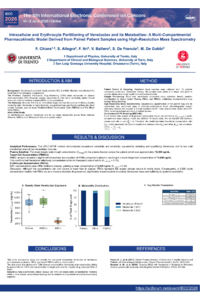
Chiara_F_et_al.pdf
Interconnections of p53 Status and TGF-β Signaling orchestrate tumor-suppressive and tumor-promoting Effects Irrespective of Tumor Cell Origin.
A Novel CAM-Based Dual-Reporter Imaging Platform to Study Secretome-Driven Vascular Remodeling in Sarcoma