Event submissions
Published
This submission belongs to the session S3. Drug Resistance and Anti-cancer Drug Development and Screening of the event The 5th International Electronic Conference on Cancers
Published date
05 Jun, 2026
Academic Editor
'%3e%3cpath%20d='M12.6657%2010.9104C12.4185%2010.325%2012.0599%209.79327%2011.6097%209.34482C11.1609%208.89508%2010.6293%208.5365%2010.0442%208.28888C10.0389%208.28626%2010.0337%208.28495%2010.0285%208.28233C10.8446%207.69279%2011.3752%206.73249%2011.3752%205.64904C11.3752%203.8542%209.92103%202.39999%208.1262%202.39999C6.33136%202.39999%204.87715%203.8542%204.87715%205.64904C4.87715%206.73249%205.40774%207.69279%206.22393%208.28364C6.21869%208.28626%206.21345%208.28757%206.20821%208.29019C5.62129%208.5378%205.09463%208.89284%204.64265%209.34613C4.1929%209.79493%203.83432%2010.3266%203.58671%2010.9117C3.34345%2011.4845%203.21226%2012.0987%203.20023%2012.7209C3.19988%2012.7349%203.20233%2012.7488%203.20744%2012.7619C3.21255%2012.7749%203.22022%2012.7867%203.22998%2012.7968C3.23975%2012.8068%203.25142%2012.8147%203.26431%2012.8202C3.2772%2012.8256%203.29105%2012.8284%203.30504%2012.8284H4.09109C4.14874%2012.8284%204.19459%2012.7825%204.1959%2012.7262C4.2221%2011.7148%204.62823%2010.7676%205.34617%2010.0497C6.08899%209.30683%207.0755%208.89808%208.1262%208.89808C9.17689%208.89808%2010.1634%209.30683%2010.9062%2010.0497C11.6242%2010.7676%2012.0303%2011.7148%2012.0565%2012.7262C12.0578%2012.7838%2012.1037%2012.8284%2012.1613%2012.8284H12.9474C12.9613%2012.8284%2012.9752%2012.8256%2012.9881%2012.8202C13.001%2012.8147%2013.0126%2012.8068%2013.0224%2012.7968C13.0322%2012.7867%2013.0398%2012.7749%2013.0449%2012.7619C13.0501%2012.7488%2013.0525%2012.7349%2013.0522%2012.7209C13.0391%2012.0947%2012.9094%2011.4855%2012.6657%2010.9104ZM8.1262%207.9024C7.52486%207.9024%206.9589%207.6679%206.53312%207.24211C6.10733%206.81633%205.87283%206.25037%205.87283%205.64904C5.87283%205.0477%206.10733%204.48174%206.53312%204.05596C6.9589%203.63018%207.52486%203.39567%208.1262%203.39567C8.72753%203.39567%209.29349%203.63018%209.71927%204.05596C10.1451%204.48174%2010.3796%205.0477%2010.3796%205.64904C10.3796%206.25037%2010.1451%206.81633%209.71927%207.24211C9.29349%207.6679%208.72753%207.9024%208.1262%207.9024Z'%20fill='%235D1EE1'/%3e%3c/g%3e%3c/svg%3e) Farrukh Aqil
Farrukh AqilCitation
Marvah Qanoot, Amjad Hussain, Synthesis and Pharmacological Evaluation of N-(2-Bromo ethyl) Phthalimide-Based Hybrid Compounds, in Proceedings of The 5th International Electronic Conference on Cancers, 10 June–12 June 2026, MDPI: Basel, Switzerland
Share
Email
Facebook
Twitter
LinkedIn
Synthesis and Pharmacological Evaluation of N-(2-Bromo ethyl) Phthalimide-Based Hybrid
Compounds
Compounds
'%3e%3cpath%20d='M12.6647%2010.9104C12.4176%2010.325%2012.0589%209.7933%2011.6088%209.34485C11.16%208.89511%2010.6283%208.53653%2010.0432%208.28891C10.038%208.28629%2010.0327%208.28498%2010.0275%208.28236C10.8437%207.69282%2011.3743%206.73252%2011.3743%205.64907C11.3743%203.85423%209.92005%202.40002%208.12522%202.40002C6.33038%202.40002%204.87618%203.85423%204.87618%205.64907C4.87618%206.73252%205.40677%207.69282%206.22296%208.28367C6.21772%208.28629%206.21248%208.2876%206.20724%208.29022C5.62031%208.53783%205.09365%208.89287%204.64167%209.34616C4.19192%209.79496%203.83334%2010.3266%203.58573%2010.9117C3.34247%2011.4846%203.21128%2012.0987%203.19925%2012.721C3.1989%2012.735%203.20135%2012.7489%203.20646%2012.7619C3.21157%2012.7749%203.21924%2012.7868%203.22901%2012.7968C3.23877%2012.8068%203.25045%2012.8148%203.26334%2012.8202C3.27623%2012.8256%203.29007%2012.8284%203.30406%2012.8284H4.09012C4.14776%2012.8284%204.19362%2012.7825%204.19493%2012.7262C4.22113%2011.7148%204.62726%2010.7676%205.34519%2010.0497C6.08802%209.30686%207.07452%208.89811%208.12522%208.89811C9.17592%208.89811%2010.1624%209.30686%2010.9052%2010.0497C11.6232%2010.7676%2012.0293%2011.7148%2012.0555%2012.7262C12.0568%2012.7839%2012.1027%2012.8284%2012.1603%2012.8284H12.9464C12.9604%2012.8284%2012.9742%2012.8256%2012.9871%2012.8202C13%2012.8148%2013.0117%2012.8068%2013.0214%2012.7968C13.0312%2012.7868%2013.0389%2012.7749%2013.044%2012.7619C13.0491%2012.7489%2013.0515%2012.735%2013.0512%2012.721C13.0381%2012.0947%2012.9084%2011.4856%2012.6647%2010.9104ZM8.12522%207.90243C7.52388%207.90243%206.95792%207.66793%206.53214%207.24215C6.10636%206.81636%205.87185%206.2504%205.87185%205.64907C5.87185%205.04773%206.10636%204.48177%206.53214%204.05599C6.95792%203.63021%207.52388%203.3957%208.12522%203.3957C8.72655%203.3957%209.29252%203.63021%209.7183%204.05599C10.1441%204.48177%2010.3786%205.04773%2010.3786%205.64907C10.3786%206.2504%2010.1441%206.81636%209.7183%207.24215C9.29252%207.66793%208.72655%207.90243%208.12522%207.90243Z'%20fill='%235D1EE1'/%3e%3c/g%3e%3c/svg%3e)
Marvah Qanoot 1

Amjad Hussain 1
1. Department of Chemistry, University of Okara, Okara-56300, Punjab, Pakistan
Abstract
The heterocyclic ring has always been essential to the development of anticancer drugs in synthetic organic chemistry, and when combined with other ring systems, it may improve the biological
activities of those drugs. Different kinds of biological activities are possessed by a distinct group
of heterocyclic compounds.
Objective:
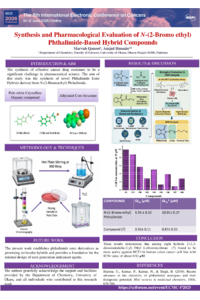
This work describes the effective and practical synthesis of a unique, hybrid series of N-(2-Bromoethyl) Phthalimide compounds and their pharmacological activity against the human colon cancer cell
line (HCT-116).
Methodology:
A number of N-2 (Bromo ethyl) Phthalimide-based hybrids, 1-8, were synthesized by reacting N-2 (Bromo ethyl) Phthalimide with various carboxylic acid-based analogues, which served as reacting agents, in the presence of N,N-dimethylformamide (DMF) as a solvent and potassium carbonate (K₂CO₃) as a catalyst. The reaction mixture was agitated at ambient temperature for approximately 15–24 hours, resulting in the formation of new phthalimide acid derivatives. The synthesized analogs were then characterized, and their structures were elucidated using several spectroscopic analyses, such as NMR, UV, IR, and EI-MS. The cytotoxic effects of newly synthesized compounds were compared to Doxorubicin in an in vitro MTT cytotoxicity assay. With micromolar (µM) half maximum inhibitory
concentration (IC50) values against tumor cells, the first screening revealed good to moderate
anticancer efficacy for these recently synthesized compounds, with a high degree of cell line selectivity. The involvement of molecular fragments such as phthalimide, linker, and terminal tails in relation to activity was validated by the SAR analysis of these derivatives. Analyses of the
extensive structure–activity relationship (SAR) were also performed.
Result:
A study of the pharmacokinetic profile of hybrid 2-(1,3-dioxoisoindolin-2-yl) Ethyl 6-chloronicotinate (7) revealed long-term behavior and strong cytotoxic activity against the human colon cancer cell line (HCT-116). This design provided strong, specific anticancer Phthalimide leads for additional cancer drug discovery optimization.
Keywords
Anticancer
Apoptosis Study
Drug Synthesis
Hybrids
N-(2-Bromo ethyl) Phthalimide
Colon Cancer
Pharmaceutical
Poster
IECC Poster-Marvah Qanoot.pdf
A Novel CAM-Based Dual-Reporter Imaging Platform to Study Secretome-Driven Vascular Remodeling in Sarcoma
Anti-cancer Drug Development by Rapid and Synchronized Dormancy-Breaking Kyoho Grape Seed Endosperm