Event submissions
Published
This submission belongs to the session S3. Drug Resistance and Anti-cancer Drug Development and Screening of the event The 5th International Electronic Conference on Cancers
Published date
05 Jun, 2026
Academic Editor
'%3e%3cpath%20d='M12.6657%2010.9104C12.4185%2010.325%2012.0599%209.79327%2011.6097%209.34482C11.1609%208.89508%2010.6293%208.5365%2010.0442%208.28888C10.0389%208.28626%2010.0337%208.28495%2010.0285%208.28233C10.8446%207.69279%2011.3752%206.73249%2011.3752%205.64904C11.3752%203.8542%209.92103%202.39999%208.1262%202.39999C6.33136%202.39999%204.87715%203.8542%204.87715%205.64904C4.87715%206.73249%205.40774%207.69279%206.22393%208.28364C6.21869%208.28626%206.21345%208.28757%206.20821%208.29019C5.62129%208.5378%205.09463%208.89284%204.64265%209.34613C4.1929%209.79493%203.83432%2010.3266%203.58671%2010.9117C3.34345%2011.4845%203.21226%2012.0987%203.20023%2012.7209C3.19988%2012.7349%203.20233%2012.7488%203.20744%2012.7619C3.21255%2012.7749%203.22022%2012.7867%203.22998%2012.7968C3.23975%2012.8068%203.25142%2012.8147%203.26431%2012.8202C3.2772%2012.8256%203.29105%2012.8284%203.30504%2012.8284H4.09109C4.14874%2012.8284%204.19459%2012.7825%204.1959%2012.7262C4.2221%2011.7148%204.62823%2010.7676%205.34617%2010.0497C6.08899%209.30683%207.0755%208.89808%208.1262%208.89808C9.17689%208.89808%2010.1634%209.30683%2010.9062%2010.0497C11.6242%2010.7676%2012.0303%2011.7148%2012.0565%2012.7262C12.0578%2012.7838%2012.1037%2012.8284%2012.1613%2012.8284H12.9474C12.9613%2012.8284%2012.9752%2012.8256%2012.9881%2012.8202C13.001%2012.8147%2013.0126%2012.8068%2013.0224%2012.7968C13.0322%2012.7867%2013.0398%2012.7749%2013.0449%2012.7619C13.0501%2012.7488%2013.0525%2012.7349%2013.0522%2012.7209C13.0391%2012.0947%2012.9094%2011.4855%2012.6657%2010.9104ZM8.1262%207.9024C7.52486%207.9024%206.9589%207.6679%206.53312%207.24211C6.10733%206.81633%205.87283%206.25037%205.87283%205.64904C5.87283%205.0477%206.10733%204.48174%206.53312%204.05596C6.9589%203.63018%207.52486%203.39567%208.1262%203.39567C8.72753%203.39567%209.29349%203.63018%209.71927%204.05596C10.1451%204.48174%2010.3796%205.0477%2010.3796%205.64904C10.3796%206.25037%2010.1451%206.81633%209.71927%207.24211C9.29349%207.6679%208.72753%207.9024%208.1262%207.9024Z'%20fill='%235D1EE1'/%3e%3c/g%3e%3c/svg%3e) Farrukh Aqil
Farrukh AqilCitation
Toshihiro Ona, Junko Johzuka, Anti-cancer Drug Development by Rapid and Synchronized Dormancy-Breaking Kyoho Grape Seed Endosperm, in Proceedings of The 5th International Electronic Conference on Cancers, 10 June–12 June 2026, MDPI: Basel, Switzerland
Share
Email
Facebook
Twitter
LinkedIn
Anti-cancer Drug Development by Rapid and Synchronized Dormancy-Breaking Kyoho Grape Seed Endosperm
'%3e%3cpath%20d='M12.6647%2010.9104C12.4176%2010.325%2012.0589%209.7933%2011.6088%209.34485C11.16%208.89511%2010.6283%208.53653%2010.0432%208.28891C10.038%208.28629%2010.0327%208.28498%2010.0275%208.28236C10.8437%207.69282%2011.3743%206.73252%2011.3743%205.64907C11.3743%203.85423%209.92005%202.40002%208.12522%202.40002C6.33038%202.40002%204.87618%203.85423%204.87618%205.64907C4.87618%206.73252%205.40677%207.69282%206.22296%208.28367C6.21772%208.28629%206.21248%208.2876%206.20724%208.29022C5.62031%208.53783%205.09365%208.89287%204.64167%209.34616C4.19192%209.79496%203.83334%2010.3266%203.58573%2010.9117C3.34247%2011.4846%203.21128%2012.0987%203.19925%2012.721C3.1989%2012.735%203.20135%2012.7489%203.20646%2012.7619C3.21157%2012.7749%203.21924%2012.7868%203.22901%2012.7968C3.23877%2012.8068%203.25045%2012.8148%203.26334%2012.8202C3.27623%2012.8256%203.29007%2012.8284%203.30406%2012.8284H4.09012C4.14776%2012.8284%204.19362%2012.7825%204.19493%2012.7262C4.22113%2011.7148%204.62726%2010.7676%205.34519%2010.0497C6.08802%209.30686%207.07452%208.89811%208.12522%208.89811C9.17592%208.89811%2010.1624%209.30686%2010.9052%2010.0497C11.6232%2010.7676%2012.0293%2011.7148%2012.0555%2012.7262C12.0568%2012.7839%2012.1027%2012.8284%2012.1603%2012.8284H12.9464C12.9604%2012.8284%2012.9742%2012.8256%2012.9871%2012.8202C13%2012.8148%2013.0117%2012.8068%2013.0214%2012.7968C13.0312%2012.7868%2013.0389%2012.7749%2013.044%2012.7619C13.0491%2012.7489%2013.0515%2012.735%2013.0512%2012.721C13.0381%2012.0947%2012.9084%2011.4856%2012.6647%2010.9104ZM8.12522%207.90243C7.52388%207.90243%206.95792%207.66793%206.53214%207.24215C6.10636%206.81636%205.87185%206.2504%205.87185%205.64907C5.87185%205.04773%206.10636%204.48177%206.53214%204.05599C6.95792%203.63021%207.52388%203.3957%208.12522%203.3957C8.72655%203.3957%209.29252%203.63021%209.7183%204.05599C10.1441%204.48177%2010.3786%205.04773%2010.3786%205.64907C10.3786%206.2504%2010.1441%206.81636%209.7183%207.24215C9.29252%207.66793%208.72655%207.90243%208.12522%207.90243Z'%20fill='%235D1EE1'/%3e%3c/g%3e%3c/svg%3e)
Toshihiro Ona 1,2
Junko Johzuka 1,2
1. Graduate School of Bioresource and Bioenvironmental Sciences, Kyushu University, Kasuga 816-8580, Japan
2. Head Office, O’Atari Inc., Onojo 816-0942, Japan
Abstract
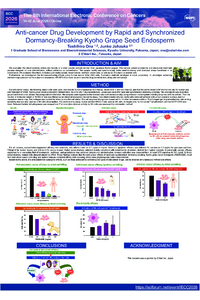
[Background/Aims] We evaluated the direct cytotoxic effects and toxicity of a dried powder sample derived from Japanese Kyoho grapes. This sample utilized a digestive and absorption treatment process designed for oral administration, without extraction or concentration. The sample rapidly and synchronously broke seed dormancy and promoted phase transitions in its constituents. We assessed the effects on human pancreatic cancer, breast cancer, and liver cancer cells, as well as on fibroblasts as normal cells. Furthermore, we investigated the immune-activating effects using human natural killer cells. Evaluation methods employed a novel, proprietary 1h phenotypic screening method—high-precision surface plasmon resonance (HP-SPR-3D)—used as an in vivo-like drug sensitivity test, along with cell assays.
[Results] For all cancers, concentration-dependent efficacy was observed, with effects noted at 2.5 mg/ml or higher and maximum efficacy at 5.0 mg/ml. Higher concentrations exhibited toxicity consistent with mitochondria shutdown, distinct from typical necrosis. In pancreatic cancer, efficacy equivalent to or exceeding that of doxorubicin, paclitaxel, and gemcitabine was achieved despite oral administration. Immune activation was observed from at least 3.75 mg/ml up to 5.0 mg/ml. At these concentrations, normal cells showed almost no effect. These findings indicate that the anti-cancer effects of rapidly and synchronously dormancy-breaking Kyoho grape seed endosperm result from both direct cancer cell killing and indirect immune-mediated effects, both occurring at the same physiologically active concentration. Based on the above, it is anticipated that synergistic effects, such as those achieved by combining two types of anti-cancer drugs, can be obtained simultaneously without side effects.
Keywords
Anti-cancer
Drug Development
Dormancy-Breaking
Kyoho Grape Seed Endosperm
Pancreas
Breast
Liver
Immune Activation
Poster
IECC 2026 Poster(Ona)v2.pdf
Synthesis and Pharmacological Evaluation of N-(2-Bromo ethyl) Phthalimide-Based Hybrid
Compounds
Compounds
Associations of Functional Polymorphisms in Long Non-Coding RNAs MEG3 and GAS5 with Breast Cancer Risk and Gene Expression