Event submissions
Published
This submission belongs to the session S5. Causes, Diagnosis and Treatment of Cancer of the event The 5th International Electronic Conference on Cancers
Published date
05 Jun, 2026
Academic Editor
'%3e%3cpath%20d='M12.6657%2010.9104C12.4185%2010.325%2012.0599%209.79327%2011.6097%209.34482C11.1609%208.89508%2010.6293%208.5365%2010.0442%208.28888C10.0389%208.28626%2010.0337%208.28495%2010.0285%208.28233C10.8446%207.69279%2011.3752%206.73249%2011.3752%205.64904C11.3752%203.8542%209.92103%202.39999%208.1262%202.39999C6.33136%202.39999%204.87715%203.8542%204.87715%205.64904C4.87715%206.73249%205.40774%207.69279%206.22393%208.28364C6.21869%208.28626%206.21345%208.28757%206.20821%208.29019C5.62129%208.5378%205.09463%208.89284%204.64265%209.34613C4.1929%209.79493%203.83432%2010.3266%203.58671%2010.9117C3.34345%2011.4845%203.21226%2012.0987%203.20023%2012.7209C3.19988%2012.7349%203.20233%2012.7488%203.20744%2012.7619C3.21255%2012.7749%203.22022%2012.7867%203.22998%2012.7968C3.23975%2012.8068%203.25142%2012.8147%203.26431%2012.8202C3.2772%2012.8256%203.29105%2012.8284%203.30504%2012.8284H4.09109C4.14874%2012.8284%204.19459%2012.7825%204.1959%2012.7262C4.2221%2011.7148%204.62823%2010.7676%205.34617%2010.0497C6.08899%209.30683%207.0755%208.89808%208.1262%208.89808C9.17689%208.89808%2010.1634%209.30683%2010.9062%2010.0497C11.6242%2010.7676%2012.0303%2011.7148%2012.0565%2012.7262C12.0578%2012.7838%2012.1037%2012.8284%2012.1613%2012.8284H12.9474C12.9613%2012.8284%2012.9752%2012.8256%2012.9881%2012.8202C13.001%2012.8147%2013.0126%2012.8068%2013.0224%2012.7968C13.0322%2012.7867%2013.0398%2012.7749%2013.0449%2012.7619C13.0501%2012.7488%2013.0525%2012.7349%2013.0522%2012.7209C13.0391%2012.0947%2012.9094%2011.4855%2012.6657%2010.9104ZM8.1262%207.9024C7.52486%207.9024%206.9589%207.6679%206.53312%207.24211C6.10733%206.81633%205.87283%206.25037%205.87283%205.64904C5.87283%205.0477%206.10733%204.48174%206.53312%204.05596C6.9589%203.63018%207.52486%203.39567%208.1262%203.39567C8.72753%203.39567%209.29349%203.63018%209.71927%204.05596C10.1451%204.48174%2010.3796%205.0477%2010.3796%205.64904C10.3796%206.25037%2010.1451%206.81633%209.71927%207.24211C9.29349%207.6679%208.72753%207.9024%208.1262%207.9024Z'%20fill='%235D1EE1'/%3e%3c/g%3e%3c/svg%3e) Masaharu Seno
Masaharu SenoCitation
Amal El Masri, Firas Haddad, Karim Bachir, Nicole Charbel, Ali Awada, Aya Tamim, Nada Assaf, Firas Kreidieh, Retrospective Registry for Uveal Melanoma in Lebanon: 10-year Single-Center Experience of a Major Referral Center in the Middle East and North Africa, in Proceedings of The 5th International Electronic Conference on Cancers, 10 June–12 June 2026, MDPI: Basel, Switzerland
Share
Email
Facebook
Twitter
LinkedIn
Retrospective Registry for Uveal Melanoma in Lebanon: 10-year Single-Center Experience of a Major Referral Center in the Middle East and North Africa

Amal El Masri 1
'%3e%3cpath%20d='M12.6647%2010.9104C12.4176%2010.325%2012.0589%209.7933%2011.6088%209.34485C11.16%208.89511%2010.6283%208.53653%2010.0432%208.28891C10.038%208.28629%2010.0327%208.28498%2010.0275%208.28236C10.8437%207.69282%2011.3743%206.73252%2011.3743%205.64907C11.3743%203.85423%209.92005%202.40002%208.12522%202.40002C6.33038%202.40002%204.87618%203.85423%204.87618%205.64907C4.87618%206.73252%205.40677%207.69282%206.22296%208.28367C6.21772%208.28629%206.21248%208.2876%206.20724%208.29022C5.62031%208.53783%205.09365%208.89287%204.64167%209.34616C4.19192%209.79496%203.83334%2010.3266%203.58573%2010.9117C3.34247%2011.4846%203.21128%2012.0987%203.19925%2012.721C3.1989%2012.735%203.20135%2012.7489%203.20646%2012.7619C3.21157%2012.7749%203.21924%2012.7868%203.22901%2012.7968C3.23877%2012.8068%203.25045%2012.8148%203.26334%2012.8202C3.27623%2012.8256%203.29007%2012.8284%203.30406%2012.8284H4.09012C4.14776%2012.8284%204.19362%2012.7825%204.19493%2012.7262C4.22113%2011.7148%204.62726%2010.7676%205.34519%2010.0497C6.08802%209.30686%207.07452%208.89811%208.12522%208.89811C9.17592%208.89811%2010.1624%209.30686%2010.9052%2010.0497C11.6232%2010.7676%2012.0293%2011.7148%2012.0555%2012.7262C12.0568%2012.7839%2012.1027%2012.8284%2012.1603%2012.8284H12.9464C12.9604%2012.8284%2012.9742%2012.8256%2012.9871%2012.8202C13%2012.8148%2013.0117%2012.8068%2013.0214%2012.7968C13.0312%2012.7868%2013.0389%2012.7749%2013.044%2012.7619C13.0491%2012.7489%2013.0515%2012.735%2013.0512%2012.721C13.0381%2012.0947%2012.9084%2011.4856%2012.6647%2010.9104ZM8.12522%207.90243C7.52388%207.90243%206.95792%207.66793%206.53214%207.24215C6.10636%206.81636%205.87185%206.2504%205.87185%205.64907C5.87185%205.04773%206.10636%204.48177%206.53214%204.05599C6.95792%203.63021%207.52388%203.3957%208.12522%203.3957C8.72655%203.3957%209.29252%203.63021%209.7183%204.05599C10.1441%204.48177%2010.3786%205.04773%2010.3786%205.64907C10.3786%206.2504%2010.1441%206.81636%209.7183%207.24215C9.29252%207.66793%208.72655%207.90243%208.12522%207.90243Z'%20fill='%235D1EE1'/%3e%3c/g%3e%3c/svg%3e)
Firas Haddad 2
Karim Bachir 1
Nicole Charbel 2
Ali Awada 1
Aya Tamim 3
Nada Assaf 4
Firas Kreidieh 5
1. Faculty of Medicine, American University of Beirut, Beirut, Lebanon
2. Department of Internal Medicine, American University of Beirut Medical Center, Beirut, Lebanon
3. Department of Biological Sciences, University of Guelph, Guelph, Canada
4. Department of Pathology, American University of Beirut Medical Center, Beirut, Lebanon
5. Department of Hematology-Oncology, American University of Beirut Medical Center, Beirut, Lebanon
Abstract
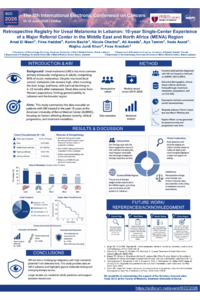
Introduction: Uveal melanoma (UM) is the most common primary intraocular malignancy in adults, comprising 80% of ocular melanomas. Despite advances in tumor control, metastatic potential remains high, with the liver, lungs, and bone being the most common sites. Once metastasis occurs, survival drops to 6–12 months. The aim of this study is to summarize the data available on patients with uveal melanoma treated in the past 10 years at the American University of Beirut Medical Center, focusing on factors affecting disease severity, clinical progression, and treatment modalities.
Methods: This study reviews the clinical, molecular, and histopathologic data of these patients. Data was retrieved from electronic health records, including baseline demographics, tumor characteristics, treatment modalities, and disease progression. Patients above 18 years with confirmed uveal melanoma were included, while those treated outside AUBMC or lost to follow-up were excluded. Descriptive statistics and regression analysis was conducted to identify factors influencing disease severity and outcomes.
Results: The mean age at diagnosis of our sample was 49.7 +- 20.13 years, predominantly comprised of male (66.67%), middle eastern (100%) patients aged > 60 (60%). Tumors lacked heterochromia (100%), portrayed melanocytotic (75%), and mostly occurred in the choroid macula or choroid macula to the epicenter. The mean thickness at presentation was 7.32 +- 6.33 mm. Tumors were most commonly brown (50%), then yellow (30%), and mixed (20%), and 55% of lesions contained subretinal fluid. Tumors were mostly in stage 1 (45%), did not involve nearby lymph nodes (60%), and did not have evidence of metastasis at diagnosis (88.89%). In total, 63.63% of our sample underwent surgery initially, with enucleation being the most common (55.56%).
Conclusion: UM remains a challenging malignancy with high metastatic potential if not detected early. This study provides valuable insights into the demographic, clinical, and treatment-related factors affecting UM outcomes in Lebanon. Further studies are needed, however, to better understand the molecular and clinical factors that influence disease progression.
Keywords
uveal melanoma
ocular melanoma
molecular profiling
prognostic biomarkers
precision oncology
Middle East and North Africa
retrospective registry
metastasis
Poster
IECC Final Poster - Uveal Melanoma.pdf
Serum from Subjects with High Body Mass Index Modulates Multiple Myeloma Cell Phenotype
SUBEPENDYMAL GIANT CELL ASTROCYTOMA: A RARE CENTRAL NERVOUS SYSTEM TUMOUR WITH A COMPLEX HISTOLOGY