Event submissions
Published
This submission belongs to the session S7. Novel Methods and Technologies for Research and Treatment of the event The 5th International Electronic Conference on Cancers
Published date
05 Jun, 2026
Academic Editor
'%3e%3cpath%20d='M12.6657%2010.9104C12.4185%2010.325%2012.0599%209.79327%2011.6097%209.34482C11.1609%208.89508%2010.6293%208.5365%2010.0442%208.28888C10.0389%208.28626%2010.0337%208.28495%2010.0285%208.28233C10.8446%207.69279%2011.3752%206.73249%2011.3752%205.64904C11.3752%203.8542%209.92103%202.39999%208.1262%202.39999C6.33136%202.39999%204.87715%203.8542%204.87715%205.64904C4.87715%206.73249%205.40774%207.69279%206.22393%208.28364C6.21869%208.28626%206.21345%208.28757%206.20821%208.29019C5.62129%208.5378%205.09463%208.89284%204.64265%209.34613C4.1929%209.79493%203.83432%2010.3266%203.58671%2010.9117C3.34345%2011.4845%203.21226%2012.0987%203.20023%2012.7209C3.19988%2012.7349%203.20233%2012.7488%203.20744%2012.7619C3.21255%2012.7749%203.22022%2012.7867%203.22998%2012.7968C3.23975%2012.8068%203.25142%2012.8147%203.26431%2012.8202C3.2772%2012.8256%203.29105%2012.8284%203.30504%2012.8284H4.09109C4.14874%2012.8284%204.19459%2012.7825%204.1959%2012.7262C4.2221%2011.7148%204.62823%2010.7676%205.34617%2010.0497C6.08899%209.30683%207.0755%208.89808%208.1262%208.89808C9.17689%208.89808%2010.1634%209.30683%2010.9062%2010.0497C11.6242%2010.7676%2012.0303%2011.7148%2012.0565%2012.7262C12.0578%2012.7838%2012.1037%2012.8284%2012.1613%2012.8284H12.9474C12.9613%2012.8284%2012.9752%2012.8256%2012.9881%2012.8202C13.001%2012.8147%2013.0126%2012.8068%2013.0224%2012.7968C13.0322%2012.7867%2013.0398%2012.7749%2013.0449%2012.7619C13.0501%2012.7488%2013.0525%2012.7349%2013.0522%2012.7209C13.0391%2012.0947%2012.9094%2011.4855%2012.6657%2010.9104ZM8.1262%207.9024C7.52486%207.9024%206.9589%207.6679%206.53312%207.24211C6.10733%206.81633%205.87283%206.25037%205.87283%205.64904C5.87283%205.0477%206.10733%204.48174%206.53312%204.05596C6.9589%203.63018%207.52486%203.39567%208.1262%203.39567C8.72753%203.39567%209.29349%203.63018%209.71927%204.05596C10.1451%204.48174%2010.3796%205.0477%2010.3796%205.64904C10.3796%206.25037%2010.1451%206.81633%209.71927%207.24211C9.29349%207.6679%208.72753%207.9024%208.1262%207.9024Z'%20fill='%235D1EE1'/%3e%3c/g%3e%3c/svg%3e) Guo-Min Li
Guo-Min LiCitation
Sofia Kleimenova, Mariia Mollaeva, Daria Prilutskaya, Nikita Yabbarov, Maria Sokol, Margarita Chirkina, Maksim Klimenko, Ivan Gulyaev, Elena Nikolskaya, Development of novel drug delivery systems based on extracellular vesicles and cell membranes for cancer therapy, in Proceedings of The 5th International Electronic Conference on Cancers, 10 June–12 June 2026, MDPI: Basel, Switzerland
Share
Email
Facebook
Twitter
LinkedIn
Development of novel drug delivery systems based on extracellular vesicles and cell membranes for cancer therapy
'%3e%3cpath%20d='M12.6647%2010.9104C12.4176%2010.325%2012.0589%209.7933%2011.6088%209.34485C11.16%208.89511%2010.6283%208.53653%2010.0432%208.28891C10.038%208.28629%2010.0327%208.28498%2010.0275%208.28236C10.8437%207.69282%2011.3743%206.73252%2011.3743%205.64907C11.3743%203.85423%209.92005%202.40002%208.12522%202.40002C6.33038%202.40002%204.87618%203.85423%204.87618%205.64907C4.87618%206.73252%205.40677%207.69282%206.22296%208.28367C6.21772%208.28629%206.21248%208.2876%206.20724%208.29022C5.62031%208.53783%205.09365%208.89287%204.64167%209.34616C4.19192%209.79496%203.83334%2010.3266%203.58573%2010.9117C3.34247%2011.4846%203.21128%2012.0987%203.19925%2012.721C3.1989%2012.735%203.20135%2012.7489%203.20646%2012.7619C3.21157%2012.7749%203.21924%2012.7868%203.22901%2012.7968C3.23877%2012.8068%203.25045%2012.8148%203.26334%2012.8202C3.27623%2012.8256%203.29007%2012.8284%203.30406%2012.8284H4.09012C4.14776%2012.8284%204.19362%2012.7825%204.19493%2012.7262C4.22113%2011.7148%204.62726%2010.7676%205.34519%2010.0497C6.08802%209.30686%207.07452%208.89811%208.12522%208.89811C9.17592%208.89811%2010.1624%209.30686%2010.9052%2010.0497C11.6232%2010.7676%2012.0293%2011.7148%2012.0555%2012.7262C12.0568%2012.7839%2012.1027%2012.8284%2012.1603%2012.8284H12.9464C12.9604%2012.8284%2012.9742%2012.8256%2012.9871%2012.8202C13%2012.8148%2013.0117%2012.8068%2013.0214%2012.7968C13.0312%2012.7868%2013.0389%2012.7749%2013.044%2012.7619C13.0491%2012.7489%2013.0515%2012.735%2013.0512%2012.721C13.0381%2012.0947%2012.9084%2011.4856%2012.6647%2010.9104ZM8.12522%207.90243C7.52388%207.90243%206.95792%207.66793%206.53214%207.24215C6.10636%206.81636%205.87185%206.2504%205.87185%205.64907C5.87185%205.04773%206.10636%204.48177%206.53214%204.05599C6.95792%203.63021%207.52388%203.3957%208.12522%203.3957C8.72655%203.3957%209.29252%203.63021%209.7183%204.05599C10.1441%204.48177%2010.3786%205.04773%2010.3786%205.64907C10.3786%206.2504%2010.1441%206.81636%209.7183%207.24215C9.29252%207.66793%208.72655%207.90243%208.12522%207.90243Z'%20fill='%235D1EE1'/%3e%3c/g%3e%3c/svg%3e)
Sofia Kleimenova 1,2
Mariia Mollaeva 1
Daria Prilutskaya 1,2

Nikita Yabbarov 1
Maria Sokol 1
Margarita Chirkina 1
Maksim Klimenko 1
Ivan Gulyaev 1

Elena Nikolskaya 1
1. Emanuel Institute of Biochemical Physics, Russian Academy of Sciences, Moscow 119334, Russia
2. Department of Technology of Chemical-Pharmaceutical and Cosmetic Products, Faculty of Chemical and Pharmaceutical Technologies, D. Mendeleev University of Chemical Technology of Russia, Moscow 125047, Russia
Abstract
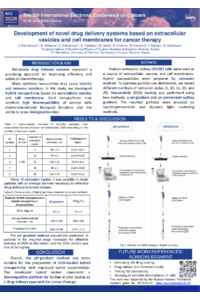
Introduction: Nanoscale drug delivery systems represent a promising approach for improving efficiency and safety of chemotherapy. However, many synthetic nanocarriers may cause toxicity and immune reactions, which limit their biomedical application. In this study, we developed hybrid nanoparticles based on extracellular vesicles and cell membranes. Such nanoparticles may combine the high biocompatibility of vesicles with membrane-derived biological functions and the ability to cross biological barriers.
Methods: Human embryonic kidney HEK293 cells were used as a source of extracellular vesicles and cell membranes. Hybrid nanoparticles were prepared by extrusion through polycarbonate membranes. To optimize particle size distribution, we tested different numbers of extrusion cycles (5, 10, 15, 20, and 25). Doxorubicin (DOX) loading was performed using two methods: a pH gradient and an ammonium sulfate gradient. The pH gradient method provides DOX diffusion through the membrane, followed by protonation and retention inside the particles, while the ammonium sulfate method relies on ionic gradients and the formation of poorly soluble sulfate complexes.
Results: The results demonstrated that 15 extrusion cycles were optimal for obtaining hybrid particles with the monodisperse size distribution. DOX loading using the pH gradient method produced particles with an average diameter of 250 ± 190 nm and a DOX concentration of 12 ± 1 µg/mL. In contrast, the ammonium sulfate gradient method resulted in a significant increase in particle size to 780 ± 360 nm, while the DOX concentration was 10 ± 3 µg/mL.
Conclusions: Overall, the pH gradient method was more suitable for the preparation of DOX-loaded hybrid nanoparticles with improved tumor accumulation. The developed hybrid system represents a biocompatible platform for further in vitro studies as a drug delivery approach for cancer therapy.
This work was supported by the Russian Science Foundation research grant No. 25-75-00151, https://rscf.ru/project/25-75-00151/
Keywords
Extracellular vesicles
Cell membrane
Hybrid nanoparticles
Doxorubicin
pH-gradient loading
Ammonium sulfate gradient
Cancer drug delivery
Poster
Kleimenova Development of novel drug delivery.pdf
Iron Oxide Nanoparticles as Potential Agents for Combined Radiotherapy
Heparan Sulfates Regulate Angiogenic Signaling and Drug Response in Aggressive Ovarian Cancer