Event submissions
Published
This submission belongs to the session S5. Causes, Diagnosis and Treatment of Cancer of the event The 5th International Electronic Conference on Cancers
Published date
05 Jun, 2026
Academic Editor
'%3e%3cpath%20d='M12.6657%2010.9104C12.4185%2010.325%2012.0599%209.79327%2011.6097%209.34482C11.1609%208.89508%2010.6293%208.5365%2010.0442%208.28888C10.0389%208.28626%2010.0337%208.28495%2010.0285%208.28233C10.8446%207.69279%2011.3752%206.73249%2011.3752%205.64904C11.3752%203.8542%209.92103%202.39999%208.1262%202.39999C6.33136%202.39999%204.87715%203.8542%204.87715%205.64904C4.87715%206.73249%205.40774%207.69279%206.22393%208.28364C6.21869%208.28626%206.21345%208.28757%206.20821%208.29019C5.62129%208.5378%205.09463%208.89284%204.64265%209.34613C4.1929%209.79493%203.83432%2010.3266%203.58671%2010.9117C3.34345%2011.4845%203.21226%2012.0987%203.20023%2012.7209C3.19988%2012.7349%203.20233%2012.7488%203.20744%2012.7619C3.21255%2012.7749%203.22022%2012.7867%203.22998%2012.7968C3.23975%2012.8068%203.25142%2012.8147%203.26431%2012.8202C3.2772%2012.8256%203.29105%2012.8284%203.30504%2012.8284H4.09109C4.14874%2012.8284%204.19459%2012.7825%204.1959%2012.7262C4.2221%2011.7148%204.62823%2010.7676%205.34617%2010.0497C6.08899%209.30683%207.0755%208.89808%208.1262%208.89808C9.17689%208.89808%2010.1634%209.30683%2010.9062%2010.0497C11.6242%2010.7676%2012.0303%2011.7148%2012.0565%2012.7262C12.0578%2012.7838%2012.1037%2012.8284%2012.1613%2012.8284H12.9474C12.9613%2012.8284%2012.9752%2012.8256%2012.9881%2012.8202C13.001%2012.8147%2013.0126%2012.8068%2013.0224%2012.7968C13.0322%2012.7867%2013.0398%2012.7749%2013.0449%2012.7619C13.0501%2012.7488%2013.0525%2012.7349%2013.0522%2012.7209C13.0391%2012.0947%2012.9094%2011.4855%2012.6657%2010.9104ZM8.1262%207.9024C7.52486%207.9024%206.9589%207.6679%206.53312%207.24211C6.10733%206.81633%205.87283%206.25037%205.87283%205.64904C5.87283%205.0477%206.10733%204.48174%206.53312%204.05596C6.9589%203.63018%207.52486%203.39567%208.1262%203.39567C8.72753%203.39567%209.29349%203.63018%209.71927%204.05596C10.1451%204.48174%2010.3796%205.0477%2010.3796%205.64904C10.3796%206.25037%2010.1451%206.81633%209.71927%207.24211C9.29349%207.6679%208.72753%207.9024%208.1262%207.9024Z'%20fill='%235D1EE1'/%3e%3c/g%3e%3c/svg%3e) Masaharu Seno
Masaharu SenoCitation
Martina Pallone, Francesca Gualtieri, Valentina Rocca, Giuseppe Viglietto, Carmela De Marco, Heparan Sulfates Regulate Angiogenic Signaling and Drug Response in Aggressive Ovarian Cancer, in Proceedings of The 5th International Electronic Conference on Cancers, 10 June–12 June 2026, MDPI: Basel, Switzerland
Share
Email
Facebook
Twitter
LinkedIn
Heparan Sulfates Regulate Angiogenic Signaling and Drug Response in Aggressive Ovarian Cancer
'%3e%3cpath%20d='M12.6647%2010.9104C12.4176%2010.325%2012.0589%209.7933%2011.6088%209.34485C11.16%208.89511%2010.6283%208.53653%2010.0432%208.28891C10.038%208.28629%2010.0327%208.28498%2010.0275%208.28236C10.8437%207.69282%2011.3743%206.73252%2011.3743%205.64907C11.3743%203.85423%209.92005%202.40002%208.12522%202.40002C6.33038%202.40002%204.87618%203.85423%204.87618%205.64907C4.87618%206.73252%205.40677%207.69282%206.22296%208.28367C6.21772%208.28629%206.21248%208.2876%206.20724%208.29022C5.62031%208.53783%205.09365%208.89287%204.64167%209.34616C4.19192%209.79496%203.83334%2010.3266%203.58573%2010.9117C3.34247%2011.4846%203.21128%2012.0987%203.19925%2012.721C3.1989%2012.735%203.20135%2012.7489%203.20646%2012.7619C3.21157%2012.7749%203.21924%2012.7868%203.22901%2012.7968C3.23877%2012.8068%203.25045%2012.8148%203.26334%2012.8202C3.27623%2012.8256%203.29007%2012.8284%203.30406%2012.8284H4.09012C4.14776%2012.8284%204.19362%2012.7825%204.19493%2012.7262C4.22113%2011.7148%204.62726%2010.7676%205.34519%2010.0497C6.08802%209.30686%207.07452%208.89811%208.12522%208.89811C9.17592%208.89811%2010.1624%209.30686%2010.9052%2010.0497C11.6232%2010.7676%2012.0293%2011.7148%2012.0555%2012.7262C12.0568%2012.7839%2012.1027%2012.8284%2012.1603%2012.8284H12.9464C12.9604%2012.8284%2012.9742%2012.8256%2012.9871%2012.8202C13%2012.8148%2013.0117%2012.8068%2013.0214%2012.7968C13.0312%2012.7868%2013.0389%2012.7749%2013.044%2012.7619C13.0491%2012.7489%2013.0515%2012.735%2013.0512%2012.721C13.0381%2012.0947%2012.9084%2011.4856%2012.6647%2010.9104ZM8.12522%207.90243C7.52388%207.90243%206.95792%207.66793%206.53214%207.24215C6.10636%206.81636%205.87185%206.2504%205.87185%205.64907C5.87185%205.04773%206.10636%204.48177%206.53214%204.05599C6.95792%203.63021%207.52388%203.3957%208.12522%203.3957C8.72655%203.3957%209.29252%203.63021%209.7183%204.05599C10.1441%204.48177%2010.3786%205.04773%2010.3786%205.64907C10.3786%206.2504%2010.1441%206.81636%209.7183%207.24215C9.29252%207.66793%208.72655%207.90243%208.12522%207.90243Z'%20fill='%235D1EE1'/%3e%3c/g%3e%3c/svg%3e)
Martina Pallone 1
Francesca Gualtieri 1
Valentina Rocca 1
Giuseppe Viglietto 1
Carmela De Marco 1,2
1. Department of Experimental and Clinical Medicine, “Magna Graecia” University, Catanzaro 88100, Italy
2. Interdepartmental Center of Services, Omics and Biobank, “Magna Graecia” University, Catanzaro 88100, Italy
Abstract
Introduction
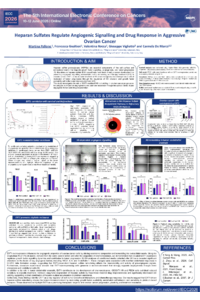
Heparan sulfate proteoglycans (HSPGs) are critical regulators of growth factor availability and angiogenic signalling within the tumour microenvironment. Dysregulation of heparan sulfate (HS) biosynthesis has been implicated in tumour progression; however, the mechanisms by which altered HS architecture spatially controls angiogenic signalling and therapy response in ovarian cancer remain incompletely understood. This study investigates the role of exostosin glycosyltransferase 1 (EXT1), a central enzyme in HS biosynthesis, in regulating angiogenesis and platinum resistance.
Methods
EXT1 was overexpressed in ovarian cancer cells to modulate HS biosynthesis and deposition. HS accumulation was assessed, and levels of angiogenic mediators in conditioned media were quantified. Endothelial tube formation was evaluated using conditioned medium and direct co-culture assays with human umbilical vein endothelial cells (HUVECs). Platinum sensitivity was assessed in EXT1-high cells, with or without enzymatic degradation of HS using heparinase, to determine the functional impact of HS-mediated sequestration.
Results
EXT1 overexpression significantly increased pericellular HS deposition, creating a localized reservoir for chemokines and pro-angiogenic growth factors. Conditioned medium from EXT1-overexpressing cells contained reduced levels of VEGFR, EDN1, IL6, and IL8 and exhibited diminished capacity to induce endothelial tube formation. In contrast, direct co-culture of EXT1-overexpressing ovarian cancer cells with HUVECs markedly enhanced tube formation, indicating that HS promotes angiogenesis through localized, contact-dependent paracrine signalling rather than freely diffusible factors. Additionally, elevated HS levels contributed to platinum resistance by sequestering therapeutic agents, impairing drug penetration, and altering receptor–ligand interactions. Enzymatic degradation of HS restored platinum sensitivity in EXT1-high cells.
Conclusions
These findings demonstrate that EXT1-driven HS remodelling regulates angiogenesis by spatially controlling growth factor bioavailability and contributes to therapy resistance, positioning HS structures as promising therapeutic targets and potential scaffolds for ligand-mediated drug delivery strategies in ovarian cancer.
Keywords
heparan sulfates
angiogenesis
drug resistance
ovarian cancer
Poster
IECC2026_ M.PALLONE .pdf
Development of novel drug delivery systems based on extracellular vesicles and cell membranes for cancer therapy
Heparan Sulfate-Mediated Mechanotransduction Promotes EMT and Aggressiveness in Ovarian Cancer