Event submissions
Published
This submission belongs to the session S5. Causes, Diagnosis and Treatment of Cancer of the event The 5th International Electronic Conference on Cancers
Published date
05 Jun, 2026
Academic Editor
'%3e%3cpath%20d='M12.6657%2010.9104C12.4185%2010.325%2012.0599%209.79327%2011.6097%209.34482C11.1609%208.89508%2010.6293%208.5365%2010.0442%208.28888C10.0389%208.28626%2010.0337%208.28495%2010.0285%208.28233C10.8446%207.69279%2011.3752%206.73249%2011.3752%205.64904C11.3752%203.8542%209.92103%202.39999%208.1262%202.39999C6.33136%202.39999%204.87715%203.8542%204.87715%205.64904C4.87715%206.73249%205.40774%207.69279%206.22393%208.28364C6.21869%208.28626%206.21345%208.28757%206.20821%208.29019C5.62129%208.5378%205.09463%208.89284%204.64265%209.34613C4.1929%209.79493%203.83432%2010.3266%203.58671%2010.9117C3.34345%2011.4845%203.21226%2012.0987%203.20023%2012.7209C3.19988%2012.7349%203.20233%2012.7488%203.20744%2012.7619C3.21255%2012.7749%203.22022%2012.7867%203.22998%2012.7968C3.23975%2012.8068%203.25142%2012.8147%203.26431%2012.8202C3.2772%2012.8256%203.29105%2012.8284%203.30504%2012.8284H4.09109C4.14874%2012.8284%204.19459%2012.7825%204.1959%2012.7262C4.2221%2011.7148%204.62823%2010.7676%205.34617%2010.0497C6.08899%209.30683%207.0755%208.89808%208.1262%208.89808C9.17689%208.89808%2010.1634%209.30683%2010.9062%2010.0497C11.6242%2010.7676%2012.0303%2011.7148%2012.0565%2012.7262C12.0578%2012.7838%2012.1037%2012.8284%2012.1613%2012.8284H12.9474C12.9613%2012.8284%2012.9752%2012.8256%2012.9881%2012.8202C13.001%2012.8147%2013.0126%2012.8068%2013.0224%2012.7968C13.0322%2012.7867%2013.0398%2012.7749%2013.0449%2012.7619C13.0501%2012.7488%2013.0525%2012.7349%2013.0522%2012.7209C13.0391%2012.0947%2012.9094%2011.4855%2012.6657%2010.9104ZM8.1262%207.9024C7.52486%207.9024%206.9589%207.6679%206.53312%207.24211C6.10733%206.81633%205.87283%206.25037%205.87283%205.64904C5.87283%205.0477%206.10733%204.48174%206.53312%204.05596C6.9589%203.63018%207.52486%203.39567%208.1262%203.39567C8.72753%203.39567%209.29349%203.63018%209.71927%204.05596C10.1451%204.48174%2010.3796%205.0477%2010.3796%205.64904C10.3796%206.25037%2010.1451%206.81633%209.71927%207.24211C9.29349%207.6679%208.72753%207.9024%208.1262%207.9024Z'%20fill='%235D1EE1'/%3e%3c/g%3e%3c/svg%3e) Nicola Amodio
Nicola AmodioCitation
Mouna Aqerrout, Imane Mharrach, Imane Ouariagli, Abdelilah Laraqui, Khalid Ennibi, Moulay Mustapha Ennaji, Urinary Dual OncomiR Signature of miR-21 and miR-155: A Non-Invasive Approach for Bladder Cancer Detection in a Moroccan Cohort, in Proceedings of The 5th International Electronic Conference on Cancers, 10 June–12 June 2026, MDPI: Basel, Switzerland
Share
Email
Facebook
Twitter
LinkedIn
Urinary Dual OncomiR Signature of miR-21 and miR-155: A Non-Invasive Approach for Bladder Cancer Detection in a Moroccan Cohort
'%3e%3cpath%20d='M12.6647%2010.9104C12.4176%2010.325%2012.0589%209.7933%2011.6088%209.34485C11.16%208.89511%2010.6283%208.53653%2010.0432%208.28891C10.038%208.28629%2010.0327%208.28498%2010.0275%208.28236C10.8437%207.69282%2011.3743%206.73252%2011.3743%205.64907C11.3743%203.85423%209.92005%202.40002%208.12522%202.40002C6.33038%202.40002%204.87618%203.85423%204.87618%205.64907C4.87618%206.73252%205.40677%207.69282%206.22296%208.28367C6.21772%208.28629%206.21248%208.2876%206.20724%208.29022C5.62031%208.53783%205.09365%208.89287%204.64167%209.34616C4.19192%209.79496%203.83334%2010.3266%203.58573%2010.9117C3.34247%2011.4846%203.21128%2012.0987%203.19925%2012.721C3.1989%2012.735%203.20135%2012.7489%203.20646%2012.7619C3.21157%2012.7749%203.21924%2012.7868%203.22901%2012.7968C3.23877%2012.8068%203.25045%2012.8148%203.26334%2012.8202C3.27623%2012.8256%203.29007%2012.8284%203.30406%2012.8284H4.09012C4.14776%2012.8284%204.19362%2012.7825%204.19493%2012.7262C4.22113%2011.7148%204.62726%2010.7676%205.34519%2010.0497C6.08802%209.30686%207.07452%208.89811%208.12522%208.89811C9.17592%208.89811%2010.1624%209.30686%2010.9052%2010.0497C11.6232%2010.7676%2012.0293%2011.7148%2012.0555%2012.7262C12.0568%2012.7839%2012.1027%2012.8284%2012.1603%2012.8284H12.9464C12.9604%2012.8284%2012.9742%2012.8256%2012.9871%2012.8202C13%2012.8148%2013.0117%2012.8068%2013.0214%2012.7968C13.0312%2012.7868%2013.0389%2012.7749%2013.044%2012.7619C13.0491%2012.7489%2013.0515%2012.735%2013.0512%2012.721C13.0381%2012.0947%2012.9084%2011.4856%2012.6647%2010.9104ZM8.12522%207.90243C7.52388%207.90243%206.95792%207.66793%206.53214%207.24215C6.10636%206.81636%205.87185%206.2504%205.87185%205.64907C5.87185%205.04773%206.10636%204.48177%206.53214%204.05599C6.95792%203.63021%207.52388%203.3957%208.12522%203.3957C8.72655%203.3957%209.29252%203.63021%209.7183%204.05599C10.1441%204.48177%2010.3786%205.04773%2010.3786%205.64907C10.3786%206.2504%2010.1441%206.81636%209.7183%207.24215C9.29252%207.66793%208.72655%207.90243%208.12522%207.90243Z'%20fill='%235D1EE1'/%3e%3c/g%3e%3c/svg%3e)
Mouna Aqerrout 1
Imane Mharrach 1
Imane Ouariagli 1
Abdelilah Laraqui 2
Khalid Ennibi 3
Moulay Mustapha Ennaji 1
1. Team of Virology, Oncology, and Biotechnologies, Laboratory of Virology, Oncology, Biosciences, Environment, and New Energies, Faculty of Sciences and Techniques of Mohammedia, Hassan II University of Casablanca, Mohammedia, 28806, Morocco
2. Sequencing Unit, Laboratory of Virology, Center of Virology, Infectious and Tropical Diseases, Mohammed V Military Teaching Hospital, Royal School of Military Health Service, Faculty of Medicine and Pharmacy, Mohammed V University, Rabat, 10000, Morocco
3. Center of Virology, Infectious and Tropical Diseases, Mohammed V Military Teaching Hospital, Faculty of Medicine and Pharmacy, Mohammed V University, Rabat, 10000, Morocco
Abstract
Bladder cancer (BCa) remains a major global health burden, particularly in low-to-middle-income countries such as Morocco, where access to invasive diagnostic tools is limited. While several urinary biomarkers have been explored, most studies focus on single molecules and are rarely population-specific. The present study aimed to assess, for the first time in a Moroccan cohort, the diagnostic utility of a dual urinary microRNA signature combining microRNA-21 (miR-21) and microRNA-155 (miR-155). Expression levels of miR-21 and miR-155 were quantified by quantitative real-time polymerase chain reaction (RT-qPCR) in urine samples from 70 BCa patients and 30 healthy controls. ΔCt values normalized to U6 small nuclear RNA (snRNA) were used for relative quantification. Diagnostic performance was evaluated using Receiver Operating Characteristic (ROC) curves, while multivariate logistic regression and clinicopathological correlations were performed to assess predictive value. Both miR-21 and miR-155 were significantly upregulated in BCa patients compared with controls (p < 0.0001). Individually, miR-21 and miR-155 achieved AUCs of 0.876 and 0.845, respectively. Their combined analysis provided superior accuracy (AUC = 0.907), outperforming single-marker approaches. Elevated expression correlated with advanced tumor stage, higher grade, and muscle invasion. Multivariate analysis identified miR-21 as an independent predictor of BCa (OR = 0.575, p = 0.023). This study highlights a novel dual urinary miRNA signature for BCa detection and risk stratification, with demonstrated relevance in a North African population. Unlike previous studies centered on single markers or non-representative cohorts, our findings emphasize the translational potential of combining miR-21 and miR-155 as a non-invasive, accessible, and effective diagnostic approach, which is particularly valuable for resource-limited settings.
Keywords
Bladder cancer
Liquid biopsy
miRNAs
Non-invasive diagnostics
Urinary biomarkers
Moroccan cohort.
Poster
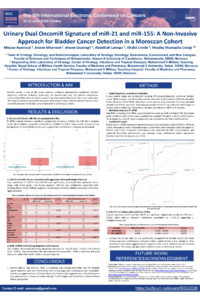
Official Poster.pdf
Analysis of Screening Results for Upper Gastrointestinal Cancer and Precancerous Lesions among High-Risk Individuals Aged 40-69 in the Chaoshan Region, Guangdong Province, China
Hyaluronic acid-functionalized CaCO₃ crystals as novel polyelectrolyte multilayer reservoirs for CPT-RB (Chemotherapy and Photodynamic therapy) targeting multiple myeloma