Event submissions
Published
This submission belongs to the session S5. Causes, Diagnosis and Treatment of Cancer of the event The 5th International Electronic Conference on Cancers
Published date
05 Jun, 2026
Academic Editor
'%3e%3cpath%20d='M12.6657%2010.9104C12.4185%2010.325%2012.0599%209.79327%2011.6097%209.34482C11.1609%208.89508%2010.6293%208.5365%2010.0442%208.28888C10.0389%208.28626%2010.0337%208.28495%2010.0285%208.28233C10.8446%207.69279%2011.3752%206.73249%2011.3752%205.64904C11.3752%203.8542%209.92103%202.39999%208.1262%202.39999C6.33136%202.39999%204.87715%203.8542%204.87715%205.64904C4.87715%206.73249%205.40774%207.69279%206.22393%208.28364C6.21869%208.28626%206.21345%208.28757%206.20821%208.29019C5.62129%208.5378%205.09463%208.89284%204.64265%209.34613C4.1929%209.79493%203.83432%2010.3266%203.58671%2010.9117C3.34345%2011.4845%203.21226%2012.0987%203.20023%2012.7209C3.19988%2012.7349%203.20233%2012.7488%203.20744%2012.7619C3.21255%2012.7749%203.22022%2012.7867%203.22998%2012.7968C3.23975%2012.8068%203.25142%2012.8147%203.26431%2012.8202C3.2772%2012.8256%203.29105%2012.8284%203.30504%2012.8284H4.09109C4.14874%2012.8284%204.19459%2012.7825%204.1959%2012.7262C4.2221%2011.7148%204.62823%2010.7676%205.34617%2010.0497C6.08899%209.30683%207.0755%208.89808%208.1262%208.89808C9.17689%208.89808%2010.1634%209.30683%2010.9062%2010.0497C11.6242%2010.7676%2012.0303%2011.7148%2012.0565%2012.7262C12.0578%2012.7838%2012.1037%2012.8284%2012.1613%2012.8284H12.9474C12.9613%2012.8284%2012.9752%2012.8256%2012.9881%2012.8202C13.001%2012.8147%2013.0126%2012.8068%2013.0224%2012.7968C13.0322%2012.7867%2013.0398%2012.7749%2013.0449%2012.7619C13.0501%2012.7488%2013.0525%2012.7349%2013.0522%2012.7209C13.0391%2012.0947%2012.9094%2011.4855%2012.6657%2010.9104ZM8.1262%207.9024C7.52486%207.9024%206.9589%207.6679%206.53312%207.24211C6.10733%206.81633%205.87283%206.25037%205.87283%205.64904C5.87283%205.0477%206.10733%204.48174%206.53312%204.05596C6.9589%203.63018%207.52486%203.39567%208.1262%203.39567C8.72753%203.39567%209.29349%203.63018%209.71927%204.05596C10.1451%204.48174%2010.3796%205.0477%2010.3796%205.64904C10.3796%206.25037%2010.1451%206.81633%209.71927%207.24211C9.29349%207.6679%208.72753%207.9024%208.1262%207.9024Z'%20fill='%235D1EE1'/%3e%3c/g%3e%3c/svg%3e) Masaharu Seno
Masaharu SenoCitation
Nemany A.N. Hanafy, Safacan Kolemen, Hyaluronic acid-functionalized CaCO₃ crystals as novel polyelectrolyte multilayer reservoirs for CPT-RB (Chemotherapy and Photodynamic therapy) targeting multiple myeloma, in Proceedings of The 5th International Electronic Conference on Cancers, 10 June–12 June 2026, MDPI: Basel, Switzerland
Share
Email
Facebook
Twitter
LinkedIn
Hyaluronic acid-functionalized CaCO₃ crystals as novel polyelectrolyte multilayer reservoirs for CPT-RB (Chemotherapy and Photodynamic therapy) targeting multiple myeloma

Nemany A.N. Hanafy 1,2
'%3e%3cpath%20d='M12.6647%2010.9104C12.4176%2010.325%2012.0589%209.7933%2011.6088%209.34485C11.16%208.89511%2010.6283%208.53653%2010.0432%208.28891C10.038%208.28629%2010.0327%208.28498%2010.0275%208.28236C10.8437%207.69282%2011.3743%206.73252%2011.3743%205.64907C11.3743%203.85423%209.92005%202.40002%208.12522%202.40002C6.33038%202.40002%204.87618%203.85423%204.87618%205.64907C4.87618%206.73252%205.40677%207.69282%206.22296%208.28367C6.21772%208.28629%206.21248%208.2876%206.20724%208.29022C5.62031%208.53783%205.09365%208.89287%204.64167%209.34616C4.19192%209.79496%203.83334%2010.3266%203.58573%2010.9117C3.34247%2011.4846%203.21128%2012.0987%203.19925%2012.721C3.1989%2012.735%203.20135%2012.7489%203.20646%2012.7619C3.21157%2012.7749%203.21924%2012.7868%203.22901%2012.7968C3.23877%2012.8068%203.25045%2012.8148%203.26334%2012.8202C3.27623%2012.8256%203.29007%2012.8284%203.30406%2012.8284H4.09012C4.14776%2012.8284%204.19362%2012.7825%204.19493%2012.7262C4.22113%2011.7148%204.62726%2010.7676%205.34519%2010.0497C6.08802%209.30686%207.07452%208.89811%208.12522%208.89811C9.17592%208.89811%2010.1624%209.30686%2010.9052%2010.0497C11.6232%2010.7676%2012.0293%2011.7148%2012.0555%2012.7262C12.0568%2012.7839%2012.1027%2012.8284%2012.1603%2012.8284H12.9464C12.9604%2012.8284%2012.9742%2012.8256%2012.9871%2012.8202C13%2012.8148%2013.0117%2012.8068%2013.0214%2012.7968C13.0312%2012.7868%2013.0389%2012.7749%2013.044%2012.7619C13.0491%2012.7489%2013.0515%2012.735%2013.0512%2012.721C13.0381%2012.0947%2012.9084%2011.4856%2012.6647%2010.9104ZM8.12522%207.90243C7.52388%207.90243%206.95792%207.66793%206.53214%207.24215C6.10636%206.81636%205.87185%206.2504%205.87185%205.64907C5.87185%205.04773%206.10636%204.48177%206.53214%204.05599C6.95792%203.63021%207.52388%203.3957%208.12522%203.3957C8.72655%203.3957%209.29252%203.63021%209.7183%204.05599C10.1441%204.48177%2010.3786%205.04773%2010.3786%205.64907C10.3786%206.2504%2010.1441%206.81636%209.7183%207.24215C9.29252%207.66793%208.72655%207.90243%208.12522%207.90243Z'%20fill='%235D1EE1'/%3e%3c/g%3e%3c/svg%3e)
Safacan Kolemen 3
1. Group of Bionanotechnology and Molecular Cell Biology, Nanomedicine Department, Institute of Nanoscience and Nanotechnology, Kafrelsheikh University, 33516 Kafrelsheikh, Egypt.
2. Koç University Research Center for Translational Medicine (KUTTAM), 34450 Istanbul, Türkiye
3. Department of Chemistry, Koç University, 34450 Istanbul, Türkiye
Abstract
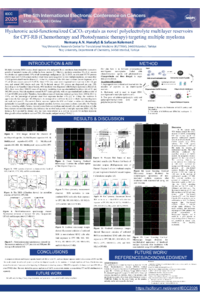
The properties of calcium carbonate (CaCO₃) make it a suitable option for drug delivery, particularly for medicinal substances with short half-lives, poor stability, limited solubility, and poor bioavailability, as well as restricted distribution or penetration. A significant step in CaCO₃ fabrication is the production of polyelectrolyte multilayered capsules. Isolated soyasaponin-integrated CaCO₃ crystals were functionalized with (chitosan/polyacrylic acid) and (polydopamine/hyaluronic acid) as multilayers. Rose Bengal as photodynamic therapy and camptothecin as chemotherapy were integrated during fabrication separately and simultaneously. The characterization of CaCO₃ crystals was investigated by using SEM, TEM, FTIR, XRD, and zeta potential measurements. Results showed an assembled structure of CaCO₃ crystals with strong integration of Rose Bengal and Camptothecin. Polyelectrolyte multilayered capsules obtained by CaCO₃ removal were observed to have cellular uptake in multiple myeloma cell lines. Hyaluronic acid-functionalized capsules were investigated in fibroblast normal cell lines under confocal microscopy to detect their application as targeted therapy for multiple myeloma. The flow cytometry and confocal microscopy confirmed ROS generation in both irradiated and non-irradiated multiple myeloma cell lines. It concluded that polyelectrolyte multilayered capsules are a good reservoir for encapsulating both chemotherapy and photodynamic therapy molecules simultaneously, and this could increase the potential therapeutic application.
Acknowledgments
Authors gratefully acknowledge the support from the 2236-B Marie Sklodowska-Curie Actions (MSCA) Cofund Scholarship Programs Contribution Fund Program (TUBITAK project ID: 123C460) and Horizon Europe MSCA Cofund Postdoctoral Program (EU project ID: 101126492). Views and opinions expressed are, however, those of the author(s) only and do not necessarily reflect those of the European Union or TUBITAK. Neither the European Union nor the granting authority can be held responsible for them.”
Keywords
Calcium carbonate Poor bioavailability Polyelectrolyte Multilayered Capsules
Poster
Poster- Nemany A.N.Hanafy-sciforum-170879.pdf
Urinary Dual OncomiR Signature of miR-21 and miR-155: A Non-Invasive Approach for Bladder Cancer Detection in a Moroccan Cohort
Extracellular vesicles as a targeted drug delivery platform for cancer treatment