Event submissions
Published
This submission belongs to the session S7. Novel Methods and Technologies for Research and Treatment of the event The 5th International Electronic Conference on Cancers
Published date
05 Jun, 2026
Academic Editor
'%3e%3cpath%20d='M12.6657%2010.9104C12.4185%2010.325%2012.0599%209.79327%2011.6097%209.34482C11.1609%208.89508%2010.6293%208.5365%2010.0442%208.28888C10.0389%208.28626%2010.0337%208.28495%2010.0285%208.28233C10.8446%207.69279%2011.3752%206.73249%2011.3752%205.64904C11.3752%203.8542%209.92103%202.39999%208.1262%202.39999C6.33136%202.39999%204.87715%203.8542%204.87715%205.64904C4.87715%206.73249%205.40774%207.69279%206.22393%208.28364C6.21869%208.28626%206.21345%208.28757%206.20821%208.29019C5.62129%208.5378%205.09463%208.89284%204.64265%209.34613C4.1929%209.79493%203.83432%2010.3266%203.58671%2010.9117C3.34345%2011.4845%203.21226%2012.0987%203.20023%2012.7209C3.19988%2012.7349%203.20233%2012.7488%203.20744%2012.7619C3.21255%2012.7749%203.22022%2012.7867%203.22998%2012.7968C3.23975%2012.8068%203.25142%2012.8147%203.26431%2012.8202C3.2772%2012.8256%203.29105%2012.8284%203.30504%2012.8284H4.09109C4.14874%2012.8284%204.19459%2012.7825%204.1959%2012.7262C4.2221%2011.7148%204.62823%2010.7676%205.34617%2010.0497C6.08899%209.30683%207.0755%208.89808%208.1262%208.89808C9.17689%208.89808%2010.1634%209.30683%2010.9062%2010.0497C11.6242%2010.7676%2012.0303%2011.7148%2012.0565%2012.7262C12.0578%2012.7838%2012.1037%2012.8284%2012.1613%2012.8284H12.9474C12.9613%2012.8284%2012.9752%2012.8256%2012.9881%2012.8202C13.001%2012.8147%2013.0126%2012.8068%2013.0224%2012.7968C13.0322%2012.7867%2013.0398%2012.7749%2013.0449%2012.7619C13.0501%2012.7488%2013.0525%2012.7349%2013.0522%2012.7209C13.0391%2012.0947%2012.9094%2011.4855%2012.6657%2010.9104ZM8.1262%207.9024C7.52486%207.9024%206.9589%207.6679%206.53312%207.24211C6.10733%206.81633%205.87283%206.25037%205.87283%205.64904C5.87283%205.0477%206.10733%204.48174%206.53312%204.05596C6.9589%203.63018%207.52486%203.39567%208.1262%203.39567C8.72753%203.39567%209.29349%203.63018%209.71927%204.05596C10.1451%204.48174%2010.3796%205.0477%2010.3796%205.64904C10.3796%206.25037%2010.1451%206.81633%209.71927%207.24211C9.29349%207.6679%208.72753%207.9024%208.1262%207.9024Z'%20fill='%235D1EE1'/%3e%3c/g%3e%3c/svg%3e) Andrew A. Gumbs
Andrew A. GumbsCitation
Daria Prilutskaya, Maria Mollaeva, Sofia Kleimenova, Nikita Yabbarov, Maria Sokol, Margarita Chirkina, Maksim Klimenko, Ivan Gulyaev, Yulia Bortnevskaya, Natal’ya Bragina, Kseniya Zhdanova, Elena Nikolskaya, Extracellular vesicles as a targeted drug delivery platform for cancer treatment, in Proceedings of The 5th International Electronic Conference on Cancers, 10 June–12 June 2026, MDPI: Basel, Switzerland
Share
Email
Facebook
Twitter
LinkedIn
Extracellular vesicles as a targeted drug delivery platform for cancer treatment
'%3e%3cpath%20d='M12.6647%2010.9104C12.4176%2010.325%2012.0589%209.7933%2011.6088%209.34485C11.16%208.89511%2010.6283%208.53653%2010.0432%208.28891C10.038%208.28629%2010.0327%208.28498%2010.0275%208.28236C10.8437%207.69282%2011.3743%206.73252%2011.3743%205.64907C11.3743%203.85423%209.92005%202.40002%208.12522%202.40002C6.33038%202.40002%204.87618%203.85423%204.87618%205.64907C4.87618%206.73252%205.40677%207.69282%206.22296%208.28367C6.21772%208.28629%206.21248%208.2876%206.20724%208.29022C5.62031%208.53783%205.09365%208.89287%204.64167%209.34616C4.19192%209.79496%203.83334%2010.3266%203.58573%2010.9117C3.34247%2011.4846%203.21128%2012.0987%203.19925%2012.721C3.1989%2012.735%203.20135%2012.7489%203.20646%2012.7619C3.21157%2012.7749%203.21924%2012.7868%203.22901%2012.7968C3.23877%2012.8068%203.25045%2012.8148%203.26334%2012.8202C3.27623%2012.8256%203.29007%2012.8284%203.30406%2012.8284H4.09012C4.14776%2012.8284%204.19362%2012.7825%204.19493%2012.7262C4.22113%2011.7148%204.62726%2010.7676%205.34519%2010.0497C6.08802%209.30686%207.07452%208.89811%208.12522%208.89811C9.17592%208.89811%2010.1624%209.30686%2010.9052%2010.0497C11.6232%2010.7676%2012.0293%2011.7148%2012.0555%2012.7262C12.0568%2012.7839%2012.1027%2012.8284%2012.1603%2012.8284H12.9464C12.9604%2012.8284%2012.9742%2012.8256%2012.9871%2012.8202C13%2012.8148%2013.0117%2012.8068%2013.0214%2012.7968C13.0312%2012.7868%2013.0389%2012.7749%2013.044%2012.7619C13.0491%2012.7489%2013.0515%2012.735%2013.0512%2012.721C13.0381%2012.0947%2012.9084%2011.4856%2012.6647%2010.9104ZM8.12522%207.90243C7.52388%207.90243%206.95792%207.66793%206.53214%207.24215C6.10636%206.81636%205.87185%206.2504%205.87185%205.64907C5.87185%205.04773%206.10636%204.48177%206.53214%204.05599C6.95792%203.63021%207.52388%203.3957%208.12522%203.3957C8.72655%203.3957%209.29252%203.63021%209.7183%204.05599C10.1441%204.48177%2010.3786%205.04773%2010.3786%205.64907C10.3786%206.2504%2010.1441%206.81636%209.7183%207.24215C9.29252%207.66793%208.72655%207.90243%208.12522%207.90243Z'%20fill='%235D1EE1'/%3e%3c/g%3e%3c/svg%3e)
Daria Prilutskaya 1,2
Maria Mollaeva 2
Sofia Kleimenova 1,2

Nikita Yabbarov 2
Maria Sokol 2
Margarita Chirkina 2
Maksim Klimenko 2
Ivan Gulyaev 2
Yulia Bortnevskaya 3
Natal’ya Bragina 3
Kseniya Zhdanova 3

Elena Nikolskaya 2
1. Faculty of Chemical and Pharmaceutical Technologies and Biomedical Products, D. Mendeleev University of Chemical Technology of Russia, Moscow, 125047, Russia.
2. Laboratory of Quantitative Oncology, Institute of Biochemical Physics NM Emanuel, Moscow, 119991, Russia.
3. Department of Chemistry and Technology of Biologically Active Compounds, Medicinal and Organic Chemistry, MIREA – Russian Technological University, Institute of Fine Chemical Technology, Moscow, 119454, Russia.
Abstract
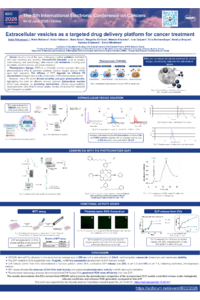
Introduction. Photodynamic therapy (PDT) is a commonly used cancer treatment method that generates cytotoxic reactive oxygen species upon light irradiation. However, its therapeutic efficacy is often limited by poor tumor selectivity and low intracellular accumulation of photosensitizers. Extracellular vesicles (EVs) are nanoscale structures released by cells of various tissues to mediate intercellular communication. Due to their natural origin, biocompatibility, and ability to carry therapeutic agents, EVs was proposed as promising drug delivery systems for cancer therapy. Tumor-derived EVs may preserve homotypic targeting properties, thereby enhancing drug accumulation in tumor tissue.
Materials and methods. EVs were isolated from A549 human lung adenocarcinoma cell line. Several EVs isolation methods were compared, including polyethylene glycol precipitation, anion-exchange chromatography and ultrafiltration. The porphyrin-based photosensitizer 5,15-bis(3-methoxy(4-(6-pyridylhexyloxy)phenyl)-10,20-di(ethynylphenyl)porphyrinato zinc (ZnP) was loaded in EVs via sonication, followed by removal of non-encapsulated ZnP using size-exclusion chromatography. The cytotoxic activity of ZnP-loaded EVs was evaluated on A549 cells after red light irradiation (660 nm). The generation of reactive oxygen species was analyzed using 2',7'-dichlorofluorescein diacetate probe.
Results. Ultrafiltration provide the efficient isolation of EVs with appropriate size characteristics and high protein content, indicating the effective vesicle recovery. The ZnP loading efficiency was approximately 40%. Neither free ZnP nor ZnP-loaded EVs showed dark toxicity on A549 cells at the tested concentrations. Photoactivity assay confirmed that ZnP preserve its photodynamic functionality after EVs loading. Flow cytometry analysis showed that ZnP-loaded EVs generated more reactive oxygen species compared to free ZnP, suggesting an enhanced oxidative effect.
Conclusions. Ultrafiltration proved to be an effective EVs isolation method. ZnP encapsulation in EVs preserved its photodynamic activity.Thus, the developed EVs-based system represents a promising approach for drug delivery.
This work was supported by the Russian Science Foundation research grant No. 25-75-00151, https://rscf.ru/project/25-75-00151/
Keywords
Cancer
photosensitizer
extracellular vesicles
photodynamic therapy
Poster
PrilutskayaDL.pdf
Hyaluronic acid-functionalized CaCO₃ crystals as novel polyelectrolyte multilayer reservoirs for CPT-RB (Chemotherapy and Photodynamic therapy) targeting multiple myeloma
Endometrioid Adenocarcinoma of the Endometrium with Mucinous Differentiation: An Anatomopathological Case Report