Event submissions
Published
This submission belongs to the session S5. Causes, Diagnosis and Treatment of Cancer of the event The 5th International Electronic Conference on Cancers
Published date
05 Jun, 2026
Academic Editor
'%3e%3cpath%20d='M12.6657%2010.9104C12.4185%2010.325%2012.0599%209.79327%2011.6097%209.34482C11.1609%208.89508%2010.6293%208.5365%2010.0442%208.28888C10.0389%208.28626%2010.0337%208.28495%2010.0285%208.28233C10.8446%207.69279%2011.3752%206.73249%2011.3752%205.64904C11.3752%203.8542%209.92103%202.39999%208.1262%202.39999C6.33136%202.39999%204.87715%203.8542%204.87715%205.64904C4.87715%206.73249%205.40774%207.69279%206.22393%208.28364C6.21869%208.28626%206.21345%208.28757%206.20821%208.29019C5.62129%208.5378%205.09463%208.89284%204.64265%209.34613C4.1929%209.79493%203.83432%2010.3266%203.58671%2010.9117C3.34345%2011.4845%203.21226%2012.0987%203.20023%2012.7209C3.19988%2012.7349%203.20233%2012.7488%203.20744%2012.7619C3.21255%2012.7749%203.22022%2012.7867%203.22998%2012.7968C3.23975%2012.8068%203.25142%2012.8147%203.26431%2012.8202C3.2772%2012.8256%203.29105%2012.8284%203.30504%2012.8284H4.09109C4.14874%2012.8284%204.19459%2012.7825%204.1959%2012.7262C4.2221%2011.7148%204.62823%2010.7676%205.34617%2010.0497C6.08899%209.30683%207.0755%208.89808%208.1262%208.89808C9.17689%208.89808%2010.1634%209.30683%2010.9062%2010.0497C11.6242%2010.7676%2012.0303%2011.7148%2012.0565%2012.7262C12.0578%2012.7838%2012.1037%2012.8284%2012.1613%2012.8284H12.9474C12.9613%2012.8284%2012.9752%2012.8256%2012.9881%2012.8202C13.001%2012.8147%2013.0126%2012.8068%2013.0224%2012.7968C13.0322%2012.7867%2013.0398%2012.7749%2013.0449%2012.7619C13.0501%2012.7488%2013.0525%2012.7349%2013.0522%2012.7209C13.0391%2012.0947%2012.9094%2011.4855%2012.6657%2010.9104ZM8.1262%207.9024C7.52486%207.9024%206.9589%207.6679%206.53312%207.24211C6.10733%206.81633%205.87283%206.25037%205.87283%205.64904C5.87283%205.0477%206.10733%204.48174%206.53312%204.05596C6.9589%203.63018%207.52486%203.39567%208.1262%203.39567C8.72753%203.39567%209.29349%203.63018%209.71927%204.05596C10.1451%204.48174%2010.3796%205.0477%2010.3796%205.64904C10.3796%206.25037%2010.1451%206.81633%209.71927%207.24211C9.29349%207.6679%208.72753%207.9024%208.1262%207.9024Z'%20fill='%235D1EE1'/%3e%3c/g%3e%3c/svg%3e) Nicola Amodio
Nicola AmodioCitation
Tinashe Adrian Mazhindu, Anna Mary Nyakabau, Webster Kadzatsa, A Cross-Sectional Evaluation of Guideline-Adherent Screening Eligibility Among Zimbabwean Patients Diagnosed with Lung Cancer, in Proceedings of The 5th International Electronic Conference on Cancers, 10 June–12 June 2026, MDPI: Basel, Switzerland
Share
Email
Facebook
Twitter
LinkedIn
A Cross-Sectional Evaluation of Guideline-Adherent Screening Eligibility Among Zimbabwean Patients Diagnosed with Lung Cancer
'%3e%3cpath%20d='M12.6647%2010.9104C12.4176%2010.325%2012.0589%209.7933%2011.6088%209.34485C11.16%208.89511%2010.6283%208.53653%2010.0432%208.28891C10.038%208.28629%2010.0327%208.28498%2010.0275%208.28236C10.8437%207.69282%2011.3743%206.73252%2011.3743%205.64907C11.3743%203.85423%209.92005%202.40002%208.12522%202.40002C6.33038%202.40002%204.87618%203.85423%204.87618%205.64907C4.87618%206.73252%205.40677%207.69282%206.22296%208.28367C6.21772%208.28629%206.21248%208.2876%206.20724%208.29022C5.62031%208.53783%205.09365%208.89287%204.64167%209.34616C4.19192%209.79496%203.83334%2010.3266%203.58573%2010.9117C3.34247%2011.4846%203.21128%2012.0987%203.19925%2012.721C3.1989%2012.735%203.20135%2012.7489%203.20646%2012.7619C3.21157%2012.7749%203.21924%2012.7868%203.22901%2012.7968C3.23877%2012.8068%203.25045%2012.8148%203.26334%2012.8202C3.27623%2012.8256%203.29007%2012.8284%203.30406%2012.8284H4.09012C4.14776%2012.8284%204.19362%2012.7825%204.19493%2012.7262C4.22113%2011.7148%204.62726%2010.7676%205.34519%2010.0497C6.08802%209.30686%207.07452%208.89811%208.12522%208.89811C9.17592%208.89811%2010.1624%209.30686%2010.9052%2010.0497C11.6232%2010.7676%2012.0293%2011.7148%2012.0555%2012.7262C12.0568%2012.7839%2012.1027%2012.8284%2012.1603%2012.8284H12.9464C12.9604%2012.8284%2012.9742%2012.8256%2012.9871%2012.8202C13%2012.8148%2013.0117%2012.8068%2013.0214%2012.7968C13.0312%2012.7868%2013.0389%2012.7749%2013.044%2012.7619C13.0491%2012.7489%2013.0515%2012.735%2013.0512%2012.721C13.0381%2012.0947%2012.9084%2011.4856%2012.6647%2010.9104ZM8.12522%207.90243C7.52388%207.90243%206.95792%207.66793%206.53214%207.24215C6.10636%206.81636%205.87185%206.2504%205.87185%205.64907C5.87185%205.04773%206.10636%204.48177%206.53214%204.05599C6.95792%203.63021%207.52388%203.3957%208.12522%203.3957C8.72655%203.3957%209.29252%203.63021%209.7183%204.05599C10.1441%204.48177%2010.3786%205.04773%2010.3786%205.64907C10.3786%206.2504%2010.1441%206.81636%209.7183%207.24215C9.29252%207.66793%208.72655%207.90243%208.12522%207.90243Z'%20fill='%235D1EE1'/%3e%3c/g%3e%3c/svg%3e)
Tinashe Adrian Mazhindu 1
Anna Mary Nyakabau 1
Webster Kadzatsa 1
1. Department of Oncology, Medicla Physics and Imaging Science, Faculty of Medicine & Health Sciences, University of Zimbabwe, Harare, Zimbabwe
Abstract
Introduction
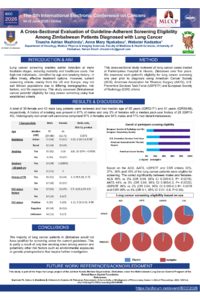
Lung cancer screening enables earlier detection at more treatable stages, reducing mortality and healthcare costs. For high-risk individuals—identified by age and smoking history—it offers timely, effective treatment options. However, current screening criteria, mainly from the US and Europe, may not suit African populations due to differing demographics, risk factors, and life expectancy. This study assessed Zimbabwean cancer patients' eligibility for lung cancer screening using four established criteria.
Methodology
This cross-sectional study reviewed all lung cancer cases treated at Parirenyatwa Hospital in Harare, Zimbabwe over five years. We assessed each patient's eligibility for lung cancer screening one year prior to diagnosis using American Cancer Society (ACS), American Association for Thoracic Surgery (AATS), U.S. Preventive Services Task Force (USPSTF) and European Society of Radiology (ESR) criteria.
Results
A total of 30 female and 43 male lung patients were reviewed and had median age of 65 years (IQR52-71) and 61 years (IQR54-69), respectively. A history of smoking was present in 81% of males and only 3% of females with a median pack-year history of 28 (IQR15-40). Histologically non-small cell carcinoma comprised 97% in females and 94% males and 77% had distant metastases. Based on the ACS, AATS, USPSTF and ESR criteria 30%, 27%, 30% and 16% of the lung cancer patients were eligible for screening. The varied significantly between males and females- ACS 49% vs 3% (OR 0.04, 95% CI 0.005-0.3, P= 0.0018); AATS 44% vs 3% (OR 0.04, 95% CI 0.005-0.3, P= 0.0032); USPSTF 49% vs 3% (OR 0.04, 95% CI 0.005-0.3 P= 0.0018 and ESR 26% vs 3% (OR 0.1, 95% CI 0.01- 0.8, P=0.03).
Conclusion
The majority of lung cancer patients in Zimbabwe would not have qualified for screening under the current guidelines. This is partly a result of very low smoking rates among women and potentially other risk factors such as environmental exposures or genetic predispositions that require further investigation
Keywords
lung cancer screening
lung cancer epidermiology
African cancer trend
Poster
IECC POSTER 2026.pdf
Development Omnipose Neural Network-Based Analytical Module for Morphometric Analysis of Metastatic Cancer Cells
The Role of DGKH in Cervical Carcinogenesis: Mechanisms and Implications