Event submissions
Published
This submission belongs to the session S5. Causes, Diagnosis and Treatment of Cancer of the event The 5th International Electronic Conference on Cancers
Published date
05 Jun, 2026
Academic Editor
'%3e%3cpath%20d='M12.6657%2010.9104C12.4185%2010.325%2012.0599%209.79327%2011.6097%209.34482C11.1609%208.89508%2010.6293%208.5365%2010.0442%208.28888C10.0389%208.28626%2010.0337%208.28495%2010.0285%208.28233C10.8446%207.69279%2011.3752%206.73249%2011.3752%205.64904C11.3752%203.8542%209.92103%202.39999%208.1262%202.39999C6.33136%202.39999%204.87715%203.8542%204.87715%205.64904C4.87715%206.73249%205.40774%207.69279%206.22393%208.28364C6.21869%208.28626%206.21345%208.28757%206.20821%208.29019C5.62129%208.5378%205.09463%208.89284%204.64265%209.34613C4.1929%209.79493%203.83432%2010.3266%203.58671%2010.9117C3.34345%2011.4845%203.21226%2012.0987%203.20023%2012.7209C3.19988%2012.7349%203.20233%2012.7488%203.20744%2012.7619C3.21255%2012.7749%203.22022%2012.7867%203.22998%2012.7968C3.23975%2012.8068%203.25142%2012.8147%203.26431%2012.8202C3.2772%2012.8256%203.29105%2012.8284%203.30504%2012.8284H4.09109C4.14874%2012.8284%204.19459%2012.7825%204.1959%2012.7262C4.2221%2011.7148%204.62823%2010.7676%205.34617%2010.0497C6.08899%209.30683%207.0755%208.89808%208.1262%208.89808C9.17689%208.89808%2010.1634%209.30683%2010.9062%2010.0497C11.6242%2010.7676%2012.0303%2011.7148%2012.0565%2012.7262C12.0578%2012.7838%2012.1037%2012.8284%2012.1613%2012.8284H12.9474C12.9613%2012.8284%2012.9752%2012.8256%2012.9881%2012.8202C13.001%2012.8147%2013.0126%2012.8068%2013.0224%2012.7968C13.0322%2012.7867%2013.0398%2012.7749%2013.0449%2012.7619C13.0501%2012.7488%2013.0525%2012.7349%2013.0522%2012.7209C13.0391%2012.0947%2012.9094%2011.4855%2012.6657%2010.9104ZM8.1262%207.9024C7.52486%207.9024%206.9589%207.6679%206.53312%207.24211C6.10733%206.81633%205.87283%206.25037%205.87283%205.64904C5.87283%205.0477%206.10733%204.48174%206.53312%204.05596C6.9589%203.63018%207.52486%203.39567%208.1262%203.39567C8.72753%203.39567%209.29349%203.63018%209.71927%204.05596C10.1451%204.48174%2010.3796%205.0477%2010.3796%205.64904C10.3796%206.25037%2010.1451%206.81633%209.71927%207.24211C9.29349%207.6679%208.72753%207.9024%208.1262%207.9024Z'%20fill='%235D1EE1'/%3e%3c/g%3e%3c/svg%3e) Masaharu Seno
Masaharu SenoCitation
Irina Valerievna Pronina, Inna Ganshina, Tatiana Zavarykina, Irina Kolyadina, PLASMA MICRORNAS IN ASSESSING THE RISK OF RECURRENCE IN TRIPLE-NEGATIVE BREAST CANCER, in Proceedings of The 5th International Electronic Conference on Cancers, 10 June–12 June 2026, MDPI: Basel, Switzerland
Share
Email
Facebook
Twitter
LinkedIn
PLASMA MICRORNAS IN ASSESSING THE RISK OF RECURRENCE IN TRIPLE-NEGATIVE BREAST CANCER
'%3e%3cpath%20d='M12.6647%2010.9104C12.4176%2010.325%2012.0589%209.7933%2011.6088%209.34485C11.16%208.89511%2010.6283%208.53653%2010.0432%208.28891C10.038%208.28629%2010.0327%208.28498%2010.0275%208.28236C10.8437%207.69282%2011.3743%206.73252%2011.3743%205.64907C11.3743%203.85423%209.92005%202.40002%208.12522%202.40002C6.33038%202.40002%204.87618%203.85423%204.87618%205.64907C4.87618%206.73252%205.40677%207.69282%206.22296%208.28367C6.21772%208.28629%206.21248%208.2876%206.20724%208.29022C5.62031%208.53783%205.09365%208.89287%204.64167%209.34616C4.19192%209.79496%203.83334%2010.3266%203.58573%2010.9117C3.34247%2011.4846%203.21128%2012.0987%203.19925%2012.721C3.1989%2012.735%203.20135%2012.7489%203.20646%2012.7619C3.21157%2012.7749%203.21924%2012.7868%203.22901%2012.7968C3.23877%2012.8068%203.25045%2012.8148%203.26334%2012.8202C3.27623%2012.8256%203.29007%2012.8284%203.30406%2012.8284H4.09012C4.14776%2012.8284%204.19362%2012.7825%204.19493%2012.7262C4.22113%2011.7148%204.62726%2010.7676%205.34519%2010.0497C6.08802%209.30686%207.07452%208.89811%208.12522%208.89811C9.17592%208.89811%2010.1624%209.30686%2010.9052%2010.0497C11.6232%2010.7676%2012.0293%2011.7148%2012.0555%2012.7262C12.0568%2012.7839%2012.1027%2012.8284%2012.1603%2012.8284H12.9464C12.9604%2012.8284%2012.9742%2012.8256%2012.9871%2012.8202C13%2012.8148%2013.0117%2012.8068%2013.0214%2012.7968C13.0312%2012.7868%2013.0389%2012.7749%2013.044%2012.7619C13.0491%2012.7489%2013.0515%2012.735%2013.0512%2012.721C13.0381%2012.0947%2012.9084%2011.4856%2012.6647%2010.9104ZM8.12522%207.90243C7.52388%207.90243%206.95792%207.66793%206.53214%207.24215C6.10636%206.81636%205.87185%206.2504%205.87185%205.64907C5.87185%205.04773%206.10636%204.48177%206.53214%204.05599C6.95792%203.63021%207.52388%203.3957%208.12522%203.3957C8.72655%203.3957%209.29252%203.63021%209.7183%204.05599C10.1441%204.48177%2010.3786%205.04773%2010.3786%205.64907C10.3786%206.2504%2010.1441%206.81636%209.7183%207.24215C9.29252%207.66793%208.72655%207.90243%208.12522%207.90243Z'%20fill='%235D1EE1'/%3e%3c/g%3e%3c/svg%3e)
Irina Valerievna Pronina 1,2,3
Inna Ganshina 4
Tatiana Zavarykina 3,5
Irina Kolyadina 3
1. Emanuel Institute of Biochemical Physics, Russian Academy of Science, 105005 Moscow, Russia
2. Department of Physiology, Human Ecology and Medical and Biological Sciences, State University of Education, 105005 Moscow, Russia
3. Kulakov National Medical Research Center of Obstetrics, Gynecology, and Perinatology, Ministry of Health of the Russian Federation, 105005 Moscow, Russia
4. 3N.N. Blokhin National Medical Research Center of Oncology, Ministry of Health of the Russian Federation, 105005 Moscow, Russia
5. Emanuel Institute of Biochemical Physics, Russian Academy of Science, Moscow, Russia
Abstract
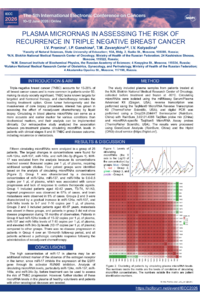
Triple-negative breast cancer (TNBC) accounts for 15-20% of all breast cancer cases and is common in patients under 50. Our retrospective study analyzed the association between pre-treatment circulating microRNA levels in TNBC patients and disease outcome.
The study included plasma samples from the Blokhin National Medical Research Center of Oncology collected before treatment. MicroRNAs were isolated using miRNeasy Serum/Plasma Advanced Kit (Qiagen); reverse transcription and ddPCR were performed using TaqMan® MicroRNA Reverse Transcription Kit, TaqMan® MicroRNA Assay probes (ThermoFisher Scientific), and TaqMan probe mix (RainSure). The results were processed using GeneCount Analysis software (RainSure) and the Hiplot (ORG) cloud service (https://hiplot.cn/).
Four patient groups were identified. Group 1 was characterized by a decreased concentration of miR-124a, miR-137, and miR-148a to 0.0-0.5 copies/μL and included patients aged 40-42 years, T3-T4, N1-N3; regional progression was observed in 67%, and brain metastases were observed in 5% of cases. Groups 2 and 3 were characterized by a gradual increase in miR-124a, miR-137, and miR-148a levels to 5-7 and 7-10 copies/μL and included patients aged 48-67 years; metastasis was absent in both groups, and patients in group 3 did not show disease progression during the 18 months of observation. Patients in group 4 had miR-124a levels of 15-32 copies/μL, miR-137 and miR-148a levels of 7-10 copies/μL, and elevated miR-34c-3p levels (12-17 copies/μL) compared to other groups. There was no disease progression in patients in group 4 over an 18-month follow-up period, and all patients achieved a pathologic complete response following the administration of neoadjuvant chemotherapy.
Analysis of circulating microRNA levels, particularly miR-124a, miR-137, miR-148a, and miR-34c-3p, before treatment can be used to assess the risk of TNBC progression. However, further studies of these microRNA levels in the plasma of healthy volunteers are needed.
Keywords
breast cancer
microRNAs
blood plasma
cancer prognosis
Poster
ProninaIV_IECC2026_poster.pdf
LUNG CANCER DETECTION BASED ON MACHINE LEARNING WITH DATA AUGMENTATION APPROACHES
Exploration of genes identified in antitumor resistance in triple-negative breast