Event submissions
Published
This submission belongs to the session S3. Drug Resistance and Anti-cancer Drug Development and Screening of the event The 5th International Electronic Conference on Cancers
Published date
05 Jun, 2026
Academic Editor
'%3e%3cpath%20d='M12.6657%2010.9104C12.4185%2010.325%2012.0599%209.79327%2011.6097%209.34482C11.1609%208.89508%2010.6293%208.5365%2010.0442%208.28888C10.0389%208.28626%2010.0337%208.28495%2010.0285%208.28233C10.8446%207.69279%2011.3752%206.73249%2011.3752%205.64904C11.3752%203.8542%209.92103%202.39999%208.1262%202.39999C6.33136%202.39999%204.87715%203.8542%204.87715%205.64904C4.87715%206.73249%205.40774%207.69279%206.22393%208.28364C6.21869%208.28626%206.21345%208.28757%206.20821%208.29019C5.62129%208.5378%205.09463%208.89284%204.64265%209.34613C4.1929%209.79493%203.83432%2010.3266%203.58671%2010.9117C3.34345%2011.4845%203.21226%2012.0987%203.20023%2012.7209C3.19988%2012.7349%203.20233%2012.7488%203.20744%2012.7619C3.21255%2012.7749%203.22022%2012.7867%203.22998%2012.7968C3.23975%2012.8068%203.25142%2012.8147%203.26431%2012.8202C3.2772%2012.8256%203.29105%2012.8284%203.30504%2012.8284H4.09109C4.14874%2012.8284%204.19459%2012.7825%204.1959%2012.7262C4.2221%2011.7148%204.62823%2010.7676%205.34617%2010.0497C6.08899%209.30683%207.0755%208.89808%208.1262%208.89808C9.17689%208.89808%2010.1634%209.30683%2010.9062%2010.0497C11.6242%2010.7676%2012.0303%2011.7148%2012.0565%2012.7262C12.0578%2012.7838%2012.1037%2012.8284%2012.1613%2012.8284H12.9474C12.9613%2012.8284%2012.9752%2012.8256%2012.9881%2012.8202C13.001%2012.8147%2013.0126%2012.8068%2013.0224%2012.7968C13.0322%2012.7867%2013.0398%2012.7749%2013.0449%2012.7619C13.0501%2012.7488%2013.0525%2012.7349%2013.0522%2012.7209C13.0391%2012.0947%2012.9094%2011.4855%2012.6657%2010.9104ZM8.1262%207.9024C7.52486%207.9024%206.9589%207.6679%206.53312%207.24211C6.10733%206.81633%205.87283%206.25037%205.87283%205.64904C5.87283%205.0477%206.10733%204.48174%206.53312%204.05596C6.9589%203.63018%207.52486%203.39567%208.1262%203.39567C8.72753%203.39567%209.29349%203.63018%209.71927%204.05596C10.1451%204.48174%2010.3796%205.0477%2010.3796%205.64904C10.3796%206.25037%2010.1451%206.81633%209.71927%207.24211C9.29349%207.6679%208.72753%207.9024%208.1262%207.9024Z'%20fill='%235D1EE1'/%3e%3c/g%3e%3c/svg%3e) Farrukh Aqil
Farrukh AqilCitation
Jaydeep Jadhav, Yuktha G, Subhash Kudhale, Mugdha Nilesh Harmalkar, “Exploring the Antioxidant and Anticancer Activity of Clematis heynei, an Endemic Medicinal Plant of the Western Ghats”, in Proceedings of The 5th International Electronic Conference on Cancers, 10 June–12 June 2026, MDPI: Basel, Switzerland
Share
Email
Facebook
Twitter
LinkedIn
“Exploring the Antioxidant and Anticancer Activity of Clematis heynei, an Endemic Medicinal Plant of the Western Ghats”
'%3e%3cpath%20d='M12.6647%2010.9104C12.4176%2010.325%2012.0589%209.7933%2011.6088%209.34485C11.16%208.89511%2010.6283%208.53653%2010.0432%208.28891C10.038%208.28629%2010.0327%208.28498%2010.0275%208.28236C10.8437%207.69282%2011.3743%206.73252%2011.3743%205.64907C11.3743%203.85423%209.92005%202.40002%208.12522%202.40002C6.33038%202.40002%204.87618%203.85423%204.87618%205.64907C4.87618%206.73252%205.40677%207.69282%206.22296%208.28367C6.21772%208.28629%206.21248%208.2876%206.20724%208.29022C5.62031%208.53783%205.09365%208.89287%204.64167%209.34616C4.19192%209.79496%203.83334%2010.3266%203.58573%2010.9117C3.34247%2011.4846%203.21128%2012.0987%203.19925%2012.721C3.1989%2012.735%203.20135%2012.7489%203.20646%2012.7619C3.21157%2012.7749%203.21924%2012.7868%203.22901%2012.7968C3.23877%2012.8068%203.25045%2012.8148%203.26334%2012.8202C3.27623%2012.8256%203.29007%2012.8284%203.30406%2012.8284H4.09012C4.14776%2012.8284%204.19362%2012.7825%204.19493%2012.7262C4.22113%2011.7148%204.62726%2010.7676%205.34519%2010.0497C6.08802%209.30686%207.07452%208.89811%208.12522%208.89811C9.17592%208.89811%2010.1624%209.30686%2010.9052%2010.0497C11.6232%2010.7676%2012.0293%2011.7148%2012.0555%2012.7262C12.0568%2012.7839%2012.1027%2012.8284%2012.1603%2012.8284H12.9464C12.9604%2012.8284%2012.9742%2012.8256%2012.9871%2012.8202C13%2012.8148%2013.0117%2012.8068%2013.0214%2012.7968C13.0312%2012.7868%2013.0389%2012.7749%2013.044%2012.7619C13.0491%2012.7489%2013.0515%2012.735%2013.0512%2012.721C13.0381%2012.0947%2012.9084%2011.4856%2012.6647%2010.9104ZM8.12522%207.90243C7.52388%207.90243%206.95792%207.66793%206.53214%207.24215C6.10636%206.81636%205.87185%206.2504%205.87185%205.64907C5.87185%205.04773%206.10636%204.48177%206.53214%204.05599C6.95792%203.63021%207.52388%203.3957%208.12522%203.3957C8.72655%203.3957%209.29252%203.63021%209.7183%204.05599C10.1441%204.48177%2010.3786%205.04773%2010.3786%205.64907C10.3786%206.2504%2010.1441%206.81636%209.7183%207.24215C9.29252%207.66793%208.72655%207.90243%208.12522%207.90243Z'%20fill='%235D1EE1'/%3e%3c/g%3e%3c/svg%3e)
Jaydeep Jadhav 1
Yuktha G 1
Subhash Kudhale 1
Mugdha Nilesh Harmalkar 1
1. School of Biotechnology and Bioinformatics, D Y Patil Deemed to be University, Navi Mumbai 400614, India
Abstract
Introduction
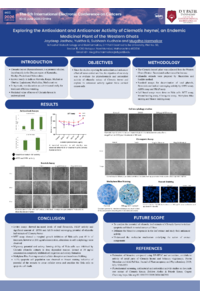
Clematis heynei (CH) is a medicinal plant endemic to the Western Ghats of Maharashtra and is traditionally used in indigenous healthcare practices. Despite its ethnomedicinal relevance, scientific validation of its bioactive potential remains limited. This study aimed to evaluate the antioxidant properties and in vitro anticancer activity of ethanolic leaf extracts of C. heynei.
Methods
Ethanolic extracts of C. heynei leaves were subjected to phytochemical analysis to determine total phenolic and flavonoid contents, along with ferric reducing antioxidant power (FRAP). Antioxidant activity was assessed using DPPH and ABTS radical scavenging assays. Anticancer potential was evaluated in HeLa cervical cancer cells through cell viability assays, morphological observation, wound healing, clonogenic assays, and cytological staining, including Hoechst nuclear staining.
Results
Phytochemical analysis revealed a higher flavonoid content compared to total phenolic content, accompanied by notable ferric reducing capacity. Antioxidant assays showed strong ABTS radical scavenging activity, while DPPH scavenging was comparatively moderate. In HeLa cells, the CH extract induced concentration-dependent reductions in cell viability, with evident morphological changes such as cell rounding and structural disruption. Wound healing and clonogenic assays demonstrated significant inhibition of cell migration and colony formation, even at lower extract concentrations. Cytological staining revealed dose-dependent cytoplasmic granulation, membrane blebbing, and loss of membrane integrity, while Hoechst staining indicated increased apoptotic cell populations at higher doses.
Conclusion
Overall, C. heynei exhibits significant antioxidant and in vitro anticancer potential, supporting its traditional medicinal use and highlighting the need for further phytochemical characterization and mechanistic studies.
Keywords
Clematis heynei
antioxidants
anticancer
HeLa cells
phytochemicals
natural products
Poster
IECC-2026_Dr Mugdha Harmalkar.pdf
Exploration of genes identified in antitumor resistance in triple-negative breast
Transcriptome differences revealed by high-plex digital spatial profiling associated with endocrine sensitivity for hormone receptor-positive/human epidermal growth factor receptor 2-negative (HR+/HER2-) early breast cancer (EBC)