Event submissions
Published
This submission belongs to the session S7. Novel Methods and Technologies for Research and Treatment of the event The 5th International Electronic Conference on Cancers
Published date
05 Jun, 2026
Academic Editor
'%3e%3cpath%20d='M12.6657%2010.9104C12.4185%2010.325%2012.0599%209.79327%2011.6097%209.34482C11.1609%208.89508%2010.6293%208.5365%2010.0442%208.28888C10.0389%208.28626%2010.0337%208.28495%2010.0285%208.28233C10.8446%207.69279%2011.3752%206.73249%2011.3752%205.64904C11.3752%203.8542%209.92103%202.39999%208.1262%202.39999C6.33136%202.39999%204.87715%203.8542%204.87715%205.64904C4.87715%206.73249%205.40774%207.69279%206.22393%208.28364C6.21869%208.28626%206.21345%208.28757%206.20821%208.29019C5.62129%208.5378%205.09463%208.89284%204.64265%209.34613C4.1929%209.79493%203.83432%2010.3266%203.58671%2010.9117C3.34345%2011.4845%203.21226%2012.0987%203.20023%2012.7209C3.19988%2012.7349%203.20233%2012.7488%203.20744%2012.7619C3.21255%2012.7749%203.22022%2012.7867%203.22998%2012.7968C3.23975%2012.8068%203.25142%2012.8147%203.26431%2012.8202C3.2772%2012.8256%203.29105%2012.8284%203.30504%2012.8284H4.09109C4.14874%2012.8284%204.19459%2012.7825%204.1959%2012.7262C4.2221%2011.7148%204.62823%2010.7676%205.34617%2010.0497C6.08899%209.30683%207.0755%208.89808%208.1262%208.89808C9.17689%208.89808%2010.1634%209.30683%2010.9062%2010.0497C11.6242%2010.7676%2012.0303%2011.7148%2012.0565%2012.7262C12.0578%2012.7838%2012.1037%2012.8284%2012.1613%2012.8284H12.9474C12.9613%2012.8284%2012.9752%2012.8256%2012.9881%2012.8202C13.001%2012.8147%2013.0126%2012.8068%2013.0224%2012.7968C13.0322%2012.7867%2013.0398%2012.7749%2013.0449%2012.7619C13.0501%2012.7488%2013.0525%2012.7349%2013.0522%2012.7209C13.0391%2012.0947%2012.9094%2011.4855%2012.6657%2010.9104ZM8.1262%207.9024C7.52486%207.9024%206.9589%207.6679%206.53312%207.24211C6.10733%206.81633%205.87283%206.25037%205.87283%205.64904C5.87283%205.0477%206.10733%204.48174%206.53312%204.05596C6.9589%203.63018%207.52486%203.39567%208.1262%203.39567C8.72753%203.39567%209.29349%203.63018%209.71927%204.05596C10.1451%204.48174%2010.3796%205.0477%2010.3796%205.64904C10.3796%206.25037%2010.1451%206.81633%209.71927%207.24211C9.29349%207.6679%208.72753%207.9024%208.1262%207.9024Z'%20fill='%235D1EE1'/%3e%3c/g%3e%3c/svg%3e) Guo-Min Li
Guo-Min LiCitation
Riddhi Shah, Davide Pradella, Ashley Sullivan, Ana Marie Perea, Daniel Heller, Robert E Schwartz, Robert Benezra, Exploring the mechanism of ID1-dependent liver inflammation induced by dietary fat and a therapeutic approach to target IDs in cancer, in Proceedings of The 5th International Electronic Conference on Cancers, 10 June–12 June 2026, MDPI: Basel, Switzerland
Share
Email
Facebook
Twitter
LinkedIn
Exploring the mechanism of ID1-dependent liver inflammation induced by dietary fat and a therapeutic approach to target IDs in cancer
'%3e%3cpath%20d='M12.6647%2010.9104C12.4176%2010.325%2012.0589%209.7933%2011.6088%209.34485C11.16%208.89511%2010.6283%208.53653%2010.0432%208.28891C10.038%208.28629%2010.0327%208.28498%2010.0275%208.28236C10.8437%207.69282%2011.3743%206.73252%2011.3743%205.64907C11.3743%203.85423%209.92005%202.40002%208.12522%202.40002C6.33038%202.40002%204.87618%203.85423%204.87618%205.64907C4.87618%206.73252%205.40677%207.69282%206.22296%208.28367C6.21772%208.28629%206.21248%208.2876%206.20724%208.29022C5.62031%208.53783%205.09365%208.89287%204.64167%209.34616C4.19192%209.79496%203.83334%2010.3266%203.58573%2010.9117C3.34247%2011.4846%203.21128%2012.0987%203.19925%2012.721C3.1989%2012.735%203.20135%2012.7489%203.20646%2012.7619C3.21157%2012.7749%203.21924%2012.7868%203.22901%2012.7968C3.23877%2012.8068%203.25045%2012.8148%203.26334%2012.8202C3.27623%2012.8256%203.29007%2012.8284%203.30406%2012.8284H4.09012C4.14776%2012.8284%204.19362%2012.7825%204.19493%2012.7262C4.22113%2011.7148%204.62726%2010.7676%205.34519%2010.0497C6.08802%209.30686%207.07452%208.89811%208.12522%208.89811C9.17592%208.89811%2010.1624%209.30686%2010.9052%2010.0497C11.6232%2010.7676%2012.0293%2011.7148%2012.0555%2012.7262C12.0568%2012.7839%2012.1027%2012.8284%2012.1603%2012.8284H12.9464C12.9604%2012.8284%2012.9742%2012.8256%2012.9871%2012.8202C13%2012.8148%2013.0117%2012.8068%2013.0214%2012.7968C13.0312%2012.7868%2013.0389%2012.7749%2013.044%2012.7619C13.0491%2012.7489%2013.0515%2012.735%2013.0512%2012.721C13.0381%2012.0947%2012.9084%2011.4856%2012.6647%2010.9104ZM8.12522%207.90243C7.52388%207.90243%206.95792%207.66793%206.53214%207.24215C6.10636%206.81636%205.87185%206.2504%205.87185%205.64907C5.87185%205.04773%206.10636%204.48177%206.53214%204.05599C6.95792%203.63021%207.52388%203.3957%208.12522%203.3957C8.72655%203.3957%209.29252%203.63021%209.7183%204.05599C10.1441%204.48177%2010.3786%205.04773%2010.3786%205.64907C10.3786%206.2504%2010.1441%206.81636%209.7183%207.24215C9.29252%207.66793%208.72655%207.90243%208.12522%207.90243Z'%20fill='%235D1EE1'/%3e%3c/g%3e%3c/svg%3e)
Riddhi Shah 1
Davide Pradella 2
Ashley Sullivan 2
Ana Marie Perea 2
Daniel Heller 2
Robert E Schwartz 3
Robert Benezra 2
1. Independent Researcher, Mumbai 400101, India
2. Cancer Biology and Genetics Program, Memorial Sloan Kettering Cancer Center, New York 10065, USA
3. Division of Regenerative Medicine, Weill Cornell Medicine, New York 10065, USA
Abstract
Introduction:
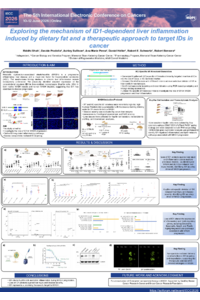
High dietary fat and fructose–induced metabolic dysfunction-associated steatohepatitis (MASH) is a major risk factor for hepatocellular carcinoma (HCC), yet mechanisms linking steatosis to chronic liver inflammation remain poorly defined. ID1, a dominant-negative helix–loop–helix transcriptional regulator, is selectively upregulated in liver-resident macrophages (Kupffer cells; KCs) in murine MASH models and patient biopsies, but not in metabolic dysfunction-associated steatotic liver disease (MAFLD). This study investigates the functional role of KC-specific ID1 in MASH pathogenesis and explores therapeutic KC-localized targeting of ID proteins using nanoparticle-encapsulated protein degraders.
Methods:
KC–specific Id1 knockout mice were generated by introducing iCre into the Clec4f locus and validated via td-Tomato lineage tracing. Mice were maintained on standard chow or high-fat, high-fructose Western diet with fructose-supplemented drinking water for up to 24 weeks to induce MASH. Disease progression was assessed by serum liver enzymes (ALT, AST, ALP) and histological NAS scoring. We employed lipid- or fucoidan-based nanoparticle formulations of the ID degraders AGX51 and AGXA to evaluate the potential for therapeutic intervention in MASH.
Results:
Global Id1 deletion protected mice from diet- and CCl₄-induced MASH, prompting evaluation of KC-specific effects. Clec4f-iCre–mediated Id1 depletion significantly reduced hepatic steatosis, NAS scores, and serum ALT, AST, and ALP following prolonged high-fat, high-fructose feeding. Transcriptomic profiling of KCs identified anti-inflammatory and lipid-regulatory genes, including Serpina1e, Serpin a3k, Abcg5, and Pcsk9, supporting an ID1-dependent inflammatory program and KC–hepatocyte crosstalk. Translationally, Cy5-labeled lipid nanoparticles efficiently localized to Kupffer cells in vivo, supporting the feasibility of nanoparticle-mediated ID1 targeting in inflammatory liver disease.
Conclusion:
These findings identify KC-specific ID1 as a critical regulator of inflammatory pathways driving MASH progression and highlight ID1 as a promising therapeutic target. Nanoparticle-based ID degradation demonstrates translational potential for inflammation-driven liver disease and aggressive cancers.
Keywords
Metabolic dysfunction-associated steatohepatitis (MASH)
hepatocellular carcinoma (HCC)
Kupffer cells
ID1 transcription factor
liver inflammation
nanoparticle drug delivery
targeted protein degradation
tumor vasculature
translational cancer biology
Poster
Sciforum-169576_Shah_ID1_MASH_Poster.pdf
Antiproliferative and apoptotic activity of Zedoary turmeric oil in human gastric carcinoma cells
Distinct YAP-TEAD signaling states revealed by integrated mRNA and protein analysis in thymic epithelial neoplasms