Event submissions
Published
This submission belongs to the session S3. Drug Resistance and Anti-cancer Drug Development and Screening of the event The 5th International Electronic Conference on Cancers
Published date
05 Jun, 2026
Academic Editor
'%3e%3cpath%20d='M12.6657%2010.9104C12.4185%2010.325%2012.0599%209.79327%2011.6097%209.34482C11.1609%208.89508%2010.6293%208.5365%2010.0442%208.28888C10.0389%208.28626%2010.0337%208.28495%2010.0285%208.28233C10.8446%207.69279%2011.3752%206.73249%2011.3752%205.64904C11.3752%203.8542%209.92103%202.39999%208.1262%202.39999C6.33136%202.39999%204.87715%203.8542%204.87715%205.64904C4.87715%206.73249%205.40774%207.69279%206.22393%208.28364C6.21869%208.28626%206.21345%208.28757%206.20821%208.29019C5.62129%208.5378%205.09463%208.89284%204.64265%209.34613C4.1929%209.79493%203.83432%2010.3266%203.58671%2010.9117C3.34345%2011.4845%203.21226%2012.0987%203.20023%2012.7209C3.19988%2012.7349%203.20233%2012.7488%203.20744%2012.7619C3.21255%2012.7749%203.22022%2012.7867%203.22998%2012.7968C3.23975%2012.8068%203.25142%2012.8147%203.26431%2012.8202C3.2772%2012.8256%203.29105%2012.8284%203.30504%2012.8284H4.09109C4.14874%2012.8284%204.19459%2012.7825%204.1959%2012.7262C4.2221%2011.7148%204.62823%2010.7676%205.34617%2010.0497C6.08899%209.30683%207.0755%208.89808%208.1262%208.89808C9.17689%208.89808%2010.1634%209.30683%2010.9062%2010.0497C11.6242%2010.7676%2012.0303%2011.7148%2012.0565%2012.7262C12.0578%2012.7838%2012.1037%2012.8284%2012.1613%2012.8284H12.9474C12.9613%2012.8284%2012.9752%2012.8256%2012.9881%2012.8202C13.001%2012.8147%2013.0126%2012.8068%2013.0224%2012.7968C13.0322%2012.7867%2013.0398%2012.7749%2013.0449%2012.7619C13.0501%2012.7488%2013.0525%2012.7349%2013.0522%2012.7209C13.0391%2012.0947%2012.9094%2011.4855%2012.6657%2010.9104ZM8.1262%207.9024C7.52486%207.9024%206.9589%207.6679%206.53312%207.24211C6.10733%206.81633%205.87283%206.25037%205.87283%205.64904C5.87283%205.0477%206.10733%204.48174%206.53312%204.05596C6.9589%203.63018%207.52486%203.39567%208.1262%203.39567C8.72753%203.39567%209.29349%203.63018%209.71927%204.05596C10.1451%204.48174%2010.3796%205.0477%2010.3796%205.64904C10.3796%206.25037%2010.1451%206.81633%209.71927%207.24211C9.29349%207.6679%208.72753%207.9024%208.1262%207.9024Z'%20fill='%235D1EE1'/%3e%3c/g%3e%3c/svg%3e) Farrukh Aqil
Farrukh AqilCitation
Marek Pająk, Jakub Włodarczyk, Magdalena Woźniczka, Jakub Fichna, The effect of the degree of oxidation and the molecular structure of cobalt complexes with imidazole on the metabolic profiles of CCD 841 CoN and HT-29 cells, in Proceedings of The 5th International Electronic Conference on Cancers, 10 June–12 June 2026, MDPI: Basel, Switzerland
Share
Email
Facebook
Twitter
LinkedIn
The effect of the degree of oxidation and the molecular structure of cobalt complexes with imidazole on the metabolic profiles of CCD 841 CoN and HT-29 cells
'%3e%3cpath%20d='M12.6647%2010.9104C12.4176%2010.325%2012.0589%209.7933%2011.6088%209.34485C11.16%208.89511%2010.6283%208.53653%2010.0432%208.28891C10.038%208.28629%2010.0327%208.28498%2010.0275%208.28236C10.8437%207.69282%2011.3743%206.73252%2011.3743%205.64907C11.3743%203.85423%209.92005%202.40002%208.12522%202.40002C6.33038%202.40002%204.87618%203.85423%204.87618%205.64907C4.87618%206.73252%205.40677%207.69282%206.22296%208.28367C6.21772%208.28629%206.21248%208.2876%206.20724%208.29022C5.62031%208.53783%205.09365%208.89287%204.64167%209.34616C4.19192%209.79496%203.83334%2010.3266%203.58573%2010.9117C3.34247%2011.4846%203.21128%2012.0987%203.19925%2012.721C3.1989%2012.735%203.20135%2012.7489%203.20646%2012.7619C3.21157%2012.7749%203.21924%2012.7868%203.22901%2012.7968C3.23877%2012.8068%203.25045%2012.8148%203.26334%2012.8202C3.27623%2012.8256%203.29007%2012.8284%203.30406%2012.8284H4.09012C4.14776%2012.8284%204.19362%2012.7825%204.19493%2012.7262C4.22113%2011.7148%204.62726%2010.7676%205.34519%2010.0497C6.08802%209.30686%207.07452%208.89811%208.12522%208.89811C9.17592%208.89811%2010.1624%209.30686%2010.9052%2010.0497C11.6232%2010.7676%2012.0293%2011.7148%2012.0555%2012.7262C12.0568%2012.7839%2012.1027%2012.8284%2012.1603%2012.8284H12.9464C12.9604%2012.8284%2012.9742%2012.8256%2012.9871%2012.8202C13%2012.8148%2013.0117%2012.8068%2013.0214%2012.7968C13.0312%2012.7868%2013.0389%2012.7749%2013.044%2012.7619C13.0491%2012.7489%2013.0515%2012.735%2013.0512%2012.721C13.0381%2012.0947%2012.9084%2011.4856%2012.6647%2010.9104ZM8.12522%207.90243C7.52388%207.90243%206.95792%207.66793%206.53214%207.24215C6.10636%206.81636%205.87185%206.2504%205.87185%205.64907C5.87185%205.04773%206.10636%204.48177%206.53214%204.05599C6.95792%203.63021%207.52388%203.3957%208.12522%203.3957C8.72655%203.3957%209.29252%203.63021%209.7183%204.05599C10.1441%204.48177%2010.3786%205.04773%2010.3786%205.64907C10.3786%206.2504%2010.1441%206.81636%209.7183%207.24215C9.29252%207.66793%208.72655%207.90243%208.12522%207.90243Z'%20fill='%235D1EE1'/%3e%3c/g%3e%3c/svg%3e)
Marek Pająk 1
Jakub Włodarczyk 2,3
Magdalena Woźniczka 1
Jakub Fichna 2
1. Department of Physical and Biocoordination Chemistry, Medical University of Lodz, Lodz 90-419, Poland
2. Department of Biochemistry, Medical University of Lodz, Lodz 90-419, Poland
3. Department of General and Oncological Surgery, Medical University of Lodz, Lodz 90-419, Poland
Abstract
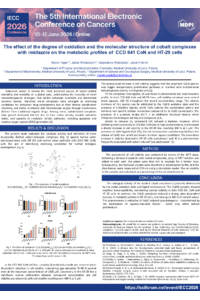
Colorectal cancer is among the most prevalent causes of cancer-related morbidity and mortality on a global scale, underscoring the necessity of novel chemotherapeutic strategies that exhibit enhanced selectivity and diminished systemic toxicity. The present study investigates the biological impact of three structurally diverse cobalt complexes bearing imidazole: the polymeric [Co(II)(imid)2], the dimeric [Co(III)(Himid)(L-(α)-histidine)2]2O22-, and the mononuclear Co(II)(Himid)2(H2O)2CO3. The first complex, [Co(II)(imid)2]n, is regarded as a paradigm of a coordination compound that crystallizes in an infinitely polymeric network, wherein each cobalt atom is linked via imidazole bridges to four adjacent cobalt atoms. The second complex, [Co(III)(Himid)(L-(α)-histidine)2]2O22-, is a dimeric, diamagnetic complex with an O2 molecule coordinated in the peroxide form with an O22- (μ-peroxo) bridge between two cobalt ions oxidized to Co(III). The third complex, Co(II)(Himid)2(H2O)2CO3, represents the first documented instance of a carbonate group functioning as a bidentate ligand in a solid cobalt complex. The biological effects of the aforementioned compounds were evaluated against normal human colon epithelial cells (CCD 841 CoN) and colonic adenocarcinoma cells (HT-29). MTT assays revealed that the dimeric Co(III) complex exhibited no cytotoxic effect on either cell line. In contrast, both the polymeric and mononuclear Co(II) compounds elicited a substantial, concentration-dependent enhancement in cell viability in HT-29 cells, reaching up to 400 % relative to the control, and a non-significant cytotoxic effect in CCD 841 CoN cells. The results suggest that both Co(II) complexes might trigger a pseudohypoxic metabolic shift in colorectal cancer cells, whereas the Co(III) complex remains biologically inert.
Keywords
Co(II)/(III) complexes
cytotoxicity
HT-29 cell line
MTT assay
pseudohypoxia.
Poster
Poster.pdf
Significance of HER2-related factor in HER2-low breast cancer
Pingyangmycin-lipiodol Emulsifier Embolisation Via Transarterial Versus Resection For Hepatic Hemangioma: A Retrospective Controlled Study