Event submissions
Published
This submission belongs to the session S5. Causes, Diagnosis and Treatment of Cancer of the event The 5th International Electronic Conference on Cancers
Published date
05 Jun, 2026
Academic Editor
'%3e%3cpath%20d='M12.6657%2010.9104C12.4185%2010.325%2012.0599%209.79327%2011.6097%209.34482C11.1609%208.89508%2010.6293%208.5365%2010.0442%208.28888C10.0389%208.28626%2010.0337%208.28495%2010.0285%208.28233C10.8446%207.69279%2011.3752%206.73249%2011.3752%205.64904C11.3752%203.8542%209.92103%202.39999%208.1262%202.39999C6.33136%202.39999%204.87715%203.8542%204.87715%205.64904C4.87715%206.73249%205.40774%207.69279%206.22393%208.28364C6.21869%208.28626%206.21345%208.28757%206.20821%208.29019C5.62129%208.5378%205.09463%208.89284%204.64265%209.34613C4.1929%209.79493%203.83432%2010.3266%203.58671%2010.9117C3.34345%2011.4845%203.21226%2012.0987%203.20023%2012.7209C3.19988%2012.7349%203.20233%2012.7488%203.20744%2012.7619C3.21255%2012.7749%203.22022%2012.7867%203.22998%2012.7968C3.23975%2012.8068%203.25142%2012.8147%203.26431%2012.8202C3.2772%2012.8256%203.29105%2012.8284%203.30504%2012.8284H4.09109C4.14874%2012.8284%204.19459%2012.7825%204.1959%2012.7262C4.2221%2011.7148%204.62823%2010.7676%205.34617%2010.0497C6.08899%209.30683%207.0755%208.89808%208.1262%208.89808C9.17689%208.89808%2010.1634%209.30683%2010.9062%2010.0497C11.6242%2010.7676%2012.0303%2011.7148%2012.0565%2012.7262C12.0578%2012.7838%2012.1037%2012.8284%2012.1613%2012.8284H12.9474C12.9613%2012.8284%2012.9752%2012.8256%2012.9881%2012.8202C13.001%2012.8147%2013.0126%2012.8068%2013.0224%2012.7968C13.0322%2012.7867%2013.0398%2012.7749%2013.0449%2012.7619C13.0501%2012.7488%2013.0525%2012.7349%2013.0522%2012.7209C13.0391%2012.0947%2012.9094%2011.4855%2012.6657%2010.9104ZM8.1262%207.9024C7.52486%207.9024%206.9589%207.6679%206.53312%207.24211C6.10733%206.81633%205.87283%206.25037%205.87283%205.64904C5.87283%205.0477%206.10733%204.48174%206.53312%204.05596C6.9589%203.63018%207.52486%203.39567%208.1262%203.39567C8.72753%203.39567%209.29349%203.63018%209.71927%204.05596C10.1451%204.48174%2010.3796%205.0477%2010.3796%205.64904C10.3796%206.25037%2010.1451%206.81633%209.71927%207.24211C9.29349%207.6679%208.72753%207.9024%208.1262%207.9024Z'%20fill='%235D1EE1'/%3e%3c/g%3e%3c/svg%3e) Masaharu Seno
Masaharu SenoCitation
Alina Badlaeva, Anna Tregubova, Natalia Arzhanukhina, Alevtina Chamorovskaya, Vladimir Borzunov, Aleksandra Asaturova, Evaluation of Interobserver Agreement in the Classification of Peritoneal Implants in Ovarian Serous Borderline Tumors and Low-Grade Serous Carcinomas: A Multi-Reviewer Study, in Proceedings of The 5th International Electronic Conference on Cancers, 10 June–12 June 2026, MDPI: Basel, Switzerland
Share
Email
Facebook
Twitter
LinkedIn
Evaluation of Interobserver Agreement in the Classification of Peritoneal Implants in Ovarian Serous Borderline Tumors and Low-Grade Serous Carcinomas: A Multi-Reviewer Study
'%3e%3cpath%20d='M12.6647%2010.9104C12.4176%2010.325%2012.0589%209.7933%2011.6088%209.34485C11.16%208.89511%2010.6283%208.53653%2010.0432%208.28891C10.038%208.28629%2010.0327%208.28498%2010.0275%208.28236C10.8437%207.69282%2011.3743%206.73252%2011.3743%205.64907C11.3743%203.85423%209.92005%202.40002%208.12522%202.40002C6.33038%202.40002%204.87618%203.85423%204.87618%205.64907C4.87618%206.73252%205.40677%207.69282%206.22296%208.28367C6.21772%208.28629%206.21248%208.2876%206.20724%208.29022C5.62031%208.53783%205.09365%208.89287%204.64167%209.34616C4.19192%209.79496%203.83334%2010.3266%203.58573%2010.9117C3.34247%2011.4846%203.21128%2012.0987%203.19925%2012.721C3.1989%2012.735%203.20135%2012.7489%203.20646%2012.7619C3.21157%2012.7749%203.21924%2012.7868%203.22901%2012.7968C3.23877%2012.8068%203.25045%2012.8148%203.26334%2012.8202C3.27623%2012.8256%203.29007%2012.8284%203.30406%2012.8284H4.09012C4.14776%2012.8284%204.19362%2012.7825%204.19493%2012.7262C4.22113%2011.7148%204.62726%2010.7676%205.34519%2010.0497C6.08802%209.30686%207.07452%208.89811%208.12522%208.89811C9.17592%208.89811%2010.1624%209.30686%2010.9052%2010.0497C11.6232%2010.7676%2012.0293%2011.7148%2012.0555%2012.7262C12.0568%2012.7839%2012.1027%2012.8284%2012.1603%2012.8284H12.9464C12.9604%2012.8284%2012.9742%2012.8256%2012.9871%2012.8202C13%2012.8148%2013.0117%2012.8068%2013.0214%2012.7968C13.0312%2012.7868%2013.0389%2012.7749%2013.044%2012.7619C13.0491%2012.7489%2013.0515%2012.735%2013.0512%2012.721C13.0381%2012.0947%2012.9084%2011.4856%2012.6647%2010.9104ZM8.12522%207.90243C7.52388%207.90243%206.95792%207.66793%206.53214%207.24215C6.10636%206.81636%205.87185%206.2504%205.87185%205.64907C5.87185%205.04773%206.10636%204.48177%206.53214%204.05599C6.95792%203.63021%207.52388%203.3957%208.12522%203.3957C8.72655%203.3957%209.29252%203.63021%209.7183%204.05599C10.1441%204.48177%2010.3786%205.04773%2010.3786%205.64907C10.3786%206.2504%2010.1441%206.81636%209.7183%207.24215C9.29252%207.66793%208.72655%207.90243%208.12522%207.90243Z'%20fill='%235D1EE1'/%3e%3c/g%3e%3c/svg%3e)
Alina Badlaeva 1,2
Anna Tregubova 1
Natalia Arzhanukhina 3
Alevtina Chamorovskaya 4
Vladimir Borzunov 5

Aleksandra Asaturova 1,2
1. 1st Pathology Department, National Medical Research Center for Obstetrics, Gynecology and Perinatology named after Academician V.I.Kulakov, Moscow, 117513, Russia
2. Department of Pathology and Clinical Pathology, Pirogov National Medical Research University, Moscow, 117513, Russia
3. Pathology Department, National Research Center of Oncology named after N.N. Blokhin, Moscow, 115522, Russia
4. Pathology Department, Regional Clinical Oncology Hospital, Yaroslavl, 150054, Russia
5. Pathology Department, Regional Clinical Oncology Dispensary, Orenburg, 460021, Russia
Abstract
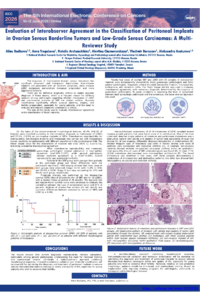
Background/Objectives: The precise distinction between invasive and non-invasive peritoneal implants in ovarian serous borderline tumors (SBTs) and low-grade serous carcinomas (LGSCs) is crucial for clinical management, as it determines surgical approach and prognosis. However, diagnostic reproducibility among pathologists remains variable. The aim of this study was to evaluate interobserver agreement in the classification of these implants. Methods: Twenty-four cases of ovarian SBT and LGSC with 33 samples of extraovarian implants were independently reviewed by three gynecologic pathologists and three general pathologists. Diagnostic criteria included destructive invasion, micropapillary architecture, and retraction clefts. The Fleiss' Kappa statistic was used to measure interobserver agreement, with consensus diagnoses determined by the majority of gynecologic pathologists. Results: Patients in the SBT group were younger than patients in the carcinoma group but these differences were not statistically significant. FIGO staging showed that most cases in both groups were advanced (stage III-IV) with 75.0% in SBTs and 91.0% in LGSC. Stage II was rare, accounting for 15% and 9% for each group, respectively. According to the consensus diagnosis, 42.4% biopsies were classified as metastases of SCLGs and 57.6% as non-invasive implants of SBTs. The most commonly detected single patterns of omentum and peritoneum metastases were destructive invasion and clefts in fibrotic stroma (both 28.5%). The mixed architecture was identified in five cases. When interobserver reproducibility was measured, gynecologic pathologists showed substantial to near-perfect agreement (κ=0.876–0.937), while general pathologists showed moderate agreement (κ = 0.467–0.698). Overall reproducibility was substantial (κ=0.61). Conclusions: The results showed that current diagnostic reproducibility remains suboptimal, particularly among general pathologists, underscoring the need for improved training and standardized criteria. Ultimately, a multidisciplinary approach combining morphological expertise, immunohistochemical validation and molecular stratification will be essential for optimizing the diagnosis and treatment of peritoneal implants to ensure tailored therapies that balance oncological safety and quality of life, especially for young patients who wish to preserve their fertility.
Keywords
noninvasive implant
metastasis
extraovarian disease
serous borderline tumor
serous carcinoma low grade
interobserver reproducibility
Poster
poster.pdf
Pingyangmycin-lipiodol Emulsifier Embolisation Via Transarterial Versus Resection For Hepatic Hemangioma: A Retrospective Controlled Study
Selective PERK inhibition as a strategy to overcome hypoxia-induced survival in colorectal cancer cells