Event submissions
Published
This submission belongs to the session S5. Causes, Diagnosis and Treatment of Cancer of the event The 5th International Electronic Conference on Cancers
Published date
05 Jun, 2026
Academic Editor
'%3e%3cpath%20d='M12.6657%2010.9104C12.4185%2010.325%2012.0599%209.79327%2011.6097%209.34482C11.1609%208.89508%2010.6293%208.5365%2010.0442%208.28888C10.0389%208.28626%2010.0337%208.28495%2010.0285%208.28233C10.8446%207.69279%2011.3752%206.73249%2011.3752%205.64904C11.3752%203.8542%209.92103%202.39999%208.1262%202.39999C6.33136%202.39999%204.87715%203.8542%204.87715%205.64904C4.87715%206.73249%205.40774%207.69279%206.22393%208.28364C6.21869%208.28626%206.21345%208.28757%206.20821%208.29019C5.62129%208.5378%205.09463%208.89284%204.64265%209.34613C4.1929%209.79493%203.83432%2010.3266%203.58671%2010.9117C3.34345%2011.4845%203.21226%2012.0987%203.20023%2012.7209C3.19988%2012.7349%203.20233%2012.7488%203.20744%2012.7619C3.21255%2012.7749%203.22022%2012.7867%203.22998%2012.7968C3.23975%2012.8068%203.25142%2012.8147%203.26431%2012.8202C3.2772%2012.8256%203.29105%2012.8284%203.30504%2012.8284H4.09109C4.14874%2012.8284%204.19459%2012.7825%204.1959%2012.7262C4.2221%2011.7148%204.62823%2010.7676%205.34617%2010.0497C6.08899%209.30683%207.0755%208.89808%208.1262%208.89808C9.17689%208.89808%2010.1634%209.30683%2010.9062%2010.0497C11.6242%2010.7676%2012.0303%2011.7148%2012.0565%2012.7262C12.0578%2012.7838%2012.1037%2012.8284%2012.1613%2012.8284H12.9474C12.9613%2012.8284%2012.9752%2012.8256%2012.9881%2012.8202C13.001%2012.8147%2013.0126%2012.8068%2013.0224%2012.7968C13.0322%2012.7867%2013.0398%2012.7749%2013.0449%2012.7619C13.0501%2012.7488%2013.0525%2012.7349%2013.0522%2012.7209C13.0391%2012.0947%2012.9094%2011.4855%2012.6657%2010.9104ZM8.1262%207.9024C7.52486%207.9024%206.9589%207.6679%206.53312%207.24211C6.10733%206.81633%205.87283%206.25037%205.87283%205.64904C5.87283%205.0477%206.10733%204.48174%206.53312%204.05596C6.9589%203.63018%207.52486%203.39567%208.1262%203.39567C8.72753%203.39567%209.29349%203.63018%209.71927%204.05596C10.1451%204.48174%2010.3796%205.0477%2010.3796%205.64904C10.3796%206.25037%2010.1451%206.81633%209.71927%207.24211C9.29349%207.6679%208.72753%207.9024%208.1262%207.9024Z'%20fill='%235D1EE1'/%3e%3c/g%3e%3c/svg%3e) Masaharu Seno
Masaharu SenoCitation
Leila Hosseinzadeh Anvar, Esmaeil Babaei, Mitra Rezaei, Mortaza Bonyadi, KRAS activity improves overall survival and fosters an anti-tumor microenvironment in colorectal cancer, in Proceedings of The 5th International Electronic Conference on Cancers, 10 June–12 June 2026, MDPI: Basel, Switzerland
Share
Email
Facebook
Twitter
LinkedIn
KRAS activity improves overall survival and fosters an anti-tumor microenvironment in colorectal cancer
'%3e%3cpath%20d='M12.6647%2010.9104C12.4176%2010.325%2012.0589%209.7933%2011.6088%209.34485C11.16%208.89511%2010.6283%208.53653%2010.0432%208.28891C10.038%208.28629%2010.0327%208.28498%2010.0275%208.28236C10.8437%207.69282%2011.3743%206.73252%2011.3743%205.64907C11.3743%203.85423%209.92005%202.40002%208.12522%202.40002C6.33038%202.40002%204.87618%203.85423%204.87618%205.64907C4.87618%206.73252%205.40677%207.69282%206.22296%208.28367C6.21772%208.28629%206.21248%208.2876%206.20724%208.29022C5.62031%208.53783%205.09365%208.89287%204.64167%209.34616C4.19192%209.79496%203.83334%2010.3266%203.58573%2010.9117C3.34247%2011.4846%203.21128%2012.0987%203.19925%2012.721C3.1989%2012.735%203.20135%2012.7489%203.20646%2012.7619C3.21157%2012.7749%203.21924%2012.7868%203.22901%2012.7968C3.23877%2012.8068%203.25045%2012.8148%203.26334%2012.8202C3.27623%2012.8256%203.29007%2012.8284%203.30406%2012.8284H4.09012C4.14776%2012.8284%204.19362%2012.7825%204.19493%2012.7262C4.22113%2011.7148%204.62726%2010.7676%205.34519%2010.0497C6.08802%209.30686%207.07452%208.89811%208.12522%208.89811C9.17592%208.89811%2010.1624%209.30686%2010.9052%2010.0497C11.6232%2010.7676%2012.0293%2011.7148%2012.0555%2012.7262C12.0568%2012.7839%2012.1027%2012.8284%2012.1603%2012.8284H12.9464C12.9604%2012.8284%2012.9742%2012.8256%2012.9871%2012.8202C13%2012.8148%2013.0117%2012.8068%2013.0214%2012.7968C13.0312%2012.7868%2013.0389%2012.7749%2013.044%2012.7619C13.0491%2012.7489%2013.0515%2012.735%2013.0512%2012.721C13.0381%2012.0947%2012.9084%2011.4856%2012.6647%2010.9104ZM8.12522%207.90243C7.52388%207.90243%206.95792%207.66793%206.53214%207.24215C6.10636%206.81636%205.87185%206.2504%205.87185%205.64907C5.87185%205.04773%206.10636%204.48177%206.53214%204.05599C6.95792%203.63021%207.52388%203.3957%208.12522%203.3957C8.72655%203.3957%209.29252%203.63021%209.7183%204.05599C10.1441%204.48177%2010.3786%205.04773%2010.3786%205.64907C10.3786%206.2504%2010.1441%206.81636%209.7183%207.24215C9.29252%207.66793%208.72655%207.90243%208.12522%207.90243Z'%20fill='%235D1EE1'/%3e%3c/g%3e%3c/svg%3e)
Leila Hosseinzadeh Anvar 1
Esmaeil Babaei 1
Mitra Rezaei 2
Mortaza Bonyadi 1
1. Department of Animal Biology, Faculty of Natural Sciences, University of Tabriz, Tabriz, Iran
2. Genomic Research Center, Shahid Beheshti University of Medical Sciences, Tehran, Iran
Abstract
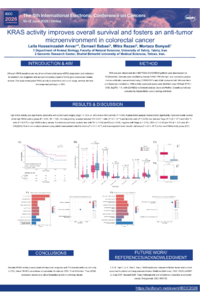
Introduction: Although KRAS mutations are key drivers of colorectal cancer (CRC) progression and resistance to treatment, the prognostic and immunomodulatory impact of KRAS gene expression remains unclear. This study investigated KRAS activity to reveal links with tumor stage, survival, immune landscape and pathways in CRC.
Methods: RNA-seq and clinical data from 549 TCGA-COAD/READ patients were downloaded via TCGAbiolinks. Samples were stratified by median KRAS TPM into high- and low-activity groups. Immune infiltration was estimated using CIBERSORTx and xCell, compared with Wilcoxon tests and Spearman correlations. Differentially expressed genes were identified using DESeq2 (FDR < 0.05, |log2FC| > 1), with GO/KEGG enrichment analysis via clusterProfiler. Overall survival was evaluated by Kaplan–Meier curves and log-rank tests.
Results: High KRAS activity was significantly associated with earlier tumor stages (stage I-II: 53% vs. 46% in low KRAS activity; P < 0.05). Kaplan–Meier analysis demonstrated significantly improved overall survival in the high KRAS activity group (P < 0.05; HR < 1). Immune profiling revealed elevated Th1 CD4+ T cells (P = 2 × 10⁻¹⁶) and dendritic cells (P = 0.018), but reduced Tregs (P = 5.9 × 10⁻⁸) and CD8+ T cells (P = 0.017) in high-KRAS-activity tumors. Correlations confirmed positive links with Th1 (r = 0.6) and DCs (r = 0.08), negative with Tregs (r = -0.33), CD8+ (r = -0.15) and Th2 (r = -0.2) cells (P < 0.05). Enrichment analysis showed upregulated hormone/antioxidant functions (P = 2.3 × 10⁻⁷) and downregulated taste receptor pathways (P = 4.2 × 10⁻⁹) in the low-KRAS-activity group.
Conclusions: Elevated KRAS activity is associated with improved prognosis and Th1-skewed anti-tumor immunity in CRC, where Th1/DC surveillance compensates for reduced CD8+ T-cell infiltration. Thus, KRAS expression serves as a critical biomarker and immunotherapy target.
Keywords
KRAS expression
Overall survival
Immune infiltration
Biomarker
Immunotherapy target
Colorectal cancer
Poster
Congress_final.pdf
A Novel Butylated Neuropeptide Antagonist Targeting Hypoxia-Induced GRPR Overexpression in Small Cell Lung Cancer
Azadirachta indica PLGA nanoparticles potentiate antitumor activity, induce apoptosis, and suppress metastasis in murine breast cancer models