Event submissions
Published
This submission belongs to the session S2. Mathematical Analysis of the event The 2nd International Online Conference on Mathematics and Applications
Published date
08 Jun, 2026
Academic Editor
'%3e%3cpath%20d='M12.6657%2010.9104C12.4185%2010.325%2012.0599%209.79327%2011.6097%209.34482C11.1609%208.89508%2010.6293%208.5365%2010.0442%208.28888C10.0389%208.28626%2010.0337%208.28495%2010.0285%208.28233C10.8446%207.69279%2011.3752%206.73249%2011.3752%205.64904C11.3752%203.8542%209.92103%202.39999%208.1262%202.39999C6.33136%202.39999%204.87715%203.8542%204.87715%205.64904C4.87715%206.73249%205.40774%207.69279%206.22393%208.28364C6.21869%208.28626%206.21345%208.28757%206.20821%208.29019C5.62129%208.5378%205.09463%208.89284%204.64265%209.34613C4.1929%209.79493%203.83432%2010.3266%203.58671%2010.9117C3.34345%2011.4845%203.21226%2012.0987%203.20023%2012.7209C3.19988%2012.7349%203.20233%2012.7488%203.20744%2012.7619C3.21255%2012.7749%203.22022%2012.7867%203.22998%2012.7968C3.23975%2012.8068%203.25142%2012.8147%203.26431%2012.8202C3.2772%2012.8256%203.29105%2012.8284%203.30504%2012.8284H4.09109C4.14874%2012.8284%204.19459%2012.7825%204.1959%2012.7262C4.2221%2011.7148%204.62823%2010.7676%205.34617%2010.0497C6.08899%209.30683%207.0755%208.89808%208.1262%208.89808C9.17689%208.89808%2010.1634%209.30683%2010.9062%2010.0497C11.6242%2010.7676%2012.0303%2011.7148%2012.0565%2012.7262C12.0578%2012.7838%2012.1037%2012.8284%2012.1613%2012.8284H12.9474C12.9613%2012.8284%2012.9752%2012.8256%2012.9881%2012.8202C13.001%2012.8147%2013.0126%2012.8068%2013.0224%2012.7968C13.0322%2012.7867%2013.0398%2012.7749%2013.0449%2012.7619C13.0501%2012.7488%2013.0525%2012.7349%2013.0522%2012.7209C13.0391%2012.0947%2012.9094%2011.4855%2012.6657%2010.9104ZM8.1262%207.9024C7.52486%207.9024%206.9589%207.6679%206.53312%207.24211C6.10733%206.81633%205.87283%206.25037%205.87283%205.64904C5.87283%205.0477%206.10733%204.48174%206.53312%204.05596C6.9589%203.63018%207.52486%203.39567%208.1262%203.39567C8.72753%203.39567%209.29349%203.63018%209.71927%204.05596C10.1451%204.48174%2010.3796%205.0477%2010.3796%205.64904C10.3796%206.25037%2010.1451%206.81633%209.71927%207.24211C9.29349%207.6679%208.72753%207.9024%208.1262%207.9024Z'%20fill='%235D1EE1'/%3e%3c/g%3e%3c/svg%3e) Michel Chipot
Michel ChipotCitation
Mujtaba Yawar, Discrete Elliptic Boundary Value Problems Defined by Symbolic Pseudodifferential Operators, in Proceedings of The 2nd International Online Conference on Mathematics and Applications, 10 June–12 June 2026, MDPI: Basel, Switzerland
Share
Email
Facebook
Twitter
LinkedIn
Discrete Elliptic Boundary Value Problems Defined by Symbolic Pseudodifferential Operators
'%3e%3cpath%20d='M12.6647%2010.9104C12.4176%2010.325%2012.0589%209.7933%2011.6088%209.34485C11.16%208.89511%2010.6283%208.53653%2010.0432%208.28891C10.038%208.28629%2010.0327%208.28498%2010.0275%208.28236C10.8437%207.69282%2011.3743%206.73252%2011.3743%205.64907C11.3743%203.85423%209.92005%202.40002%208.12522%202.40002C6.33038%202.40002%204.87618%203.85423%204.87618%205.64907C4.87618%206.73252%205.40677%207.69282%206.22296%208.28367C6.21772%208.28629%206.21248%208.2876%206.20724%208.29022C5.62031%208.53783%205.09365%208.89287%204.64167%209.34616C4.19192%209.79496%203.83334%2010.3266%203.58573%2010.9117C3.34247%2011.4846%203.21128%2012.0987%203.19925%2012.721C3.1989%2012.735%203.20135%2012.7489%203.20646%2012.7619C3.21157%2012.7749%203.21924%2012.7868%203.22901%2012.7968C3.23877%2012.8068%203.25045%2012.8148%203.26334%2012.8202C3.27623%2012.8256%203.29007%2012.8284%203.30406%2012.8284H4.09012C4.14776%2012.8284%204.19362%2012.7825%204.19493%2012.7262C4.22113%2011.7148%204.62726%2010.7676%205.34519%2010.0497C6.08802%209.30686%207.07452%208.89811%208.12522%208.89811C9.17592%208.89811%2010.1624%209.30686%2010.9052%2010.0497C11.6232%2010.7676%2012.0293%2011.7148%2012.0555%2012.7262C12.0568%2012.7839%2012.1027%2012.8284%2012.1603%2012.8284H12.9464C12.9604%2012.8284%2012.9742%2012.8256%2012.9871%2012.8202C13%2012.8148%2013.0117%2012.8068%2013.0214%2012.7968C13.0312%2012.7868%2013.0389%2012.7749%2013.044%2012.7619C13.0491%2012.7489%2013.0515%2012.735%2013.0512%2012.721C13.0381%2012.0947%2012.9084%2011.4856%2012.6647%2010.9104ZM8.12522%207.90243C7.52388%207.90243%206.95792%207.66793%206.53214%207.24215C6.10636%206.81636%205.87185%206.2504%205.87185%205.64907C5.87185%205.04773%206.10636%204.48177%206.53214%204.05599C6.95792%203.63021%207.52388%203.3957%208.12522%203.3957C8.72655%203.3957%209.29252%203.63021%209.7183%204.05599C10.1441%204.48177%2010.3786%205.04773%2010.3786%205.64907C10.3786%206.2504%2010.1441%206.81636%209.7183%207.24215C9.29252%207.66793%208.72655%207.90243%208.12522%207.90243Z'%20fill='%235D1EE1'/%3e%3c/g%3e%3c/svg%3e)
Mujtaba Yawar 1
1. Department of Applied mathematics and computer modeling, Institute of engineering and digital technology, Belgorod National research University, 85 Pobedy Street, Belgorod, 308015, Russia
Abstract
Abstract
This paper presents a symbolic framework for the analysis of discrete elliptic boundary value problems on lattice domains. Discrete symbol classes, a notion of ellipticity, and compatible boundary operators are introduced. By extending the theory of pseudodifferential operators to the discrete setting, elliptic difference operators are formulated via their symbols on the dual torus, and ellipticity is characterized through principal symbol estimates. Using Vasil’ev’s wave factorization method, adapted to discrete symbols, we construct parametrices and establish well-posedness of discrete boundary value problems.
Introduction
Discrete analogues of pseudodifferential operators arise naturally in numerical analysis and discrete physical models. While elliptic boundary value problems in the continuous setting are well understood, their discrete counterparts require specialized analytical tools. Symbolic pseudodifferential calculus provides a natural framework for studying ellipticity, boundary conditions, and regularity, motivating its extension to lattice-based operators.
Methodology
The analysis is carried out on discrete domains Ωh⊂Zn. Discrete pseudodifferential operators are defined using the discrete Fourier transform and suitable symbol classes. Boundary value problems are formulated by coupling interior difference operators with boundary operators acting on the discrete boundary. Ellipticity is defined through principal symbol estimates, allowing for the construction of parametrices within the discrete symbolic calculus.
Results
The main result shows that elliptic difference operators admit parametrices obtained via wave factorization of their symbols. This approach yields a discrete analogue of the Lopatinski–Shapiro condition and implies Fredholm properties, as well as existence, uniqueness, and regularity of solutions, even for irregular lattice boundaries.
Conclusion
This work establishes a rigorous symbolic theory for discrete elliptic boundary value problems. By adapting Vasil’ev’s wave factorization to the discrete setting, the paper bridges continuous pseudodifferential theory and discrete models, providing a solid analytical foundation for stability analysis and numerical methods for elliptic problems on lattices.
Keywords
Discrete elliptic operators
Pseudodifferential operators
Symbolic calculus
Wave factorization
Boundary value problems
Lattice domains
Poster
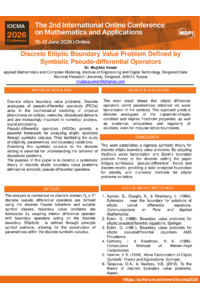
Dr. Mujtaba yawar poster(sciforum-171137).pdf
Solution of the fundamental integral equation in heat transfer and its repercussion for architecture, fire prevention and tunnelling
An adaptive hybrid conjugate gradient algorithm for the optimization of image restoration model