Event submissions
Published
This submission belongs to the session S1. Inorganic Crystalline Materials of the event The 5th International Online Conference on Crystals
Published date
10 Jun, 2026
Academic Editor
'%3e%3cpath%20d='M12.6657%2010.9104C12.4185%2010.325%2012.0599%209.79327%2011.6097%209.34482C11.1609%208.89508%2010.6293%208.5365%2010.0442%208.28888C10.0389%208.28626%2010.0337%208.28495%2010.0285%208.28233C10.8446%207.69279%2011.3752%206.73249%2011.3752%205.64904C11.3752%203.8542%209.92103%202.39999%208.1262%202.39999C6.33136%202.39999%204.87715%203.8542%204.87715%205.64904C4.87715%206.73249%205.40774%207.69279%206.22393%208.28364C6.21869%208.28626%206.21345%208.28757%206.20821%208.29019C5.62129%208.5378%205.09463%208.89284%204.64265%209.34613C4.1929%209.79493%203.83432%2010.3266%203.58671%2010.9117C3.34345%2011.4845%203.21226%2012.0987%203.20023%2012.7209C3.19988%2012.7349%203.20233%2012.7488%203.20744%2012.7619C3.21255%2012.7749%203.22022%2012.7867%203.22998%2012.7968C3.23975%2012.8068%203.25142%2012.8147%203.26431%2012.8202C3.2772%2012.8256%203.29105%2012.8284%203.30504%2012.8284H4.09109C4.14874%2012.8284%204.19459%2012.7825%204.1959%2012.7262C4.2221%2011.7148%204.62823%2010.7676%205.34617%2010.0497C6.08899%209.30683%207.0755%208.89808%208.1262%208.89808C9.17689%208.89808%2010.1634%209.30683%2010.9062%2010.0497C11.6242%2010.7676%2012.0303%2011.7148%2012.0565%2012.7262C12.0578%2012.7838%2012.1037%2012.8284%2012.1613%2012.8284H12.9474C12.9613%2012.8284%2012.9752%2012.8256%2012.9881%2012.8202C13.001%2012.8147%2013.0126%2012.8068%2013.0224%2012.7968C13.0322%2012.7867%2013.0398%2012.7749%2013.0449%2012.7619C13.0501%2012.7488%2013.0525%2012.7349%2013.0522%2012.7209C13.0391%2012.0947%2012.9094%2011.4855%2012.6657%2010.9104ZM8.1262%207.9024C7.52486%207.9024%206.9589%207.6679%206.53312%207.24211C6.10733%206.81633%205.87283%206.25037%205.87283%205.64904C5.87283%205.0477%206.10733%204.48174%206.53312%204.05596C6.9589%203.63018%207.52486%203.39567%208.1262%203.39567C8.72753%203.39567%209.29349%203.63018%209.71927%204.05596C10.1451%204.48174%2010.3796%205.0477%2010.3796%205.64904C10.3796%206.25037%2010.1451%206.81633%209.71927%207.24211C9.29349%207.6679%208.72753%207.9024%208.1262%207.9024Z'%20fill='%235D1EE1'/%3e%3c/g%3e%3c/svg%3e) Zongyou Yin
Zongyou YinCitation
Margarida Taborda António, Jorge Martins, Elvira Fortunato, Rodrigo Martins, Pedro Barquinha, Ana Rovisco, Rapid Microwave-Assisted Hydrothermal Growth of ZTO Nanowires through Systematic Parameter Optimization, in Proceedings of The 5th International Online Conference on Crystals, 15 June–17 June 2026, MDPI: Basel, Switzerland
Share
Email
Facebook
Twitter
LinkedIn
Rapid Microwave-Assisted Hydrothermal Growth of ZTO Nanowires through Systematic Parameter Optimization
'%3e%3cpath%20d='M12.6647%2010.9104C12.4176%2010.325%2012.0589%209.7933%2011.6088%209.34485C11.16%208.89511%2010.6283%208.53653%2010.0432%208.28891C10.038%208.28629%2010.0327%208.28498%2010.0275%208.28236C10.8437%207.69282%2011.3743%206.73252%2011.3743%205.64907C11.3743%203.85423%209.92005%202.40002%208.12522%202.40002C6.33038%202.40002%204.87618%203.85423%204.87618%205.64907C4.87618%206.73252%205.40677%207.69282%206.22296%208.28367C6.21772%208.28629%206.21248%208.2876%206.20724%208.29022C5.62031%208.53783%205.09365%208.89287%204.64167%209.34616C4.19192%209.79496%203.83334%2010.3266%203.58573%2010.9117C3.34247%2011.4846%203.21128%2012.0987%203.19925%2012.721C3.1989%2012.735%203.20135%2012.7489%203.20646%2012.7619C3.21157%2012.7749%203.21924%2012.7868%203.22901%2012.7968C3.23877%2012.8068%203.25045%2012.8148%203.26334%2012.8202C3.27623%2012.8256%203.29007%2012.8284%203.30406%2012.8284H4.09012C4.14776%2012.8284%204.19362%2012.7825%204.19493%2012.7262C4.22113%2011.7148%204.62726%2010.7676%205.34519%2010.0497C6.08802%209.30686%207.07452%208.89811%208.12522%208.89811C9.17592%208.89811%2010.1624%209.30686%2010.9052%2010.0497C11.6232%2010.7676%2012.0293%2011.7148%2012.0555%2012.7262C12.0568%2012.7839%2012.1027%2012.8284%2012.1603%2012.8284H12.9464C12.9604%2012.8284%2012.9742%2012.8256%2012.9871%2012.8202C13%2012.8148%2013.0117%2012.8068%2013.0214%2012.7968C13.0312%2012.7868%2013.0389%2012.7749%2013.044%2012.7619C13.0491%2012.7489%2013.0515%2012.735%2013.0512%2012.721C13.0381%2012.0947%2012.9084%2011.4856%2012.6647%2010.9104ZM8.12522%207.90243C7.52388%207.90243%206.95792%207.66793%206.53214%207.24215C6.10636%206.81636%205.87185%206.2504%205.87185%205.64907C5.87185%205.04773%206.10636%204.48177%206.53214%204.05599C6.95792%203.63021%207.52388%203.3957%208.12522%203.3957C8.72655%203.3957%209.29252%203.63021%209.7183%204.05599C10.1441%204.48177%2010.3786%205.04773%2010.3786%205.64907C10.3786%206.2504%2010.1441%206.81636%209.7183%207.24215C9.29252%207.66793%208.72655%207.90243%208.12522%207.90243Z'%20fill='%235D1EE1'/%3e%3c/g%3e%3c/svg%3e)
Margarida Taborda António 1
Jorge Martins 1

Elvira Fortunato 1

Rodrigo Martins 1

Pedro Barquinha 1

Ana Rovisco 1
1. CENIMAT|i3N, Department of Materials Science, School of Science and Technology, NOVA University Lisbon and CEMOP/UNINOVA, Caparica, Portugal
Abstract
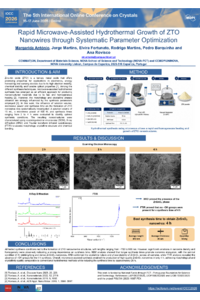
Zinc–tin oxide (ZTO) is a ternary metal oxide that offers promising properties for applications in electronics, energy harvesting and sensing devices due to its high electron mobility, chemical stability and tunable optical properties [1]. Among the different synthesis techniques, microwave-assisted hydrothermal synthesis has emerged as an efficient approach for producing nanostructured materials due to its fast and homogeneous heating [2]. However, the morphology and crystalline phases obtained are strongly influenced by the synthesis parameters employed [3]. In this work, the influence of solution volume, microwave power and synthesis time on the formation of ZTO nanowires was systematically investigated. Two solution volumes (7.5 mL and 15 mL), two microwave powers (75 W and 100 W) and synthesis times ranging from 2 to 4 h were evaluated to identify optimal synthesis conditions. The resulting nanostructures were characterized using scanning electron microscopy (SEM), X-ray diffraction (XRD) and Fourier transform infrared spectroscopy (FTIR) to assess morphology, crystalline structure and chemical bonding. Overall, the results demonstrate that synthesis time, microwave power and solution volume play critical roles in controlling ZTO nanowire morphology and growth. By optimizing these parameters, ZnSnO3 nanowires with comparable morphological and crystallinity quality to those obtained via conventional oven-based hydrothermal synthesis [4] were successfully produced in only 4 h, corresponding to a reduction of 20 h in synthesis time.
Acknowledgements: This work is funded by National Funds through FCT - Portuguese Foundation for Science and Technology, References LA/P/0037/2020, UIDP/50025/2020 and UIDB/ 50025/2020 and the project FOLOW (2023.11887.PEX). This work also received funding from the European Community's H2020 program [GA No. 101008701 (EMERGE)].
References
[1] Rovisco, A. et al., Discover Nano 2025, 20, 229.
[2] Rovisco, A. et al., Nanomaterials 2022, 12, 2119.
[3] Rovisco, A. et al., Nanomaterials 2019, 9, 1002.
[4] Rovisco, A. et al., ACS Appl. Nano Mater. 2018, 1, 3986–3997.
Keywords
Zinc-tin oxide
microwave-assisted synthesis
nanowires
synthesis optimization.
Poster
IOCC poster MAntonio.pdf
Structural analysis of DMF cocrystalization as a quantitative stabilization strategy for metastable N, N’-bis(4-chlorophenyl)thiourea
Optical and thermal properties of tin disulphide Single Crystals