Event submissions
Published
This submission belongs to the session S1. Inorganic Crystalline Materials of the event The 5th International Online Conference on Crystals
Published date
10 Jun, 2026
Academic Editor
'%3e%3cpath%20d='M12.6657%2010.9104C12.4185%2010.325%2012.0599%209.79327%2011.6097%209.34482C11.1609%208.89508%2010.6293%208.5365%2010.0442%208.28888C10.0389%208.28626%2010.0337%208.28495%2010.0285%208.28233C10.8446%207.69279%2011.3752%206.73249%2011.3752%205.64904C11.3752%203.8542%209.92103%202.39999%208.1262%202.39999C6.33136%202.39999%204.87715%203.8542%204.87715%205.64904C4.87715%206.73249%205.40774%207.69279%206.22393%208.28364C6.21869%208.28626%206.21345%208.28757%206.20821%208.29019C5.62129%208.5378%205.09463%208.89284%204.64265%209.34613C4.1929%209.79493%203.83432%2010.3266%203.58671%2010.9117C3.34345%2011.4845%203.21226%2012.0987%203.20023%2012.7209C3.19988%2012.7349%203.20233%2012.7488%203.20744%2012.7619C3.21255%2012.7749%203.22022%2012.7867%203.22998%2012.7968C3.23975%2012.8068%203.25142%2012.8147%203.26431%2012.8202C3.2772%2012.8256%203.29105%2012.8284%203.30504%2012.8284H4.09109C4.14874%2012.8284%204.19459%2012.7825%204.1959%2012.7262C4.2221%2011.7148%204.62823%2010.7676%205.34617%2010.0497C6.08899%209.30683%207.0755%208.89808%208.1262%208.89808C9.17689%208.89808%2010.1634%209.30683%2010.9062%2010.0497C11.6242%2010.7676%2012.0303%2011.7148%2012.0565%2012.7262C12.0578%2012.7838%2012.1037%2012.8284%2012.1613%2012.8284H12.9474C12.9613%2012.8284%2012.9752%2012.8256%2012.9881%2012.8202C13.001%2012.8147%2013.0126%2012.8068%2013.0224%2012.7968C13.0322%2012.7867%2013.0398%2012.7749%2013.0449%2012.7619C13.0501%2012.7488%2013.0525%2012.7349%2013.0522%2012.7209C13.0391%2012.0947%2012.9094%2011.4855%2012.6657%2010.9104ZM8.1262%207.9024C7.52486%207.9024%206.9589%207.6679%206.53312%207.24211C6.10733%206.81633%205.87283%206.25037%205.87283%205.64904C5.87283%205.0477%206.10733%204.48174%206.53312%204.05596C6.9589%203.63018%207.52486%203.39567%208.1262%203.39567C8.72753%203.39567%209.29349%203.63018%209.71927%204.05596C10.1451%204.48174%2010.3796%205.0477%2010.3796%205.64904C10.3796%206.25037%2010.1451%206.81633%209.71927%207.24211C9.29349%207.6679%208.72753%207.9024%208.1262%207.9024Z'%20fill='%235D1EE1'/%3e%3c/g%3e%3c/svg%3e) John Parthenios
John PartheniosCitation
Bogdan Cojocaru, Octavian Dumitru Pavel, Simona Margareta Coman, Simple TiO₂-based photocatalyst for HMF transformation under UV irradiation, in Proceedings of The 5th International Online Conference on Crystals, 15 June–17 June 2026, MDPI: Basel, Switzerland
Share
Email
Facebook
Twitter
LinkedIn
Simple TiO2-based photocatalyst for HMF transformation under UV irradiation

Bogdan Cojocaru 1

Octavian Dumitru Pavel 1

Simona Margareta Coman 1
1. Faculty of Chemistry, University of Bucharest, Bucharest, Romania
Abstract
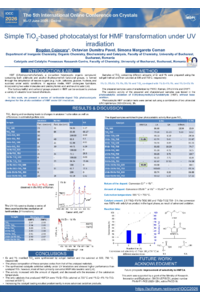
5-hydroxymethylfurfural (HMF), a six-carbon heterocyclic organic compound containing both aldehyde and alcohol functional groups, is produced from the dehydration of hexose sugars under acidic conditions. The hydroxymethyl and carbonyl groups of HMF can be oxidized to form various important furanic chemicals, which serve as platform molecules for further transformations. During the last years, research in the field of photocatalysis has expanded from degradation of harmful compounds to synthesis as a green chemistry tool to replace dangerous and polluting routes. Different catalysts were already reported as active in the selective oxidation of HMF under UV or visible light irradiation. Doping of TiO2 with rare earth metals is a very efficient way to improve its photocatalytic performance as a result of different factors. In our work, TiO2 containing different amounts of Er and Yb was prepared using the sol–gel method and then calcined at 500 and 750oC, respectively. The characterization of these samples showed that the phase distribution of these is different than that of the pristine TiO2. While the pristine TiO2 calcined at 500oC contained about 5% anatase along with the predominant rutile phase, the doped samples contained 100% anatase. The increased calcination temperature led to a content of about 66% in rutile for TiO2, compared to the doped samples, which contained a maximum of 28% rutile for 1%Yb-TiO2. These catalysts were active under UV irradiation, more active than the pristine TiO2, but most of them oxidized HMF to lactic acid (LA, major product) and glycolic acid (GA). The activity increased with the amount of dopant, and decreased with the increase of the calcination temperature. The only catalysts that led to 2,5-hydroxymethylfurancarboxylic acid (HMFCA) as the reaction product were 1%Er-TiO2 calcined at 750⁰C and 1%Er-1%Yb-TiO2 calcined at 500⁰C, the samples with the smallest amount of rutile. No base was added in our experiments.
Keywords
Titanium dixode
lanthanides
HMF
HMFCA
Poster
Cojocaru B IOCC2026.pdf
Optical and thermal properties of tin disulphide Single Crystals
Petrography and Geochemistry of Gold-Like Rocks from Battambang, Mondulkiri, Kratie, and Takeo Provinces, Cambodia: A Scientific Evaluation of Local Beliefs