Event submissions
Published
This submission belongs to the session S1. Inorganic Crystalline Materials of the event The 5th International Online Conference on Crystals
Published date
10 Jun, 2026
Academic Editor
'%3e%3cpath%20d='M12.6657%2010.9104C12.4185%2010.325%2012.0599%209.79327%2011.6097%209.34482C11.1609%208.89508%2010.6293%208.5365%2010.0442%208.28888C10.0389%208.28626%2010.0337%208.28495%2010.0285%208.28233C10.8446%207.69279%2011.3752%206.73249%2011.3752%205.64904C11.3752%203.8542%209.92103%202.39999%208.1262%202.39999C6.33136%202.39999%204.87715%203.8542%204.87715%205.64904C4.87715%206.73249%205.40774%207.69279%206.22393%208.28364C6.21869%208.28626%206.21345%208.28757%206.20821%208.29019C5.62129%208.5378%205.09463%208.89284%204.64265%209.34613C4.1929%209.79493%203.83432%2010.3266%203.58671%2010.9117C3.34345%2011.4845%203.21226%2012.0987%203.20023%2012.7209C3.19988%2012.7349%203.20233%2012.7488%203.20744%2012.7619C3.21255%2012.7749%203.22022%2012.7867%203.22998%2012.7968C3.23975%2012.8068%203.25142%2012.8147%203.26431%2012.8202C3.2772%2012.8256%203.29105%2012.8284%203.30504%2012.8284H4.09109C4.14874%2012.8284%204.19459%2012.7825%204.1959%2012.7262C4.2221%2011.7148%204.62823%2010.7676%205.34617%2010.0497C6.08899%209.30683%207.0755%208.89808%208.1262%208.89808C9.17689%208.89808%2010.1634%209.30683%2010.9062%2010.0497C11.6242%2010.7676%2012.0303%2011.7148%2012.0565%2012.7262C12.0578%2012.7838%2012.1037%2012.8284%2012.1613%2012.8284H12.9474C12.9613%2012.8284%2012.9752%2012.8256%2012.9881%2012.8202C13.001%2012.8147%2013.0126%2012.8068%2013.0224%2012.7968C13.0322%2012.7867%2013.0398%2012.7749%2013.0449%2012.7619C13.0501%2012.7488%2013.0525%2012.7349%2013.0522%2012.7209C13.0391%2012.0947%2012.9094%2011.4855%2012.6657%2010.9104ZM8.1262%207.9024C7.52486%207.9024%206.9589%207.6679%206.53312%207.24211C6.10733%206.81633%205.87283%206.25037%205.87283%205.64904C5.87283%205.0477%206.10733%204.48174%206.53312%204.05596C6.9589%203.63018%207.52486%203.39567%208.1262%203.39567C8.72753%203.39567%209.29349%203.63018%209.71927%204.05596C10.1451%204.48174%2010.3796%205.0477%2010.3796%205.64904C10.3796%206.25037%2010.1451%206.81633%209.71927%207.24211C9.29349%207.6679%208.72753%207.9024%208.1262%207.9024Z'%20fill='%235D1EE1'/%3e%3c/g%3e%3c/svg%3e) John Parthenios
John PartheniosCitation
Nikolina Filipović, Gala Bereš, Anamarija Stanković, Tomislav Balić, Preparation and Structural Characterization of Copper(II) Complex with Maltol, in Proceedings of The 5th International Online Conference on Crystals, 15 June–17 June 2026, MDPI: Basel, Switzerland
Share
Email
Facebook
Twitter
LinkedIn
Preparation and Structural Characterization of Copper(II) Complex with Maltol

Nikolina Filipović 1
'%3e%3cpath%20d='M12.6647%2010.9104C12.4176%2010.325%2012.0589%209.7933%2011.6088%209.34485C11.16%208.89511%2010.6283%208.53653%2010.0432%208.28891C10.038%208.28629%2010.0327%208.28498%2010.0275%208.28236C10.8437%207.69282%2011.3743%206.73252%2011.3743%205.64907C11.3743%203.85423%209.92005%202.40002%208.12522%202.40002C6.33038%202.40002%204.87618%203.85423%204.87618%205.64907C4.87618%206.73252%205.40677%207.69282%206.22296%208.28367C6.21772%208.28629%206.21248%208.2876%206.20724%208.29022C5.62031%208.53783%205.09365%208.89287%204.64167%209.34616C4.19192%209.79496%203.83334%2010.3266%203.58573%2010.9117C3.34247%2011.4846%203.21128%2012.0987%203.19925%2012.721C3.1989%2012.735%203.20135%2012.7489%203.20646%2012.7619C3.21157%2012.7749%203.21924%2012.7868%203.22901%2012.7968C3.23877%2012.8068%203.25045%2012.8148%203.26334%2012.8202C3.27623%2012.8256%203.29007%2012.8284%203.30406%2012.8284H4.09012C4.14776%2012.8284%204.19362%2012.7825%204.19493%2012.7262C4.22113%2011.7148%204.62726%2010.7676%205.34519%2010.0497C6.08802%209.30686%207.07452%208.89811%208.12522%208.89811C9.17592%208.89811%2010.1624%209.30686%2010.9052%2010.0497C11.6232%2010.7676%2012.0293%2011.7148%2012.0555%2012.7262C12.0568%2012.7839%2012.1027%2012.8284%2012.1603%2012.8284H12.9464C12.9604%2012.8284%2012.9742%2012.8256%2012.9871%2012.8202C13%2012.8148%2013.0117%2012.8068%2013.0214%2012.7968C13.0312%2012.7868%2013.0389%2012.7749%2013.044%2012.7619C13.0491%2012.7489%2013.0515%2012.735%2013.0512%2012.721C13.0381%2012.0947%2012.9084%2011.4856%2012.6647%2010.9104ZM8.12522%207.90243C7.52388%207.90243%206.95792%207.66793%206.53214%207.24215C6.10636%206.81636%205.87185%206.2504%205.87185%205.64907C5.87185%205.04773%206.10636%204.48177%206.53214%204.05599C6.95792%203.63021%207.52388%203.3957%208.12522%203.3957C8.72655%203.3957%209.29252%203.63021%209.7183%204.05599C10.1441%204.48177%2010.3786%205.04773%2010.3786%205.64907C10.3786%206.2504%2010.1441%206.81636%209.7183%207.24215C9.29252%207.66793%208.72655%207.90243%208.12522%207.90243Z'%20fill='%235D1EE1'/%3e%3c/g%3e%3c/svg%3e)
Gala Bereš 1

Anamarija Stanković 1
Tomislav Balić 1
1. Department of Chemistry, University of Osijek, cara Hadrijana 8/a, 31 000, Croatia
Abstract
Maltol (3-hydroxy-2-methyl-4H-pyran-4-one) is a bidentate ligand that coordinates transition metal ions via its hydroxyl and carbonyl groups. Copper(II) forms stable complexes with oxygen-donor ligands due to its flexible coordination geometry and biological relevance. This study investigates the complexation of copper(II) nitrate trihydrate with maltol, forming a stable complex with distinct structural characteristics. The copper(II)–maltol complex was synthesized by reacting copper(II) nitrate trihydrate with maltol in aqueous solution under ambient conditions. The resulting solid was characterized using FT-IR, PXRD, and TGA/DSC to evaluate coordination modes, structure, thermal stability, and solution behavior. FT-IR analysis showed the absence of the C–OH stretching vibration at 3255 cm⁻¹, indicating deprotonation of maltol and coordination to the copper ion. The C=O stretching vibration shifted from 1616 cm⁻¹ in free maltol to 1568 cm⁻¹ in the complex, confirming chelation. A weak Cu–O band at 719 cm⁻¹ was observed, with no nitrate ions detected. Thermal analysis revealed a single-step degradation, with 70% mass loss attributed to the removal of maltol, and a sharp exothermic peak at 220°C in the DSC curve, consistent with CuO. X-ray diffraction confirmed the monoclinic crystal system (space group C2/c) with square-planar coordination around the copper ion, exhibiting Jahn–Teller distortion. This study successfully synthesized and characterized the copper(II)–maltol complex. FT-IR confirmed maltol coordination with copper, forming a stable chelate. Thermal analysis indicated good stability, and X-ray diffraction revealed a monoclinic structure with Jahn–Teller distortion. These findings enhance understanding of copper(II) coordination chemistry with maltol.
This research was funded by the European Union—NextGenerationEU Project “Advanced Interdisciplinary Approaches to Environmental Chemistry: From Materials to Sustainable Solutions for Pollution” (Grant number: 581-UNIOS-101).
Keywords
Copper(II) complexes Maltol Coordination chemistry Chelate effect Spectroscopic characterization
Poster
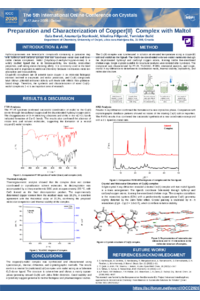
Preparation and Characterization of Cu(II) Complex with Maltol_Bereš.pdf
Synthesis and crystal structure of a polymeric Mn(II) coordination complex based on 3,4-pyridinecarboxylate
Nanostructured CuO, ZnO, and ZnO/CuO thin films synthesized by SILAR method and their enhanced photocatalytic activity for methylene blue degradation