Event submissions
Published
This submission belongs to the session S1. Inorganic Crystalline Materials of the event The 5th International Online Conference on Crystals
Published date
10 Jun, 2026
Academic Editor
'%3e%3cpath%20d='M12.6657%2010.9104C12.4185%2010.325%2012.0599%209.79327%2011.6097%209.34482C11.1609%208.89508%2010.6293%208.5365%2010.0442%208.28888C10.0389%208.28626%2010.0337%208.28495%2010.0285%208.28233C10.8446%207.69279%2011.3752%206.73249%2011.3752%205.64904C11.3752%203.8542%209.92103%202.39999%208.1262%202.39999C6.33136%202.39999%204.87715%203.8542%204.87715%205.64904C4.87715%206.73249%205.40774%207.69279%206.22393%208.28364C6.21869%208.28626%206.21345%208.28757%206.20821%208.29019C5.62129%208.5378%205.09463%208.89284%204.64265%209.34613C4.1929%209.79493%203.83432%2010.3266%203.58671%2010.9117C3.34345%2011.4845%203.21226%2012.0987%203.20023%2012.7209C3.19988%2012.7349%203.20233%2012.7488%203.20744%2012.7619C3.21255%2012.7749%203.22022%2012.7867%203.22998%2012.7968C3.23975%2012.8068%203.25142%2012.8147%203.26431%2012.8202C3.2772%2012.8256%203.29105%2012.8284%203.30504%2012.8284H4.09109C4.14874%2012.8284%204.19459%2012.7825%204.1959%2012.7262C4.2221%2011.7148%204.62823%2010.7676%205.34617%2010.0497C6.08899%209.30683%207.0755%208.89808%208.1262%208.89808C9.17689%208.89808%2010.1634%209.30683%2010.9062%2010.0497C11.6242%2010.7676%2012.0303%2011.7148%2012.0565%2012.7262C12.0578%2012.7838%2012.1037%2012.8284%2012.1613%2012.8284H12.9474C12.9613%2012.8284%2012.9752%2012.8256%2012.9881%2012.8202C13.001%2012.8147%2013.0126%2012.8068%2013.0224%2012.7968C13.0322%2012.7867%2013.0398%2012.7749%2013.0449%2012.7619C13.0501%2012.7488%2013.0525%2012.7349%2013.0522%2012.7209C13.0391%2012.0947%2012.9094%2011.4855%2012.6657%2010.9104ZM8.1262%207.9024C7.52486%207.9024%206.9589%207.6679%206.53312%207.24211C6.10733%206.81633%205.87283%206.25037%205.87283%205.64904C5.87283%205.0477%206.10733%204.48174%206.53312%204.05596C6.9589%203.63018%207.52486%203.39567%208.1262%203.39567C8.72753%203.39567%209.29349%203.63018%209.71927%204.05596C10.1451%204.48174%2010.3796%205.0477%2010.3796%205.64904C10.3796%206.25037%2010.1451%206.81633%209.71927%207.24211C9.29349%207.6679%208.72753%207.9024%208.1262%207.9024Z'%20fill='%235D1EE1'/%3e%3c/g%3e%3c/svg%3e) Zongyou Yin
Zongyou YinCitation
Karim Chourti, Hajar KABDANI, Fatima CHAOU, Ilyas JAFALI, El houssien AKICHOUH, Amine BENDAHHOU, Mohamed ABOU SALAMA, Study of Structural Evolution and Dielectric Properties of Solid Solutions A₂(Sm₁₋xREx)Ti₂Nb₃O₁₅ (A = Sr, Ba; RE = Nd, Sm, Gd, La), in Proceedings of The 5th International Online Conference on Crystals, 15 June–17 June 2026, MDPI: Basel, Switzerland
Share
Email
Facebook
Twitter
LinkedIn
Study of Structural Evolution and Dielectric Properties of Solid Solutions A2(Sm1-xREx)Ti2Nb3O15 (A = Sr, Ba; RE = Nd, Sm, Gd, La)

Karim Chourti 1
'%3e%3cpath%20d='M12.6647%2010.9104C12.4176%2010.325%2012.0589%209.7933%2011.6088%209.34485C11.16%208.89511%2010.6283%208.53653%2010.0432%208.28891C10.038%208.28629%2010.0327%208.28498%2010.0275%208.28236C10.8437%207.69282%2011.3743%206.73252%2011.3743%205.64907C11.3743%203.85423%209.92005%202.40002%208.12522%202.40002C6.33038%202.40002%204.87618%203.85423%204.87618%205.64907C4.87618%206.73252%205.40677%207.69282%206.22296%208.28367C6.21772%208.28629%206.21248%208.2876%206.20724%208.29022C5.62031%208.53783%205.09365%208.89287%204.64167%209.34616C4.19192%209.79496%203.83334%2010.3266%203.58573%2010.9117C3.34247%2011.4846%203.21128%2012.0987%203.19925%2012.721C3.1989%2012.735%203.20135%2012.7489%203.20646%2012.7619C3.21157%2012.7749%203.21924%2012.7868%203.22901%2012.7968C3.23877%2012.8068%203.25045%2012.8148%203.26334%2012.8202C3.27623%2012.8256%203.29007%2012.8284%203.30406%2012.8284H4.09012C4.14776%2012.8284%204.19362%2012.7825%204.19493%2012.7262C4.22113%2011.7148%204.62726%2010.7676%205.34519%2010.0497C6.08802%209.30686%207.07452%208.89811%208.12522%208.89811C9.17592%208.89811%2010.1624%209.30686%2010.9052%2010.0497C11.6232%2010.7676%2012.0293%2011.7148%2012.0555%2012.7262C12.0568%2012.7839%2012.1027%2012.8284%2012.1603%2012.8284H12.9464C12.9604%2012.8284%2012.9742%2012.8256%2012.9871%2012.8202C13%2012.8148%2013.0117%2012.8068%2013.0214%2012.7968C13.0312%2012.7868%2013.0389%2012.7749%2013.044%2012.7619C13.0491%2012.7489%2013.0515%2012.735%2013.0512%2012.721C13.0381%2012.0947%2012.9084%2011.4856%2012.6647%2010.9104ZM8.12522%207.90243C7.52388%207.90243%206.95792%207.66793%206.53214%207.24215C6.10636%206.81636%205.87185%206.2504%205.87185%205.64907C5.87185%205.04773%206.10636%204.48177%206.53214%204.05599C6.95792%203.63021%207.52388%203.3957%208.12522%203.3957C8.72655%203.3957%209.29252%203.63021%209.7183%204.05599C10.1441%204.48177%2010.3786%205.04773%2010.3786%205.64907C10.3786%206.2504%2010.1441%206.81636%209.7183%207.24215C9.29252%207.66793%208.72655%207.90243%208.12522%207.90243Z'%20fill='%235D1EE1'/%3e%3c/g%3e%3c/svg%3e)
Hajar KABDANI 1
Fatima CHAOU 2
Ilyas JAFALI 3
El houssien AKICHOUH 1

Amine BENDAHHOU 1
Mohamed ABOU SALAMA 1
1. Department of Chemistry, Laboratory of Molecular Chemistry, Materials and Environment, Faculty Multidisciplinary Nador, University Mohamed Premier, B.P. 300, Selouane, Nador 62700, Morocco.
2. Laboratory of Physical Chemistry of Materials, Faculty of Sciences, Chouaib Doukkali University, El Jadida, Morocco
3. Regional Center for Education and Training Professions (CRMEF), Provincial Annex of Al Hoceïma, Morocco
Abstract
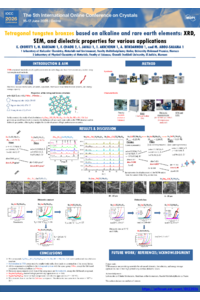
Tetragonal tungsten bronzes (TTBs) represent an important class of functional ceramics, known for their high dielectric properties and thermal stability. Tailoring the properties of these materials through ionic substitution enables modulation of the crystal structure and, consequently, their electrical performance. In this context, the study of solid solutions A₂(Sm₁₋ₓREₓ)Ti₂Nb₃O₁₅ (A = Sr, Ba; RE = Nd, Sm, Gd, La) provides an ideal framework to examine the influence of rare-earth ionic radii on the TTB structure and its dielectric properties, offering key insights for the development of high-performance ceramics.
The compounds A₂(Sm₁₋ₓREₓ)Ti₂Nb₃O₁₅ (A = Sr, Ba; RE = Nd, Sm, Gd, La) were synthesized via solid-state reaction. The resulting ceramics were characterized using various techniques, including X-ray diffraction (XRD), scanning electron microscopy (SEM), and dielectric measurements. Substitution with different rare-earth elements in the TTB compounds leads to a gradual decrease in lattice parameters as the ionic radius decreases (from La to Gd), accompanied by a space group transition from P4bm for La, Sm, and Nd to P4/mbm for Gd. Dielectric properties show significant variation depending on the rare-earth element, with high dielectric constants and low losses, reflecting the influence of local polarization and structural distortions. SEM observations reveal changes in grain morphology and size consistent with the effects induced by ionic substitution. Overall, these results highlight a direct correlation between the RE ionic radius, lattice distortions, and dielectric properties, confirming the crucial role of substitution chemistry in tuning the properties of tetragonal tungsten bronzes.
Keywords
solid-state reaction
ceramics
TTB compounds
Dielectric properties
SEM
Poster
Poster_karim template_ICMES_2026.pdf
Synergistic Effects of Medium Composition and Phenol Oxidase Induction on Fungal Nanoparticle Biosynthesis
Preparation and Characterization of Zinc(II) Complexes with Coumalic Acid