Event submissions
Published
This submission belongs to the session S1. Inorganic Crystalline Materials of the event The 5th International Online Conference on Crystals
Published date
10 Jun, 2026
Academic Editor
'%3e%3cpath%20d='M12.6657%2010.9104C12.4185%2010.325%2012.0599%209.79327%2011.6097%209.34482C11.1609%208.89508%2010.6293%208.5365%2010.0442%208.28888C10.0389%208.28626%2010.0337%208.28495%2010.0285%208.28233C10.8446%207.69279%2011.3752%206.73249%2011.3752%205.64904C11.3752%203.8542%209.92103%202.39999%208.1262%202.39999C6.33136%202.39999%204.87715%203.8542%204.87715%205.64904C4.87715%206.73249%205.40774%207.69279%206.22393%208.28364C6.21869%208.28626%206.21345%208.28757%206.20821%208.29019C5.62129%208.5378%205.09463%208.89284%204.64265%209.34613C4.1929%209.79493%203.83432%2010.3266%203.58671%2010.9117C3.34345%2011.4845%203.21226%2012.0987%203.20023%2012.7209C3.19988%2012.7349%203.20233%2012.7488%203.20744%2012.7619C3.21255%2012.7749%203.22022%2012.7867%203.22998%2012.7968C3.23975%2012.8068%203.25142%2012.8147%203.26431%2012.8202C3.2772%2012.8256%203.29105%2012.8284%203.30504%2012.8284H4.09109C4.14874%2012.8284%204.19459%2012.7825%204.1959%2012.7262C4.2221%2011.7148%204.62823%2010.7676%205.34617%2010.0497C6.08899%209.30683%207.0755%208.89808%208.1262%208.89808C9.17689%208.89808%2010.1634%209.30683%2010.9062%2010.0497C11.6242%2010.7676%2012.0303%2011.7148%2012.0565%2012.7262C12.0578%2012.7838%2012.1037%2012.8284%2012.1613%2012.8284H12.9474C12.9613%2012.8284%2012.9752%2012.8256%2012.9881%2012.8202C13.001%2012.8147%2013.0126%2012.8068%2013.0224%2012.7968C13.0322%2012.7867%2013.0398%2012.7749%2013.0449%2012.7619C13.0501%2012.7488%2013.0525%2012.7349%2013.0522%2012.7209C13.0391%2012.0947%2012.9094%2011.4855%2012.6657%2010.9104ZM8.1262%207.9024C7.52486%207.9024%206.9589%207.6679%206.53312%207.24211C6.10733%206.81633%205.87283%206.25037%205.87283%205.64904C5.87283%205.0477%206.10733%204.48174%206.53312%204.05596C6.9589%203.63018%207.52486%203.39567%208.1262%203.39567C8.72753%203.39567%209.29349%203.63018%209.71927%204.05596C10.1451%204.48174%2010.3796%205.0477%2010.3796%205.64904C10.3796%206.25037%2010.1451%206.81633%209.71927%207.24211C9.29349%207.6679%208.72753%207.9024%208.1262%207.9024Z'%20fill='%235D1EE1'/%3e%3c/g%3e%3c/svg%3e) John Parthenios
John PartheniosCitation
Nikolina Filipović, Anamarija Stanković, Tomislav Balić, Tea Kozić, Preparation and Characterization of Zinc(II) Complexes with Coumalic Acid, in Proceedings of The 5th International Online Conference on Crystals, 15 June–17 June 2026, MDPI: Basel, Switzerland
Share
Email
Facebook
Twitter
LinkedIn
Preparation and Characterization of Zinc(II) Complexes with Coumalic Acid

Nikolina Filipović 1

Anamarija Stanković 1
'%3e%3cpath%20d='M12.6647%2010.9104C12.4176%2010.325%2012.0589%209.7933%2011.6088%209.34485C11.16%208.89511%2010.6283%208.53653%2010.0432%208.28891C10.038%208.28629%2010.0327%208.28498%2010.0275%208.28236C10.8437%207.69282%2011.3743%206.73252%2011.3743%205.64907C11.3743%203.85423%209.92005%202.40002%208.12522%202.40002C6.33038%202.40002%204.87618%203.85423%204.87618%205.64907C4.87618%206.73252%205.40677%207.69282%206.22296%208.28367C6.21772%208.28629%206.21248%208.2876%206.20724%208.29022C5.62031%208.53783%205.09365%208.89287%204.64167%209.34616C4.19192%209.79496%203.83334%2010.3266%203.58573%2010.9117C3.34247%2011.4846%203.21128%2012.0987%203.19925%2012.721C3.1989%2012.735%203.20135%2012.7489%203.20646%2012.7619C3.21157%2012.7749%203.21924%2012.7868%203.22901%2012.7968C3.23877%2012.8068%203.25045%2012.8148%203.26334%2012.8202C3.27623%2012.8256%203.29007%2012.8284%203.30406%2012.8284H4.09012C4.14776%2012.8284%204.19362%2012.7825%204.19493%2012.7262C4.22113%2011.7148%204.62726%2010.7676%205.34519%2010.0497C6.08802%209.30686%207.07452%208.89811%208.12522%208.89811C9.17592%208.89811%2010.1624%209.30686%2010.9052%2010.0497C11.6232%2010.7676%2012.0293%2011.7148%2012.0555%2012.7262C12.0568%2012.7839%2012.1027%2012.8284%2012.1603%2012.8284H12.9464C12.9604%2012.8284%2012.9742%2012.8256%2012.9871%2012.8202C13%2012.8148%2013.0117%2012.8068%2013.0214%2012.7968C13.0312%2012.7868%2013.0389%2012.7749%2013.044%2012.7619C13.0491%2012.7489%2013.0515%2012.735%2013.0512%2012.721C13.0381%2012.0947%2012.9084%2011.4856%2012.6647%2010.9104ZM8.12522%207.90243C7.52388%207.90243%206.95792%207.66793%206.53214%207.24215C6.10636%206.81636%205.87185%206.2504%205.87185%205.64907C5.87185%205.04773%206.10636%204.48177%206.53214%204.05599C6.95792%203.63021%207.52388%203.3957%208.12522%203.3957C8.72655%203.3957%209.29252%203.63021%209.7183%204.05599C10.1441%204.48177%2010.3786%205.04773%2010.3786%205.64907C10.3786%206.2504%2010.1441%206.81636%209.7183%207.24215C9.29252%207.66793%208.72655%207.90243%208.12522%207.90243Z'%20fill='%235D1EE1'/%3e%3c/g%3e%3c/svg%3e)
Tomislav Balić 1
Tea Kozić 1
1. Department of Chemistry, University of Osijek, cara Hadrijana 8/a, 31 000, Croatia
Abstract
Introduction:
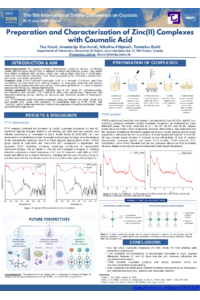
Coumalic acid (2H-pyran-2-one-5-carboxylic acid) is an oxygen-rich heterocyclic compound containing both carboxylic and lactone functional groups, making it a suitable ligand for coordination with metal ions. Zinc(II), a d¹⁰ metal center with a preference for oxygen donor atoms, readily forms stable complexes with carboxylate-containing ligands. Studying Zn(II)–coumalic acid interactions provides insight into coordination behavior, ligand binding modes, and structural diversity. This study investigates the formation of zinc(II) complexes using nitrate and acetate precursors.
Methods:
Zinc(II) complexes were synthesized by reacting aqueous solutions of zinc(II) nitrate hexahydrate and zinc(II) acetate dihydrate with coumalic acid under ambient conditions. The resulting solids were isolated and characterized by FTIR, PXRD, TGA/DSC, and UV–Vis spectroscopy. These techniques were used to evaluate coordination modes, structural features, thermal stability, and solution behavior. A comparative analysis of nitrate- and acetate-derived systems was conducted.
Results:
Complex formation was confirmed in both systems, indicating effective coordination through oxygen donor atoms. Spectroscopic data suggest that coordination primarily involves the deprotonated carboxylate group, with possible participation of the lactone carbonyl oxygen. Coumalic acid may act as a mono- or bidentate ligand, enabling the formation of stable coordination motifs. The obtained solids exhibit characteristic spectroscopic features and thermal behavior consistent with coordinated zinc(II) systems.
Conclusions:
Zinc(II) forms stable complexes with coumalic acid through coordination involving oxygen donor atoms, predominantly from the carboxylate group. The results highlight the ligand’s versatility and its ability to support different coordination modes, contributing to the structural diversity of Zn(II) complexes.
Funding:
This research was funded by the European Union-NextGenerationEU Project “Advanced Interdisciplinary Approaches to Environmental Chemistry: From Materials to Sustainable Solutions for Pollution” (Grant number: 581-UNIOS-101).
Keywords
Zinc(II) complexes Coumalic acid Coordination chemistry Carboxylate ligands Spectroscopic characterization
Poster
Preparation and Characterization of Zinc(II) Complexes with Coumalic Acid_Kozić.pdf
Study of Structural Evolution and Dielectric Properties of Solid Solutions A2(Sm1-xREx)Ti2Nb3O15 (A = Sr, Ba; RE = Nd, Sm, Gd, La)
Interaction Between Phthalate Plasticizers and Calcium Oxalate: Impacts on Precipitation Behavior