Event submissions
Published
This submission belongs to the session S1. Inorganic Crystalline Materials of the event The 5th International Online Conference on Crystals
Published date
10 Jun, 2026
Academic Editor
'%3e%3cpath%20d='M12.6657%2010.9104C12.4185%2010.325%2012.0599%209.79327%2011.6097%209.34482C11.1609%208.89508%2010.6293%208.5365%2010.0442%208.28888C10.0389%208.28626%2010.0337%208.28495%2010.0285%208.28233C10.8446%207.69279%2011.3752%206.73249%2011.3752%205.64904C11.3752%203.8542%209.92103%202.39999%208.1262%202.39999C6.33136%202.39999%204.87715%203.8542%204.87715%205.64904C4.87715%206.73249%205.40774%207.69279%206.22393%208.28364C6.21869%208.28626%206.21345%208.28757%206.20821%208.29019C5.62129%208.5378%205.09463%208.89284%204.64265%209.34613C4.1929%209.79493%203.83432%2010.3266%203.58671%2010.9117C3.34345%2011.4845%203.21226%2012.0987%203.20023%2012.7209C3.19988%2012.7349%203.20233%2012.7488%203.20744%2012.7619C3.21255%2012.7749%203.22022%2012.7867%203.22998%2012.7968C3.23975%2012.8068%203.25142%2012.8147%203.26431%2012.8202C3.2772%2012.8256%203.29105%2012.8284%203.30504%2012.8284H4.09109C4.14874%2012.8284%204.19459%2012.7825%204.1959%2012.7262C4.2221%2011.7148%204.62823%2010.7676%205.34617%2010.0497C6.08899%209.30683%207.0755%208.89808%208.1262%208.89808C9.17689%208.89808%2010.1634%209.30683%2010.9062%2010.0497C11.6242%2010.7676%2012.0303%2011.7148%2012.0565%2012.7262C12.0578%2012.7838%2012.1037%2012.8284%2012.1613%2012.8284H12.9474C12.9613%2012.8284%2012.9752%2012.8256%2012.9881%2012.8202C13.001%2012.8147%2013.0126%2012.8068%2013.0224%2012.7968C13.0322%2012.7867%2013.0398%2012.7749%2013.0449%2012.7619C13.0501%2012.7488%2013.0525%2012.7349%2013.0522%2012.7209C13.0391%2012.0947%2012.9094%2011.4855%2012.6657%2010.9104ZM8.1262%207.9024C7.52486%207.9024%206.9589%207.6679%206.53312%207.24211C6.10733%206.81633%205.87283%206.25037%205.87283%205.64904C5.87283%205.0477%206.10733%204.48174%206.53312%204.05596C6.9589%203.63018%207.52486%203.39567%208.1262%203.39567C8.72753%203.39567%209.29349%203.63018%209.71927%204.05596C10.1451%204.48174%2010.3796%205.0477%2010.3796%205.64904C10.3796%206.25037%2010.1451%206.81633%209.71927%207.24211C9.29349%207.6679%208.72753%207.9024%208.1262%207.9024Z'%20fill='%235D1EE1'/%3e%3c/g%3e%3c/svg%3e) Zongyou Yin
Zongyou YinCitation
Kristijan Živković, Aleksander Učakar, Anamarija Stanković, Nives Matijaković Mlinarić, Design of Mono- and Multimetal Oxide Nanoparticles for Enhanced Antimicrobial Surface Applications, in Proceedings of The 5th International Online Conference on Crystals, 15 June–17 June 2026, MDPI: Basel, Switzerland
Share
Email
Facebook
Twitter
LinkedIn
Design of Mono- and Multimetal Oxide Nanoparticles for Enhanced Antimicrobial Surface Applications
'%3e%3cpath%20d='M12.6647%2010.9104C12.4176%2010.325%2012.0589%209.7933%2011.6088%209.34485C11.16%208.89511%2010.6283%208.53653%2010.0432%208.28891C10.038%208.28629%2010.0327%208.28498%2010.0275%208.28236C10.8437%207.69282%2011.3743%206.73252%2011.3743%205.64907C11.3743%203.85423%209.92005%202.40002%208.12522%202.40002C6.33038%202.40002%204.87618%203.85423%204.87618%205.64907C4.87618%206.73252%205.40677%207.69282%206.22296%208.28367C6.21772%208.28629%206.21248%208.2876%206.20724%208.29022C5.62031%208.53783%205.09365%208.89287%204.64167%209.34616C4.19192%209.79496%203.83334%2010.3266%203.58573%2010.9117C3.34247%2011.4846%203.21128%2012.0987%203.19925%2012.721C3.1989%2012.735%203.20135%2012.7489%203.20646%2012.7619C3.21157%2012.7749%203.21924%2012.7868%203.22901%2012.7968C3.23877%2012.8068%203.25045%2012.8148%203.26334%2012.8202C3.27623%2012.8256%203.29007%2012.8284%203.30406%2012.8284H4.09012C4.14776%2012.8284%204.19362%2012.7825%204.19493%2012.7262C4.22113%2011.7148%204.62726%2010.7676%205.34519%2010.0497C6.08802%209.30686%207.07452%208.89811%208.12522%208.89811C9.17592%208.89811%2010.1624%209.30686%2010.9052%2010.0497C11.6232%2010.7676%2012.0293%2011.7148%2012.0555%2012.7262C12.0568%2012.7839%2012.1027%2012.8284%2012.1603%2012.8284H12.9464C12.9604%2012.8284%2012.9742%2012.8256%2012.9871%2012.8202C13%2012.8148%2013.0117%2012.8068%2013.0214%2012.7968C13.0312%2012.7868%2013.0389%2012.7749%2013.044%2012.7619C13.0491%2012.7489%2013.0515%2012.735%2013.0512%2012.721C13.0381%2012.0947%2012.9084%2011.4856%2012.6647%2010.9104ZM8.12522%207.90243C7.52388%207.90243%206.95792%207.66793%206.53214%207.24215C6.10636%206.81636%205.87185%206.2504%205.87185%205.64907C5.87185%205.04773%206.10636%204.48177%206.53214%204.05599C6.95792%203.63021%207.52388%203.3957%208.12522%203.3957C8.72655%203.3957%209.29252%203.63021%209.7183%204.05599C10.1441%204.48177%2010.3786%205.04773%2010.3786%205.64907C10.3786%206.2504%2010.1441%206.81636%209.7183%207.24215C9.29252%207.66793%208.72655%207.90243%208.12522%207.90243Z'%20fill='%235D1EE1'/%3e%3c/g%3e%3c/svg%3e)
Kristijan Živković 1
Aleksander Učakar 2

Anamarija Stanković 3

Nives Matijaković Mlinarić 4
1. Faculty of Science, University of Zagreb, 10000 Zagreb, Croatia
2. Institut Jožef Stefan, 1000 Ljubljana, Slovenia
3. Department of Chemistry, Josip Juraj Strossmayer University of Osijek, Ulica cara Hadrijana 8/A, 31000 Osijek, Croatia
4. Ruđer Bošković Institute, 10000 Zagreb, Croatia
Abstract
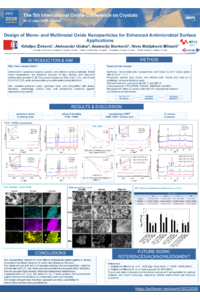
The rapid rise of antimicrobial resistance poses a critical threat to global health, accounting for more than 35,000 deaths annually across the EU, Iceland, and Norway alone. This escalating burden necessitates the development of innovative antimicrobial materials that can overcome the limitations of conventional approaches. Unlike antibiotic-releasing coatings, metal oxide nanoparticles (NPs) offer durable, long-term antimicrobial activity without inducing resistance, positioning them as a promising next-generation solution. Their high physicochemical stability, robustness, and low cytotoxicity further support their integration into biomedical and surface-coating applications. Among these, copper oxide (CuO) and zinc oxide (ZnO) nanoparticles stand out due to their strong intrinsic antimicrobial activity and biological relevance as essential trace elements [1,2].
In this work, we present a systematic investigation of mono- and multicomponent nanoparticle systems, including CuO, ZnO, Y₂O₃, and multimetallic Cu–Zn–Y oxide nanoparticles. The nanomaterials were synthesised using a controlled approach based on different anionic precursors, with tannic acid acting as a stabilising and structure-directing agent.
The antibacterial performance of the prepared nanoparticles was evaluated against Staphylococcus aureus, revealing pronounced antimicrobial activity across all systems, with clear differences linked to structural and compositional variations. The results demonstrate that nanoparticle size, morphology, and surface chemistry are key determinants of antibacterial efficiency, while multimetallic Cu–Zn–Y nanoparticles exhibit enhanced tunability and potential for synergistic effects.
Overall, this study provides new insights into the structure–activity relationships governing nanoparticle-mediated antibacterial effects, and establishes a rational framework for the design of advanced, biocompatible antimicrobial coatings. The findings highlight the potential of multimetallic nanoparticle systems as versatile platforms for next-generation biomedical and surface-engineering applications.
The authors acknowledge Croatian Science Foundation support through the UIP project BIO-METONIC.
References
1 .Matijaković Mlinarić, N. et al. , ACS Appl. Nano Mater. 7, 12550–12563 (2024).
2. Matijaković Mlinarić, N. et al. Nanomaterials 14, 570 (2024).
Keywords
CuO nanoparticles
ZnO nanoparticles
Y2O3 nanoparticles
antibacterial application
Poster
Kristijan_Zivkovic_IOCC2026.pdf
PHASE FORMATION IN THE Ag2S−Sb2S3−GeS2 SYSTEM
Investigation of detector technology alternatives in Cone beam CT—A Simulation study