Event submissions
Published
This submission belongs to the session S1. Inorganic Crystalline Materials of the event The 5th International Online Conference on Crystals
Published date
10 Jun, 2026
Academic Editor
'%3e%3cpath%20d='M12.6657%2010.9104C12.4185%2010.325%2012.0599%209.79327%2011.6097%209.34482C11.1609%208.89508%2010.6293%208.5365%2010.0442%208.28888C10.0389%208.28626%2010.0337%208.28495%2010.0285%208.28233C10.8446%207.69279%2011.3752%206.73249%2011.3752%205.64904C11.3752%203.8542%209.92103%202.39999%208.1262%202.39999C6.33136%202.39999%204.87715%203.8542%204.87715%205.64904C4.87715%206.73249%205.40774%207.69279%206.22393%208.28364C6.21869%208.28626%206.21345%208.28757%206.20821%208.29019C5.62129%208.5378%205.09463%208.89284%204.64265%209.34613C4.1929%209.79493%203.83432%2010.3266%203.58671%2010.9117C3.34345%2011.4845%203.21226%2012.0987%203.20023%2012.7209C3.19988%2012.7349%203.20233%2012.7488%203.20744%2012.7619C3.21255%2012.7749%203.22022%2012.7867%203.22998%2012.7968C3.23975%2012.8068%203.25142%2012.8147%203.26431%2012.8202C3.2772%2012.8256%203.29105%2012.8284%203.30504%2012.8284H4.09109C4.14874%2012.8284%204.19459%2012.7825%204.1959%2012.7262C4.2221%2011.7148%204.62823%2010.7676%205.34617%2010.0497C6.08899%209.30683%207.0755%208.89808%208.1262%208.89808C9.17689%208.89808%2010.1634%209.30683%2010.9062%2010.0497C11.6242%2010.7676%2012.0303%2011.7148%2012.0565%2012.7262C12.0578%2012.7838%2012.1037%2012.8284%2012.1613%2012.8284H12.9474C12.9613%2012.8284%2012.9752%2012.8256%2012.9881%2012.8202C13.001%2012.8147%2013.0126%2012.8068%2013.0224%2012.7968C13.0322%2012.7867%2013.0398%2012.7749%2013.0449%2012.7619C13.0501%2012.7488%2013.0525%2012.7349%2013.0522%2012.7209C13.0391%2012.0947%2012.9094%2011.4855%2012.6657%2010.9104ZM8.1262%207.9024C7.52486%207.9024%206.9589%207.6679%206.53312%207.24211C6.10733%206.81633%205.87283%206.25037%205.87283%205.64904C5.87283%205.0477%206.10733%204.48174%206.53312%204.05596C6.9589%203.63018%207.52486%203.39567%208.1262%203.39567C8.72753%203.39567%209.29349%203.63018%209.71927%204.05596C10.1451%204.48174%2010.3796%205.0477%2010.3796%205.64904C10.3796%206.25037%2010.1451%206.81633%209.71927%207.24211C9.29349%207.6679%208.72753%207.9024%208.1262%207.9024Z'%20fill='%235D1EE1'/%3e%3c/g%3e%3c/svg%3e) Zongyou Yin
Zongyou YinCitation
Theodoros Tryfonidis, Dionysios Linardatos, Vasileios Ntoupis, George Saatsakis, Ioannis Valais, Nektarios Kalyvas, George Fountos, Ioannis Kandarakis, Christos Michail, X-ray luminescence performance of a BGO single crystal under the influence of external temperatures: Comparison with BaF₂ , in Proceedings of The 5th International Online Conference on Crystals, 15 June–17 June 2026, MDPI: Basel, Switzerland
Share
Email
Facebook
Twitter
LinkedIn
X-ray luminescence performance of a BGO single crystal under the influence of external temperatures: Comparison with BaF2
'%3e%3cpath%20d='M12.6647%2010.9104C12.4176%2010.325%2012.0589%209.7933%2011.6088%209.34485C11.16%208.89511%2010.6283%208.53653%2010.0432%208.28891C10.038%208.28629%2010.0327%208.28498%2010.0275%208.28236C10.8437%207.69282%2011.3743%206.73252%2011.3743%205.64907C11.3743%203.85423%209.92005%202.40002%208.12522%202.40002C6.33038%202.40002%204.87618%203.85423%204.87618%205.64907C4.87618%206.73252%205.40677%207.69282%206.22296%208.28367C6.21772%208.28629%206.21248%208.2876%206.20724%208.29022C5.62031%208.53783%205.09365%208.89287%204.64167%209.34616C4.19192%209.79496%203.83334%2010.3266%203.58573%2010.9117C3.34247%2011.4846%203.21128%2012.0987%203.19925%2012.721C3.1989%2012.735%203.20135%2012.7489%203.20646%2012.7619C3.21157%2012.7749%203.21924%2012.7868%203.22901%2012.7968C3.23877%2012.8068%203.25045%2012.8148%203.26334%2012.8202C3.27623%2012.8256%203.29007%2012.8284%203.30406%2012.8284H4.09012C4.14776%2012.8284%204.19362%2012.7825%204.19493%2012.7262C4.22113%2011.7148%204.62726%2010.7676%205.34519%2010.0497C6.08802%209.30686%207.07452%208.89811%208.12522%208.89811C9.17592%208.89811%2010.1624%209.30686%2010.9052%2010.0497C11.6232%2010.7676%2012.0293%2011.7148%2012.0555%2012.7262C12.0568%2012.7839%2012.1027%2012.8284%2012.1603%2012.8284H12.9464C12.9604%2012.8284%2012.9742%2012.8256%2012.9871%2012.8202C13%2012.8148%2013.0117%2012.8068%2013.0214%2012.7968C13.0312%2012.7868%2013.0389%2012.7749%2013.044%2012.7619C13.0491%2012.7489%2013.0515%2012.735%2013.0512%2012.721C13.0381%2012.0947%2012.9084%2011.4856%2012.6647%2010.9104ZM8.12522%207.90243C7.52388%207.90243%206.95792%207.66793%206.53214%207.24215C6.10636%206.81636%205.87185%206.2504%205.87185%205.64907C5.87185%205.04773%206.10636%204.48177%206.53214%204.05599C6.95792%203.63021%207.52388%203.3957%208.12522%203.3957C8.72655%203.3957%209.29252%203.63021%209.7183%204.05599C10.1441%204.48177%2010.3786%205.04773%2010.3786%205.64907C10.3786%206.2504%2010.1441%206.81636%209.7183%207.24215C9.29252%207.66793%208.72655%207.90243%208.12522%207.90243Z'%20fill='%235D1EE1'/%3e%3c/g%3e%3c/svg%3e)
Theodoros Tryfonidis 1
Dionysios Linardatos 1
Vasileios Ntoupis 1
George Saatsakis 1

Ioannis Valais 1
Nektarios Kalyvas 1

George Fountos 1

Ioannis Kandarakis 1

Christos Michail 1
1. Department of Biomedical Engineering, Radiation Physics, Materials Technology and Biomedical Imaging Laboratory, University of West Attica, Athens, 12210, Greece
Abstract
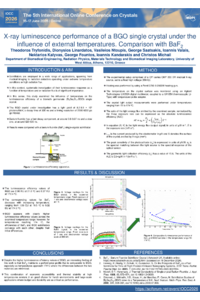
Background. Scintillators are employed in a wide range of applications, spanning from medical imaging to radiation detectors operating under extreme temperature conditions or high radiation flux. In this context, systematic investigation of their luminescence response as a function of temperature and or radiation flux is of significant importance. In this sense, this study examined the influence of temperature on the luminescence efficiency of a bismuth germanate (Bi4Ge3O12-BGO) single crystal. Results were compared with a barium fluoride (BaF2) single-crystal scintillator.
Materials and Methods. The experimental setup, comprised of a medical X-ray unit, for crystal irradiation was set to a voltage of 90 kVp. The crystal light output measurements were performed under temperatures ranging from 19 to 174 oC. The BGO crystal under investigation has a light yield of 8.2-8.9 × 10³ photons/MeV, a decay time of 300 ns and a timing resolution of 2500-6000 ps @ FWHM.
Results. The luminescence efficiency values of BGO are 2.96 EU at 21.0 oC and 0.37 EU at 172.4 oC. The corresponding values for BaF2 decrease with increasing temperature, ranging from 1.56 EU at 19.5 oC to 0.32 EU at 174.2 oC. BGO appears with clearly higher luminescence efficiency values across the examined temperature range; however, for temperatures reaching 174 οC, the efficiencies of BaF2 and BGO scintillators converge with each other, despite their initial differences.
Conclusion. Despite the higher luminescence efficiency values of BGO, an interesting finding of this work is that BaF2 maintains a performance profile that is comparable to BGO, especially as temperatures approach 174°C where the differences between the two materials are minimized. This combination of economic accessibility and thermal stability at high temperatures renders it an good choice for harsh environments and large-scale applications where budget and durability are as critical as performance.
Keywords
Single crystals
BGO
BaF2
thermal behavior
extreme environments
medical detectors
Poster
Tryfonidis_IOCC_2026.pdf
Growing single crystals of sodium tungstate by the low-gradient Czochralski method
Geometry of the Adsorption Sites in Metal Nanoparticles and Surfaces