Event submissions
Published
This submission belongs to the session S3. Organic Crystalline Materials of the event The 5th International Online Conference on Crystals
Published date
10 Jun, 2026
Academic Editor
'%3e%3cpath%20d='M12.6657%2010.9104C12.4185%2010.325%2012.0599%209.79327%2011.6097%209.34482C11.1609%208.89508%2010.6293%208.5365%2010.0442%208.28888C10.0389%208.28626%2010.0337%208.28495%2010.0285%208.28233C10.8446%207.69279%2011.3752%206.73249%2011.3752%205.64904C11.3752%203.8542%209.92103%202.39999%208.1262%202.39999C6.33136%202.39999%204.87715%203.8542%204.87715%205.64904C4.87715%206.73249%205.40774%207.69279%206.22393%208.28364C6.21869%208.28626%206.21345%208.28757%206.20821%208.29019C5.62129%208.5378%205.09463%208.89284%204.64265%209.34613C4.1929%209.79493%203.83432%2010.3266%203.58671%2010.9117C3.34345%2011.4845%203.21226%2012.0987%203.20023%2012.7209C3.19988%2012.7349%203.20233%2012.7488%203.20744%2012.7619C3.21255%2012.7749%203.22022%2012.7867%203.22998%2012.7968C3.23975%2012.8068%203.25142%2012.8147%203.26431%2012.8202C3.2772%2012.8256%203.29105%2012.8284%203.30504%2012.8284H4.09109C4.14874%2012.8284%204.19459%2012.7825%204.1959%2012.7262C4.2221%2011.7148%204.62823%2010.7676%205.34617%2010.0497C6.08899%209.30683%207.0755%208.89808%208.1262%208.89808C9.17689%208.89808%2010.1634%209.30683%2010.9062%2010.0497C11.6242%2010.7676%2012.0303%2011.7148%2012.0565%2012.7262C12.0578%2012.7838%2012.1037%2012.8284%2012.1613%2012.8284H12.9474C12.9613%2012.8284%2012.9752%2012.8256%2012.9881%2012.8202C13.001%2012.8147%2013.0126%2012.8068%2013.0224%2012.7968C13.0322%2012.7867%2013.0398%2012.7749%2013.0449%2012.7619C13.0501%2012.7488%2013.0525%2012.7349%2013.0522%2012.7209C13.0391%2012.0947%2012.9094%2011.4855%2012.6657%2010.9104ZM8.1262%207.9024C7.52486%207.9024%206.9589%207.6679%206.53312%207.24211C6.10733%206.81633%205.87283%206.25037%205.87283%205.64904C5.87283%205.0477%206.10733%204.48174%206.53312%204.05596C6.9589%203.63018%207.52486%203.39567%208.1262%203.39567C8.72753%203.39567%209.29349%203.63018%209.71927%204.05596C10.1451%204.48174%2010.3796%205.0477%2010.3796%205.64904C10.3796%206.25037%2010.1451%206.81633%209.71927%207.24211C9.29349%207.6679%208.72753%207.9024%208.1262%207.9024Z'%20fill='%235D1EE1'/%3e%3c/g%3e%3c/svg%3e) Stanislav Ferdov
Stanislav FerdovCitation
Hassan M. Alshamaa, Jesús M. Torres, Sergio Martínez Rodríguez, José A. Gavira, Preliminary Characterization of Cross-Linked Amidase Crystals, in Proceedings of The 5th International Online Conference on Crystals, 15 June–17 June 2026, MDPI: Basel, Switzerland
Share
Email
Facebook
Twitter
LinkedIn
Preliminary Characterization of Cross-Linked Amidase Crystals
'%3e%3cpath%20d='M12.6647%2010.9104C12.4176%2010.325%2012.0589%209.7933%2011.6088%209.34485C11.16%208.89511%2010.6283%208.53653%2010.0432%208.28891C10.038%208.28629%2010.0327%208.28498%2010.0275%208.28236C10.8437%207.69282%2011.3743%206.73252%2011.3743%205.64907C11.3743%203.85423%209.92005%202.40002%208.12522%202.40002C6.33038%202.40002%204.87618%203.85423%204.87618%205.64907C4.87618%206.73252%205.40677%207.69282%206.22296%208.28367C6.21772%208.28629%206.21248%208.2876%206.20724%208.29022C5.62031%208.53783%205.09365%208.89287%204.64167%209.34616C4.19192%209.79496%203.83334%2010.3266%203.58573%2010.9117C3.34247%2011.4846%203.21128%2012.0987%203.19925%2012.721C3.1989%2012.735%203.20135%2012.7489%203.20646%2012.7619C3.21157%2012.7749%203.21924%2012.7868%203.22901%2012.7968C3.23877%2012.8068%203.25045%2012.8148%203.26334%2012.8202C3.27623%2012.8256%203.29007%2012.8284%203.30406%2012.8284H4.09012C4.14776%2012.8284%204.19362%2012.7825%204.19493%2012.7262C4.22113%2011.7148%204.62726%2010.7676%205.34519%2010.0497C6.08802%209.30686%207.07452%208.89811%208.12522%208.89811C9.17592%208.89811%2010.1624%209.30686%2010.9052%2010.0497C11.6232%2010.7676%2012.0293%2011.7148%2012.0555%2012.7262C12.0568%2012.7839%2012.1027%2012.8284%2012.1603%2012.8284H12.9464C12.9604%2012.8284%2012.9742%2012.8256%2012.9871%2012.8202C13%2012.8148%2013.0117%2012.8068%2013.0214%2012.7968C13.0312%2012.7868%2013.0389%2012.7749%2013.044%2012.7619C13.0491%2012.7489%2013.0515%2012.735%2013.0512%2012.721C13.0381%2012.0947%2012.9084%2011.4856%2012.6647%2010.9104ZM8.12522%207.90243C7.52388%207.90243%206.95792%207.66793%206.53214%207.24215C6.10636%206.81636%205.87185%206.2504%205.87185%205.64907C5.87185%205.04773%206.10636%204.48177%206.53214%204.05599C6.95792%203.63021%207.52388%203.3957%208.12522%203.3957C8.72655%203.3957%209.29252%203.63021%209.7183%204.05599C10.1441%204.48177%2010.3786%205.04773%2010.3786%205.64907C10.3786%206.2504%2010.1441%206.81636%209.7183%207.24215C9.29252%207.66793%208.72655%207.90243%208.12522%207.90243Z'%20fill='%235D1EE1'/%3e%3c/g%3e%3c/svg%3e)
Hassan M. Alshamaa 1
Jesús M. Torres 2
Sergio Martínez Rodríguez 2,3

José A. Gavira 1,3
1. Crystallographic Studies Laboratory, IACT-CSIC, 18100 Armilla, Granada, Spain
2. Department of Biochemistry and Molecular Biology III and Immunology, University of Granada, 18016 Granada, Spain
3. Raw Materials, Human and Environmental Health, Associated Unit of the CSIC, IACT-CSIC, 18100 Armilla, Granada, Spain
Abstract
Cross-linked enzyme crystals (CLECs) are highly purified and stabilized biocatalysts produced through enzyme crystallization followed by chemical cross-linking, which locks the enzymes into an insoluble crystalline matrix. This self-immobilization approach exhibits high stability, controllable size, and easy reuse, turning them into particularly attractive and efficient biocatalysts for a variety of applications. Furthermore, CLECs have been explored as microporous platforms for the controlled and sustained release of protein and peptide therapeutics, as integral components of CLECs-based biosensors, and for several promising medical and biotechnological applications [2, 3]. However, their principal limitation is the strict requirement for enzyme crystallization, an expensive, time-consuming, and labor-intensive process that necessitates highly purified enzymes and carefully optimized crystallization conditions [1].
By optimizing crystal morphology and crystallization conditions, CLECs can preserve catalytic activity and selectivity similar to those of soluble enzymes in aqueous media, while also maintaining functional behavior comparable to crude enzymes in organic solvents [3]. In this work, we have purified, crystallized, and produced CLECs of a new penicillin-binding protein showing D-amidase activity from Rhizobium species (RhiDamid). After enzyme characterization in solution, its crystallization conditions were systematically optimized in order to obtain well-formed and stable crystals suitable for further processing. The resulting crystals were then successfully cross-linked with glutaraldehyde to obtain Cross-Linked Amidase Crystals (CLACs), retaining D-amidase catalytic activity after the cross-linking step. Preliminary data regarding the physicochemical and catalytic characterization of these CLACs is presented, highlighting their potential stability and applicability as reusable biocatalysts in future biotechnological developments.
Keywords
Penicillin-binding protein
D-amidase
Crystallization
Cross-Linked Enzyme Crystals.
Poster
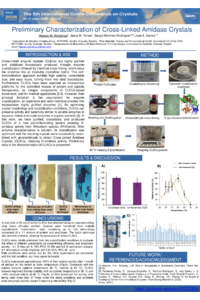
Hassan_Alshamaa_Poster_crystal2026.pdf
Comparative study of fluid inclusions in Dicumyl and Benzoyl Peroxides
Bulk Crystallization as a High-Potential Purification Strategy for C-Phycocyanin