Event submissions
Published
This submission belongs to the session S4. Hybrid and Composite Crystalline Materials of the event The 5th International Online Conference on Crystals
Published date
10 Jun, 2026
Academic Editor
'%3e%3cpath%20d='M12.6657%2010.9104C12.4185%2010.325%2012.0599%209.79327%2011.6097%209.34482C11.1609%208.89508%2010.6293%208.5365%2010.0442%208.28888C10.0389%208.28626%2010.0337%208.28495%2010.0285%208.28233C10.8446%207.69279%2011.3752%206.73249%2011.3752%205.64904C11.3752%203.8542%209.92103%202.39999%208.1262%202.39999C6.33136%202.39999%204.87715%203.8542%204.87715%205.64904C4.87715%206.73249%205.40774%207.69279%206.22393%208.28364C6.21869%208.28626%206.21345%208.28757%206.20821%208.29019C5.62129%208.5378%205.09463%208.89284%204.64265%209.34613C4.1929%209.79493%203.83432%2010.3266%203.58671%2010.9117C3.34345%2011.4845%203.21226%2012.0987%203.20023%2012.7209C3.19988%2012.7349%203.20233%2012.7488%203.20744%2012.7619C3.21255%2012.7749%203.22022%2012.7867%203.22998%2012.7968C3.23975%2012.8068%203.25142%2012.8147%203.26431%2012.8202C3.2772%2012.8256%203.29105%2012.8284%203.30504%2012.8284H4.09109C4.14874%2012.8284%204.19459%2012.7825%204.1959%2012.7262C4.2221%2011.7148%204.62823%2010.7676%205.34617%2010.0497C6.08899%209.30683%207.0755%208.89808%208.1262%208.89808C9.17689%208.89808%2010.1634%209.30683%2010.9062%2010.0497C11.6242%2010.7676%2012.0303%2011.7148%2012.0565%2012.7262C12.0578%2012.7838%2012.1037%2012.8284%2012.1613%2012.8284H12.9474C12.9613%2012.8284%2012.9752%2012.8256%2012.9881%2012.8202C13.001%2012.8147%2013.0126%2012.8068%2013.0224%2012.7968C13.0322%2012.7867%2013.0398%2012.7749%2013.0449%2012.7619C13.0501%2012.7488%2013.0525%2012.7349%2013.0522%2012.7209C13.0391%2012.0947%2012.9094%2011.4855%2012.6657%2010.9104ZM8.1262%207.9024C7.52486%207.9024%206.9589%207.6679%206.53312%207.24211C6.10733%206.81633%205.87283%206.25037%205.87283%205.64904C5.87283%205.0477%206.10733%204.48174%206.53312%204.05596C6.9589%203.63018%207.52486%203.39567%208.1262%203.39567C8.72753%203.39567%209.29349%203.63018%209.71927%204.05596C10.1451%204.48174%2010.3796%205.0477%2010.3796%205.64904C10.3796%206.25037%2010.1451%206.81633%209.71927%207.24211C9.29349%207.6679%208.72753%207.9024%208.1262%207.9024Z'%20fill='%235D1EE1'/%3e%3c/g%3e%3c/svg%3e) Ferdinando Costantino
Ferdinando CostantinoCitation
Alin-Alexandru Andrei, Izabell Craciunescu, Lucian Barbu-Tudoran, George-Marian Ispas, Gavril-Ionel Giurgi, Alexandru Daniel Oprea, Mioara Zagrai, Cristian Sevcencu, Influence of Inorganic Fillers on the Mechanical Properties of Polypyrrole Composite Thin Films, in Proceedings of The 5th International Online Conference on Crystals, 15 June–17 June 2026, MDPI: Basel, Switzerland
Share
Email
Facebook
Twitter
LinkedIn
Influence of Inorganic Fillers on the Mechanical Properties of Polypyrrole Composite Thin Films
'%3e%3cpath%20d='M12.6647%2010.9104C12.4176%2010.325%2012.0589%209.7933%2011.6088%209.34485C11.16%208.89511%2010.6283%208.53653%2010.0432%208.28891C10.038%208.28629%2010.0327%208.28498%2010.0275%208.28236C10.8437%207.69282%2011.3743%206.73252%2011.3743%205.64907C11.3743%203.85423%209.92005%202.40002%208.12522%202.40002C6.33038%202.40002%204.87618%203.85423%204.87618%205.64907C4.87618%206.73252%205.40677%207.69282%206.22296%208.28367C6.21772%208.28629%206.21248%208.2876%206.20724%208.29022C5.62031%208.53783%205.09365%208.89287%204.64167%209.34616C4.19192%209.79496%203.83334%2010.3266%203.58573%2010.9117C3.34247%2011.4846%203.21128%2012.0987%203.19925%2012.721C3.1989%2012.735%203.20135%2012.7489%203.20646%2012.7619C3.21157%2012.7749%203.21924%2012.7868%203.22901%2012.7968C3.23877%2012.8068%203.25045%2012.8148%203.26334%2012.8202C3.27623%2012.8256%203.29007%2012.8284%203.30406%2012.8284H4.09012C4.14776%2012.8284%204.19362%2012.7825%204.19493%2012.7262C4.22113%2011.7148%204.62726%2010.7676%205.34519%2010.0497C6.08802%209.30686%207.07452%208.89811%208.12522%208.89811C9.17592%208.89811%2010.1624%209.30686%2010.9052%2010.0497C11.6232%2010.7676%2012.0293%2011.7148%2012.0555%2012.7262C12.0568%2012.7839%2012.1027%2012.8284%2012.1603%2012.8284H12.9464C12.9604%2012.8284%2012.9742%2012.8256%2012.9871%2012.8202C13%2012.8148%2013.0117%2012.8068%2013.0214%2012.7968C13.0312%2012.7868%2013.0389%2012.7749%2013.044%2012.7619C13.0491%2012.7489%2013.0515%2012.735%2013.0512%2012.721C13.0381%2012.0947%2012.9084%2011.4856%2012.6647%2010.9104ZM8.12522%207.90243C7.52388%207.90243%206.95792%207.66793%206.53214%207.24215C6.10636%206.81636%205.87185%206.2504%205.87185%205.64907C5.87185%205.04773%206.10636%204.48177%206.53214%204.05599C6.95792%203.63021%207.52388%203.3957%208.12522%203.3957C8.72655%203.3957%209.29252%203.63021%209.7183%204.05599C10.1441%204.48177%2010.3786%205.04773%2010.3786%205.64907C10.3786%206.2504%2010.1441%206.81636%209.7183%207.24215C9.29252%207.66793%208.72655%207.90243%208.12522%207.90243Z'%20fill='%235D1EE1'/%3e%3c/g%3e%3c/svg%3e)
Alin-Alexandru Andrei 1,2

Izabell Craciunescu 1

Lucian Barbu-Tudoran 1
George-Marian Ispas 1
Gavril-Ionel Giurgi 1
Alexandru Daniel Oprea 1

Mioara Zagrai 1
Cristian Sevcencu 1,2
1. National Institute for Research and Development of Isotopic and Molecular Technologies (INCDTIM), 400293 Cluj-Napoca, Romania
2. Doctoral School in Integrative Biology, Faculty of Biology and Geology, Babes-Bolyai University, Cluj-Napoca, Romania
Abstract
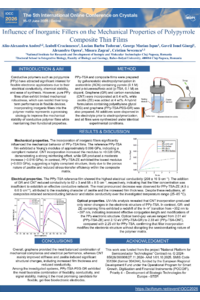
Conductive polymers such as polypyrrole (PPy) have attracted significant interest for flexible electronic applications due to their electrical conductivity, chemical stability, and ease of synthesis. However, pure PPy films often exhibit limited mechanical robustness, which can restrict their long-term performance in flexible devices. Incorporating inorganic fillers into the polymer matrix represents a promising strategy to improve the mechanical stability of conductive polymer films while maintaining their functional properties.
In this work, composite thin films based on p-toluenesulfonic acid-doped polypyrrole (PPy-TSA) incorporating inorganic fillers such as graphene (GR), carbon nanotubes (CNTs), and zeolite (ZE) were investigated. The composite films were obtained by electrochemical polymerization using a galvanostatic method, in which pyrrole was polymerized in the presence of the inorganic components dispersed in the electrolyte solution. The inorganic fillers were used as commercially available materials, while the PPy matrix was synthesized in situ during the electrochemical process.
The morphology of the films was analyzed by scanning electron microscopy (SEM), highlighting the dispersion of the inorganic components within the polymer matrix and their effect on the structural organization of the films. Mechanical performance was evaluated through flexibility and repeated bending tests in order to assess the structural integrity of the composite films under deformation.
The results indicate that the incorporation of inorganic fillers contributes to improved mechanical stability and resistance to structural damage during bending, suggesting a reinforcing effect within the PPy matrix. These findings highlight the potential of inorganic filler-reinforced polypyrrole films for flexible electronic applications where both electrical functionality and mechanical durability are required.
Keywords
polypyrrole
conductive polymer films
flexible electronic applications
inorganic fillers
Poster
Alin-Alexandru Andrei poster IOCC2026.pdf
Flexible Polypyrrole Composite Films with Organic and Inorganic Fillers for Electrocardiographic Sensing Applications
MOF-Based Composites for Sustainable Processes