Event submissions
Published
This submission belongs to the session S5. Materials for Energy Applications of the event The 5th International Online Conference on Crystals
Published date
10 Jun, 2026
Academic Editor
'%3e%3cpath%20d='M12.6657%2010.9104C12.4185%2010.325%2012.0599%209.79327%2011.6097%209.34482C11.1609%208.89508%2010.6293%208.5365%2010.0442%208.28888C10.0389%208.28626%2010.0337%208.28495%2010.0285%208.28233C10.8446%207.69279%2011.3752%206.73249%2011.3752%205.64904C11.3752%203.8542%209.92103%202.39999%208.1262%202.39999C6.33136%202.39999%204.87715%203.8542%204.87715%205.64904C4.87715%206.73249%205.40774%207.69279%206.22393%208.28364C6.21869%208.28626%206.21345%208.28757%206.20821%208.29019C5.62129%208.5378%205.09463%208.89284%204.64265%209.34613C4.1929%209.79493%203.83432%2010.3266%203.58671%2010.9117C3.34345%2011.4845%203.21226%2012.0987%203.20023%2012.7209C3.19988%2012.7349%203.20233%2012.7488%203.20744%2012.7619C3.21255%2012.7749%203.22022%2012.7867%203.22998%2012.7968C3.23975%2012.8068%203.25142%2012.8147%203.26431%2012.8202C3.2772%2012.8256%203.29105%2012.8284%203.30504%2012.8284H4.09109C4.14874%2012.8284%204.19459%2012.7825%204.1959%2012.7262C4.2221%2011.7148%204.62823%2010.7676%205.34617%2010.0497C6.08899%209.30683%207.0755%208.89808%208.1262%208.89808C9.17689%208.89808%2010.1634%209.30683%2010.9062%2010.0497C11.6242%2010.7676%2012.0303%2011.7148%2012.0565%2012.7262C12.0578%2012.7838%2012.1037%2012.8284%2012.1613%2012.8284H12.9474C12.9613%2012.8284%2012.9752%2012.8256%2012.9881%2012.8202C13.001%2012.8147%2013.0126%2012.8068%2013.0224%2012.7968C13.0322%2012.7867%2013.0398%2012.7749%2013.0449%2012.7619C13.0501%2012.7488%2013.0525%2012.7349%2013.0522%2012.7209C13.0391%2012.0947%2012.9094%2011.4855%2012.6657%2010.9104ZM8.1262%207.9024C7.52486%207.9024%206.9589%207.6679%206.53312%207.24211C6.10733%206.81633%205.87283%206.25037%205.87283%205.64904C5.87283%205.0477%206.10733%204.48174%206.53312%204.05596C6.9589%203.63018%207.52486%203.39567%208.1262%203.39567C8.72753%203.39567%209.29349%203.63018%209.71927%204.05596C10.1451%204.48174%2010.3796%205.0477%2010.3796%205.64904C10.3796%206.25037%2010.1451%206.81633%209.71927%207.24211C9.29349%207.6679%208.72753%207.9024%208.1262%207.9024Z'%20fill='%235D1EE1'/%3e%3c/g%3e%3c/svg%3e) Alessandra Toncelli
Alessandra ToncelliCitation
Ivan Yakovkin, Nataliia Petrova, Plasmonic Poynting vector vortices for uniform coupling to photocatalytic coatings, in Proceedings of The 5th International Online Conference on Crystals, 15 June–17 June 2026, MDPI: Basel, Switzerland
Share
Email
Facebook
Twitter
LinkedIn
Plasmonic Poynting vector vortices for uniform coupling to photocatalytic coatings
'%3e%3cpath%20d='M12.6647%2010.9104C12.4176%2010.325%2012.0589%209.7933%2011.6088%209.34485C11.16%208.89511%2010.6283%208.53653%2010.0432%208.28891C10.038%208.28629%2010.0327%208.28498%2010.0275%208.28236C10.8437%207.69282%2011.3743%206.73252%2011.3743%205.64907C11.3743%203.85423%209.92005%202.40002%208.12522%202.40002C6.33038%202.40002%204.87618%203.85423%204.87618%205.64907C4.87618%206.73252%205.40677%207.69282%206.22296%208.28367C6.21772%208.28629%206.21248%208.2876%206.20724%208.29022C5.62031%208.53783%205.09365%208.89287%204.64167%209.34616C4.19192%209.79496%203.83334%2010.3266%203.58573%2010.9117C3.34247%2011.4846%203.21128%2012.0987%203.19925%2012.721C3.1989%2012.735%203.20135%2012.7489%203.20646%2012.7619C3.21157%2012.7749%203.21924%2012.7868%203.22901%2012.7968C3.23877%2012.8068%203.25045%2012.8148%203.26334%2012.8202C3.27623%2012.8256%203.29007%2012.8284%203.30406%2012.8284H4.09012C4.14776%2012.8284%204.19362%2012.7825%204.19493%2012.7262C4.22113%2011.7148%204.62726%2010.7676%205.34519%2010.0497C6.08802%209.30686%207.07452%208.89811%208.12522%208.89811C9.17592%208.89811%2010.1624%209.30686%2010.9052%2010.0497C11.6232%2010.7676%2012.0293%2011.7148%2012.0555%2012.7262C12.0568%2012.7839%2012.1027%2012.8284%2012.1603%2012.8284H12.9464C12.9604%2012.8284%2012.9742%2012.8256%2012.9871%2012.8202C13%2012.8148%2013.0117%2012.8068%2013.0214%2012.7968C13.0312%2012.7868%2013.0389%2012.7749%2013.044%2012.7619C13.0491%2012.7489%2013.0515%2012.735%2013.0512%2012.721C13.0381%2012.0947%2012.9084%2011.4856%2012.6647%2010.9104ZM8.12522%207.90243C7.52388%207.90243%206.95792%207.66793%206.53214%207.24215C6.10636%206.81636%205.87185%206.2504%205.87185%205.64907C5.87185%205.04773%206.10636%204.48177%206.53214%204.05599C6.95792%203.63021%207.52388%203.3957%208.12522%203.3957C8.72655%203.3957%209.29252%203.63021%209.7183%204.05599C10.1441%204.48177%2010.3786%205.04773%2010.3786%205.64907C10.3786%206.2504%2010.1441%206.81636%209.7183%207.24215C9.29252%207.66793%208.72655%207.90243%208.12522%207.90243Z'%20fill='%235D1EE1'/%3e%3c/g%3e%3c/svg%3e)
Ivan Yakovkin 1
Nataliia Petrova 2
1. Department of Theoretical Physics, Institute of Physics, National Academy of Sciences of Ukraine, Kyiv, 03028, Ukraine
2. Department of Adsorption Phenomena, Institute of Physics, National Academy of Sciences of Ukraine, Kyiv, 03028, Ukraine
Abstract
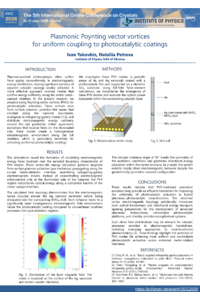
Plasmon-assisted photocatalysis often suffers from spatial nonuniformity in electromagnetic energy distribution, leaving significant portions of adjacent catalytic coatings weakly activated. A more effective approach involves modes that confine energy uniformly along the entire metal–catalyst interface. In the present research, we propose using Poynting vector vortices (PVVs) for photocatalytic activation. These vortices arise from surface plasmon polariton-like waves that circulate along the nanorod boundaries, analogous to whispering-gallery modes [1,2], and distribute electromagnetic energy uniformly around the rod perimeter. Unlike asymmetric excitations that localize fields on the illuminated side, these modes create a homogeneous electromagnetic environment along the full interface, which is particularly beneficial for activating conformal photocatalytic coatings.
We investigate these PVV modes in periodic arrays of Au and Ag nanorods coated with a photocatalytic film and supported on a dielectric SiO2 substrate. Using full-field finite-element simulations, we characterize the emergence of these PVV modes and evaluate the optical power dissipated within the surrounding catalytic layer. The circulating energy flow establishes a chiral electromagnetic topology that introduces local optical handedness even in geometrically symmetric structures. Such chiral field distributions may be relevant for catalytic processes sensitive to electromagnetic handedness, including emerging approaches to enantioselective photochemistry [3]. These findings highlight the potential of PVV modes for achieving more uniform and controllable photocatalytic activation across extended metal–catalyst interfaces.
[1] Cole, R. M., et al. "Easily coupled whispering gallery plasmons in dielectric nanospheres embedded in gold films." Physical review letters 97.13 (2006): 137401.
[2] Chen, Yongpeng, et al. "Recent progress on optoplasmonic whispering‐gallery‐mode microcavities." Advanced Optical Materials 9.12 (2021): 2100143.
[3] Goerlitzer, Eric Sidney Aaron, et al. "Molecular-induced chirality transfer to plasmonic lattice modes." ACS photonics 10.6 (2023): 1821-1831.
Keywords
Poynting vector vortices
plasmonics
photocatalysis
Poster
YP_IOCC2026.pdf
Electrolessly Deposited Transition Metal Phosphide Catalysts for Hydrogen Generation from Hydrolysis of Sodium Borohydride
Schiff Base Metal Complexes as Efficient Catalysts for Energy-Related Applications