Event submissions
Published
This submission belongs to the session S5. Materials for Energy Applications of the event The 5th International Online Conference on Crystals
Published date
10 Jun, 2026
Academic Editor
'%3e%3cpath%20d='M12.6657%2010.9104C12.4185%2010.325%2012.0599%209.79327%2011.6097%209.34482C11.1609%208.89508%2010.6293%208.5365%2010.0442%208.28888C10.0389%208.28626%2010.0337%208.28495%2010.0285%208.28233C10.8446%207.69279%2011.3752%206.73249%2011.3752%205.64904C11.3752%203.8542%209.92103%202.39999%208.1262%202.39999C6.33136%202.39999%204.87715%203.8542%204.87715%205.64904C4.87715%206.73249%205.40774%207.69279%206.22393%208.28364C6.21869%208.28626%206.21345%208.28757%206.20821%208.29019C5.62129%208.5378%205.09463%208.89284%204.64265%209.34613C4.1929%209.79493%203.83432%2010.3266%203.58671%2010.9117C3.34345%2011.4845%203.21226%2012.0987%203.20023%2012.7209C3.19988%2012.7349%203.20233%2012.7488%203.20744%2012.7619C3.21255%2012.7749%203.22022%2012.7867%203.22998%2012.7968C3.23975%2012.8068%203.25142%2012.8147%203.26431%2012.8202C3.2772%2012.8256%203.29105%2012.8284%203.30504%2012.8284H4.09109C4.14874%2012.8284%204.19459%2012.7825%204.1959%2012.7262C4.2221%2011.7148%204.62823%2010.7676%205.34617%2010.0497C6.08899%209.30683%207.0755%208.89808%208.1262%208.89808C9.17689%208.89808%2010.1634%209.30683%2010.9062%2010.0497C11.6242%2010.7676%2012.0303%2011.7148%2012.0565%2012.7262C12.0578%2012.7838%2012.1037%2012.8284%2012.1613%2012.8284H12.9474C12.9613%2012.8284%2012.9752%2012.8256%2012.9881%2012.8202C13.001%2012.8147%2013.0126%2012.8068%2013.0224%2012.7968C13.0322%2012.7867%2013.0398%2012.7749%2013.0449%2012.7619C13.0501%2012.7488%2013.0525%2012.7349%2013.0522%2012.7209C13.0391%2012.0947%2012.9094%2011.4855%2012.6657%2010.9104ZM8.1262%207.9024C7.52486%207.9024%206.9589%207.6679%206.53312%207.24211C6.10733%206.81633%205.87283%206.25037%205.87283%205.64904C5.87283%205.0477%206.10733%204.48174%206.53312%204.05596C6.9589%203.63018%207.52486%203.39567%208.1262%203.39567C8.72753%203.39567%209.29349%203.63018%209.71927%204.05596C10.1451%204.48174%2010.3796%205.0477%2010.3796%205.64904C10.3796%206.25037%2010.1451%206.81633%209.71927%207.24211C9.29349%207.6679%208.72753%207.9024%208.1262%207.9024Z'%20fill='%235D1EE1'/%3e%3c/g%3e%3c/svg%3e) Alessandra Toncelli
Alessandra ToncelliCitation
Ila Gabriele Diniz Dias de Azevedo, Camila Pacelly Brandão de Araujo, Carlson Pereira de Souza, Christian Turquat, Madjid Arab, André Luis Lopes Moriyama, NaNbO₃ synthesis using combined EDTA/Citrate complexation, in Proceedings of The 5th International Online Conference on Crystals, 15 June–17 June 2026, MDPI: Basel, Switzerland
Share
Email
Facebook
Twitter
LinkedIn
NaNbO3 synthesis using combined EDTA/Citrate complexation
'%3e%3cpath%20d='M12.6647%2010.9104C12.4176%2010.325%2012.0589%209.7933%2011.6088%209.34485C11.16%208.89511%2010.6283%208.53653%2010.0432%208.28891C10.038%208.28629%2010.0327%208.28498%2010.0275%208.28236C10.8437%207.69282%2011.3743%206.73252%2011.3743%205.64907C11.3743%203.85423%209.92005%202.40002%208.12522%202.40002C6.33038%202.40002%204.87618%203.85423%204.87618%205.64907C4.87618%206.73252%205.40677%207.69282%206.22296%208.28367C6.21772%208.28629%206.21248%208.2876%206.20724%208.29022C5.62031%208.53783%205.09365%208.89287%204.64167%209.34616C4.19192%209.79496%203.83334%2010.3266%203.58573%2010.9117C3.34247%2011.4846%203.21128%2012.0987%203.19925%2012.721C3.1989%2012.735%203.20135%2012.7489%203.20646%2012.7619C3.21157%2012.7749%203.21924%2012.7868%203.22901%2012.7968C3.23877%2012.8068%203.25045%2012.8148%203.26334%2012.8202C3.27623%2012.8256%203.29007%2012.8284%203.30406%2012.8284H4.09012C4.14776%2012.8284%204.19362%2012.7825%204.19493%2012.7262C4.22113%2011.7148%204.62726%2010.7676%205.34519%2010.0497C6.08802%209.30686%207.07452%208.89811%208.12522%208.89811C9.17592%208.89811%2010.1624%209.30686%2010.9052%2010.0497C11.6232%2010.7676%2012.0293%2011.7148%2012.0555%2012.7262C12.0568%2012.7839%2012.1027%2012.8284%2012.1603%2012.8284H12.9464C12.9604%2012.8284%2012.9742%2012.8256%2012.9871%2012.8202C13%2012.8148%2013.0117%2012.8068%2013.0214%2012.7968C13.0312%2012.7868%2013.0389%2012.7749%2013.044%2012.7619C13.0491%2012.7489%2013.0515%2012.735%2013.0512%2012.721C13.0381%2012.0947%2012.9084%2011.4856%2012.6647%2010.9104ZM8.12522%207.90243C7.52388%207.90243%206.95792%207.66793%206.53214%207.24215C6.10636%206.81636%205.87185%206.2504%205.87185%205.64907C5.87185%205.04773%206.10636%204.48177%206.53214%204.05599C6.95792%203.63021%207.52388%203.3957%208.12522%203.3957C8.72655%203.3957%209.29252%203.63021%209.7183%204.05599C10.1441%204.48177%2010.3786%205.04773%2010.3786%205.64907C10.3786%206.2504%2010.1441%206.81636%209.7183%207.24215C9.29252%207.66793%208.72655%207.90243%208.12522%207.90243Z'%20fill='%235D1EE1'/%3e%3c/g%3e%3c/svg%3e)
Ila Gabriele Diniz Dias de Azevedo 1,2
Camila Pacelly Brandão de Araujo 1,3
Carlson Pereira de Souza 1,4
Christian Turquat 2

Madjid Arab 2
André Luis Lopes Moriyama 1,4
1. Graduate Program in Chemical Engineering, Technology Center, Federal University of Rio Grande do Norte, Campus Universitário, Lagoa Nova, 59078-970, Natal, Rio Grande do Norte, Brazil
2. Institute of Materials, Microelectronics and Nanosciences of Provence, Nano-Structure, Reactivity & Environment Team, University of Toulon, Bât. R - Campus La Garde, Av. de l'Université, 83130, La Garde, France
3. School of Science and Technology, Anel Viário Contorno do Campus s/n - Capim Macio, 59078-970, Natal, Natal, Rio Grande do Norte, Brazil
4. Department of Chemical Engineering, Technology Center, Federal University of Rio Grande do Norte, Campus Universitário, Lagoa Nova, 59078-970, Natal, Rio Grande do Norte, Brazil
Abstract
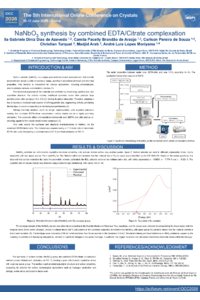
The synthesis methodologies and reaction parameters directly affect the structure and morphology of materials such as perovskite-type compounds. In this work, sodium niobate (NaNbO3) was produced using the combined EDTA/citrate complexation method, with ratios of 1:1:3 metal ions (sodium and niobium): EDTA: citric acid, and pre-treatment at 230 °C and temperature calcination at 700 °C. The sample was analyzed using XRD with Rietveld refinement and UV-Vis ERD. The study revealed that the material has an orthorhombic crystal structure and P21ma space group identified by CIF 9014103. Based on the atomic positions obtained from Rietveld refinement, it was observed that each NaNbO3 sample maintained a basic perovskite network, particularly the BO₆ polyedra centered on the niobium cation site, with lattice parameters of a = 5.565Å, b = 7.774 Å and c = 5.521 Å. The crystallite size of sodium niobate was obtained using a Scherrer-type relationship, with a value of 169.91 nm. But the synthesis method promoted significant distortions within the NbO6 coordination polyhedra. The bandgap value obtained was 2.69 eV, which is lower than those reported in the literature (~3.4 eV). These variations can be attributed to changes in the crystalline structure and particle morphology, which may undergo phase transitions that affect their electronic properties and, consequently, their bandgap. Therefore, the synthesis method used is effective in producing NaNbO₃ with tunable properties, expanding its potential for technological applications such as hydrogen production and storage.
Keywords
sodium niobate
EDTA/Citrate
bandgap.
Poster
crystals - template - Ila Gabriele Azevedo.pdf
Magnetic Doping-Induced Half-Metallicity and Large Anomalous Hall Effect in Half-Heusler Alloy HfPtSi
Solubility of Metals in Semiconductors: Insights from Iron Silicide System