Event submissions
Published
This submission belongs to the session S7. Crystalline Metals and Alloys of the event The 5th International Online Conference on Crystals
Published date
10 Jun, 2026
Academic Editor
'%3e%3cpath%20d='M12.6657%2010.9104C12.4185%2010.325%2012.0599%209.79327%2011.6097%209.34482C11.1609%208.89508%2010.6293%208.5365%2010.0442%208.28888C10.0389%208.28626%2010.0337%208.28495%2010.0285%208.28233C10.8446%207.69279%2011.3752%206.73249%2011.3752%205.64904C11.3752%203.8542%209.92103%202.39999%208.1262%202.39999C6.33136%202.39999%204.87715%203.8542%204.87715%205.64904C4.87715%206.73249%205.40774%207.69279%206.22393%208.28364C6.21869%208.28626%206.21345%208.28757%206.20821%208.29019C5.62129%208.5378%205.09463%208.89284%204.64265%209.34613C4.1929%209.79493%203.83432%2010.3266%203.58671%2010.9117C3.34345%2011.4845%203.21226%2012.0987%203.20023%2012.7209C3.19988%2012.7349%203.20233%2012.7488%203.20744%2012.7619C3.21255%2012.7749%203.22022%2012.7867%203.22998%2012.7968C3.23975%2012.8068%203.25142%2012.8147%203.26431%2012.8202C3.2772%2012.8256%203.29105%2012.8284%203.30504%2012.8284H4.09109C4.14874%2012.8284%204.19459%2012.7825%204.1959%2012.7262C4.2221%2011.7148%204.62823%2010.7676%205.34617%2010.0497C6.08899%209.30683%207.0755%208.89808%208.1262%208.89808C9.17689%208.89808%2010.1634%209.30683%2010.9062%2010.0497C11.6242%2010.7676%2012.0303%2011.7148%2012.0565%2012.7262C12.0578%2012.7838%2012.1037%2012.8284%2012.1613%2012.8284H12.9474C12.9613%2012.8284%2012.9752%2012.8256%2012.9881%2012.8202C13.001%2012.8147%2013.0126%2012.8068%2013.0224%2012.7968C13.0322%2012.7867%2013.0398%2012.7749%2013.0449%2012.7619C13.0501%2012.7488%2013.0525%2012.7349%2013.0522%2012.7209C13.0391%2012.0947%2012.9094%2011.4855%2012.6657%2010.9104ZM8.1262%207.9024C7.52486%207.9024%206.9589%207.6679%206.53312%207.24211C6.10733%206.81633%205.87283%206.25037%205.87283%205.64904C5.87283%205.0477%206.10733%204.48174%206.53312%204.05596C6.9589%203.63018%207.52486%203.39567%208.1262%203.39567C8.72753%203.39567%209.29349%203.63018%209.71927%204.05596C10.1451%204.48174%2010.3796%205.0477%2010.3796%205.64904C10.3796%206.25037%2010.1451%206.81633%209.71927%207.24211C9.29349%207.6679%208.72753%207.9024%208.1262%207.9024Z'%20fill='%235D1EE1'/%3e%3c/g%3e%3c/svg%3e) Shouxun Ji
Shouxun JiCitation
Mane Sahakyan, Optical properties of non-centrosymmetric Th-based superconductors: a density functional theory study, in Proceedings of The 5th International Online Conference on Crystals, 15 June–17 June 2026, MDPI: Basel, Switzerland
Share
Email
Facebook
Twitter
LinkedIn
Optical properties of non-centrosymmetric Th-based superconductors: a density functional theory study
'%3e%3cpath%20d='M12.6647%2010.9104C12.4176%2010.325%2012.0589%209.7933%2011.6088%209.34485C11.16%208.89511%2010.6283%208.53653%2010.0432%208.28891C10.038%208.28629%2010.0327%208.28498%2010.0275%208.28236C10.8437%207.69282%2011.3743%206.73252%2011.3743%205.64907C11.3743%203.85423%209.92005%202.40002%208.12522%202.40002C6.33038%202.40002%204.87618%203.85423%204.87618%205.64907C4.87618%206.73252%205.40677%207.69282%206.22296%208.28367C6.21772%208.28629%206.21248%208.2876%206.20724%208.29022C5.62031%208.53783%205.09365%208.89287%204.64167%209.34616C4.19192%209.79496%203.83334%2010.3266%203.58573%2010.9117C3.34247%2011.4846%203.21128%2012.0987%203.19925%2012.721C3.1989%2012.735%203.20135%2012.7489%203.20646%2012.7619C3.21157%2012.7749%203.21924%2012.7868%203.22901%2012.7968C3.23877%2012.8068%203.25045%2012.8148%203.26334%2012.8202C3.27623%2012.8256%203.29007%2012.8284%203.30406%2012.8284H4.09012C4.14776%2012.8284%204.19362%2012.7825%204.19493%2012.7262C4.22113%2011.7148%204.62726%2010.7676%205.34519%2010.0497C6.08802%209.30686%207.07452%208.89811%208.12522%208.89811C9.17592%208.89811%2010.1624%209.30686%2010.9052%2010.0497C11.6232%2010.7676%2012.0293%2011.7148%2012.0555%2012.7262C12.0568%2012.7839%2012.1027%2012.8284%2012.1603%2012.8284H12.9464C12.9604%2012.8284%2012.9742%2012.8256%2012.9871%2012.8202C13%2012.8148%2013.0117%2012.8068%2013.0214%2012.7968C13.0312%2012.7868%2013.0389%2012.7749%2013.044%2012.7619C13.0491%2012.7489%2013.0515%2012.735%2013.0512%2012.721C13.0381%2012.0947%2012.9084%2011.4856%2012.6647%2010.9104ZM8.12522%207.90243C7.52388%207.90243%206.95792%207.66793%206.53214%207.24215C6.10636%206.81636%205.87185%206.2504%205.87185%205.64907C5.87185%205.04773%206.10636%204.48177%206.53214%204.05599C6.95792%203.63021%207.52388%203.3957%208.12522%203.3957C8.72655%203.3957%209.29252%203.63021%209.7183%204.05599C10.1441%204.48177%2010.3786%205.04773%2010.3786%205.64907C10.3786%206.2504%2010.1441%206.81636%209.7183%207.24215C9.29252%207.66793%208.72655%207.90243%208.12522%207.90243Z'%20fill='%235D1EE1'/%3e%3c/g%3e%3c/svg%3e)
Mane Sahakyan 1
1. Institute of Low Temperature and Structure Research, Polish Academy of Sciences, Wrocław, 50-422, Poland
Abstract
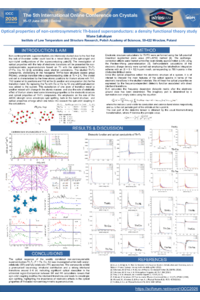
Non-centrosymmetric superconductors are the subject of intensive study because the lack of an inversion center can lead to mixed spin-singlet and spin-triplet pairing states[1]. Here, we investigate the optical properties with the help of electronic transitions for non-centrosymmetric superconductors based on Th with the stoichiometry Th7T3 (T=Fe, Co, Ni) [3-5], which exhibit weak electron correlations. The full potential linear augmented plane wave (FP-LAPW) method was employed, as well as scalar and fully relativistic treatments. The Th7T3 compounds crystallize in the hexagonal Th7Fe3-type structure (space group P63mc) and undergo a superconducting transition at Tc≈2TK. The crystal unit cell contains three inequivalent thorium positions (Th1, Th2 at 6c, Th3 at 2b) and one transition metal position (6c). By replacing the Fe with Co or Co with Ni, one additional electron is added to the system. This substitution of one transition metal atom for another, along with the change in atomic masses and the role of the relativistic effect of the thorium atoms, leads to interesting properties in the electronic and optical structures of the Th7T3 compounds. We emphasize the role of the ASOC strength since anisotropic spin splitting, both in the band structure and optical properties, emerges when one takes into account the spin–orbit coupling in the calculations. By providing the frequency-independent dielectric function calculations at 2, 10, and 50 K temperatures, we assume that transitions between Th-6d and T-d valence electrons are mainly responsible for the superconducting properties.
[1]Bauer, E. & Sigrist, M. Non-Centrosymmetric Superconductors: Springer-Verlag Berlin Heidelberg 847 (2012).
[2-3] Sahakyan, M. & Tran, V. H. Journal of Physics: Cond Mat 28, 205701 (2016), Phil. Mag. 42, 957-966 (2017).
[4] Tran, V. H. & Sahakyan, M. Scientific Reports 7, 15769 (2017).
[5] R Idczak, M Sahakyan, VH Tran Journal of Physics: Condensed Matter 30 (47), 475802 (2018).
Keywords
spin-orbit coupling
optical properties
superconduting materials
density functional theory
Poster
IOCC-2026-M-Sahakyan-poster.pdf
Mechanistic Role of Shear Rate on Transport-Controlled Crystal Growth in Antisolvent Crystallization
Effect of heterogeneous interfaces on the mechanical characteristic and deformation behavior of metal Bilayers