Event submissions
Published
This submission belongs to the session S1. Technology Enhanced Education of the event The 1st International Online Conference on Education Sciences
Published date
10 Jun, 2026
Academic Editor
'%3e%3cpath%20d='M12.6657%2010.9104C12.4185%2010.325%2012.0599%209.79327%2011.6097%209.34482C11.1609%208.89508%2010.6293%208.5365%2010.0442%208.28888C10.0389%208.28626%2010.0337%208.28495%2010.0285%208.28233C10.8446%207.69279%2011.3752%206.73249%2011.3752%205.64904C11.3752%203.8542%209.92103%202.39999%208.1262%202.39999C6.33136%202.39999%204.87715%203.8542%204.87715%205.64904C4.87715%206.73249%205.40774%207.69279%206.22393%208.28364C6.21869%208.28626%206.21345%208.28757%206.20821%208.29019C5.62129%208.5378%205.09463%208.89284%204.64265%209.34613C4.1929%209.79493%203.83432%2010.3266%203.58671%2010.9117C3.34345%2011.4845%203.21226%2012.0987%203.20023%2012.7209C3.19988%2012.7349%203.20233%2012.7488%203.20744%2012.7619C3.21255%2012.7749%203.22022%2012.7867%203.22998%2012.7968C3.23975%2012.8068%203.25142%2012.8147%203.26431%2012.8202C3.2772%2012.8256%203.29105%2012.8284%203.30504%2012.8284H4.09109C4.14874%2012.8284%204.19459%2012.7825%204.1959%2012.7262C4.2221%2011.7148%204.62823%2010.7676%205.34617%2010.0497C6.08899%209.30683%207.0755%208.89808%208.1262%208.89808C9.17689%208.89808%2010.1634%209.30683%2010.9062%2010.0497C11.6242%2010.7676%2012.0303%2011.7148%2012.0565%2012.7262C12.0578%2012.7838%2012.1037%2012.8284%2012.1613%2012.8284H12.9474C12.9613%2012.8284%2012.9752%2012.8256%2012.9881%2012.8202C13.001%2012.8147%2013.0126%2012.8068%2013.0224%2012.7968C13.0322%2012.7867%2013.0398%2012.7749%2013.0449%2012.7619C13.0501%2012.7488%2013.0525%2012.7349%2013.0522%2012.7209C13.0391%2012.0947%2012.9094%2011.4855%2012.6657%2010.9104ZM8.1262%207.9024C7.52486%207.9024%206.9589%207.6679%206.53312%207.24211C6.10733%206.81633%205.87283%206.25037%205.87283%205.64904C5.87283%205.0477%206.10733%204.48174%206.53312%204.05596C6.9589%203.63018%207.52486%203.39567%208.1262%203.39567C8.72753%203.39567%209.29349%203.63018%209.71927%204.05596C10.1451%204.48174%2010.3796%205.0477%2010.3796%205.64904C10.3796%206.25037%2010.1451%206.81633%209.71927%207.24211C9.29349%207.6679%208.72753%207.9024%208.1262%207.9024Z'%20fill='%235D1EE1'/%3e%3c/g%3e%3c/svg%3e) Mike Joy
Mike JoyCitation
Mike Borowczak, Andrea C Borowczak, Trust but Verify: AI Policy Clarity Across the STEM Pipeline — Engineering Undergraduates and K-12 Educators, in Proceedings of The 1st International Online Conference on Education Sciences, 15 June–17 June 2026, MDPI: Basel, Switzerland
Share
Email
Facebook
Twitter
LinkedIn
Trust but Verify: AI Policy Clarity Across the STEM Pipeline — Engineering Undergraduates and K-12 Educators

Mike Borowczak 1

Andrea C Borowczak 2
1. University of Central Florida, Orlando, FL, 32816, USA
2. School of Teacher Education, College of Community Innovation and Education, University of Central Florida, Orlando, FL, 32816, USA
Abstract
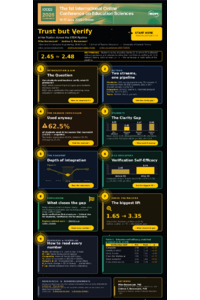
Introduction. Engineering students report the lowest AI policy clarity in courses that say nothing — even lower than courses that ban AI. This finding emerged from a dataset spanning nine semesters and 128 course experiences at a large public research university. The authors' prior work on technology integration across the K-12-to-university pipeline has shown that the framing around a technology predicts practitioner confidence more reliably than the technology itself. This study extends that principle to AI policy and asks whether the Clarity Gap observed among engineering undergraduates appears in K-12 STEM educators encountering AI tools through professional development.
Methods. Two datasets ground the analysis. The university dataset captures student-reported AI policy clarity, tool adoption, and verification behavior across five policy categories (Disallowed, Allowed-Informal, Allowed-Formal, Encouraged, and Critical Use) from 2023 through 2025. The educator dataset draws from a multi-session PD series delivered to STEM educators, scaffolding a progression from AI-assisted curriculum design through structured verification of AI-generated content to hands-on programming with LLM assistance — a direct translation of the "Trust but Verify" framework validated on the university side. Earlier PD sessions using micro:bit devices provide a longitudinal baseline.
Results. Allowed-Informal courses — where AI use was permitted without explicit guidance — produce clarity scores significantly below prohibition. Preliminary educator data indicate a parallel pattern: educators whose schools have issued explicit AI guidance report higher baseline verification confidence than those operating without institutional direction.
Conclusions. Despite widespread AI adoption, policies governing its classroom use remain underdeveloped. Policy silence is the primary barrier to productive AI integration in both collegiate and K-12 classrooms. Mandating explicit AI guidance, at the course level for universities, at the school or district level for K-12, addresses AI integration ambiguity directly. The authors posit that a specific policy stance matters less than its existence for effective educator and student use.
Keywords
generative AI policy
AI literacy
engineering education
STEM professional development
policy clarity
trust but verify
K-12 educator preparation
Poster
Poster_IOCES_Borowczak_TrustButVerify.pdf
Prompting Your Way to Better Learning: How Generative AI Empowers Educators to Create Interactive, Accessible Teaching Materials
Evaluating Gamified Experiential Learning as a Mechanism to Bridge the Theory and Practice in Introductory Accounting