Event submissions
Published
This submission belongs to the session S3. Curriculum and Instruction of the event The 1st International Online Conference on Education Sciences
Published date
10 Jun, 2026
Academic Editor
'%3e%3cpath%20d='M12.6657%2010.9104C12.4185%2010.325%2012.0599%209.79327%2011.6097%209.34482C11.1609%208.89508%2010.6293%208.5365%2010.0442%208.28888C10.0389%208.28626%2010.0337%208.28495%2010.0285%208.28233C10.8446%207.69279%2011.3752%206.73249%2011.3752%205.64904C11.3752%203.8542%209.92103%202.39999%208.1262%202.39999C6.33136%202.39999%204.87715%203.8542%204.87715%205.64904C4.87715%206.73249%205.40774%207.69279%206.22393%208.28364C6.21869%208.28626%206.21345%208.28757%206.20821%208.29019C5.62129%208.5378%205.09463%208.89284%204.64265%209.34613C4.1929%209.79493%203.83432%2010.3266%203.58671%2010.9117C3.34345%2011.4845%203.21226%2012.0987%203.20023%2012.7209C3.19988%2012.7349%203.20233%2012.7488%203.20744%2012.7619C3.21255%2012.7749%203.22022%2012.7867%203.22998%2012.7968C3.23975%2012.8068%203.25142%2012.8147%203.26431%2012.8202C3.2772%2012.8256%203.29105%2012.8284%203.30504%2012.8284H4.09109C4.14874%2012.8284%204.19459%2012.7825%204.1959%2012.7262C4.2221%2011.7148%204.62823%2010.7676%205.34617%2010.0497C6.08899%209.30683%207.0755%208.89808%208.1262%208.89808C9.17689%208.89808%2010.1634%209.30683%2010.9062%2010.0497C11.6242%2010.7676%2012.0303%2011.7148%2012.0565%2012.7262C12.0578%2012.7838%2012.1037%2012.8284%2012.1613%2012.8284H12.9474C12.9613%2012.8284%2012.9752%2012.8256%2012.9881%2012.8202C13.001%2012.8147%2013.0126%2012.8068%2013.0224%2012.7968C13.0322%2012.7867%2013.0398%2012.7749%2013.0449%2012.7619C13.0501%2012.7488%2013.0525%2012.7349%2013.0522%2012.7209C13.0391%2012.0947%2012.9094%2011.4855%2012.6657%2010.9104ZM8.1262%207.9024C7.52486%207.9024%206.9589%207.6679%206.53312%207.24211C6.10733%206.81633%205.87283%206.25037%205.87283%205.64904C5.87283%205.0477%206.10733%204.48174%206.53312%204.05596C6.9589%203.63018%207.52486%203.39567%208.1262%203.39567C8.72753%203.39567%209.29349%203.63018%209.71927%204.05596C10.1451%204.48174%2010.3796%205.0477%2010.3796%205.64904C10.3796%206.25037%2010.1451%206.81633%209.71927%207.24211C9.29349%207.6679%208.72753%207.9024%208.1262%207.9024Z'%20fill='%235D1EE1'/%3e%3c/g%3e%3c/svg%3e) Daniel Muijs
Daniel MuijsCitation
Mariam Ibrahim Alzaabi, Hend Abdullah Alnuaimi, Alya Hassan Al Maazmi, Robin Ogdol, Developmental and Contextual Predictors, and Behavioral Patterns of Off-Task Behavior in UAE Early Childhood English Classrooms, in Proceedings of The 1st International Online Conference on Education Sciences, 15 June–17 June 2026, MDPI: Basel, Switzerland
Share
Email
Facebook
Twitter
LinkedIn
Developmental and Contextual Predictors, and Behavioral Patterns of Off-Task Behavior in UAE Early Childhood English Classrooms
'%3e%3cpath%20d='M12.6647%2010.9104C12.4176%2010.325%2012.0589%209.7933%2011.6088%209.34485C11.16%208.89511%2010.6283%208.53653%2010.0432%208.28891C10.038%208.28629%2010.0327%208.28498%2010.0275%208.28236C10.8437%207.69282%2011.3743%206.73252%2011.3743%205.64907C11.3743%203.85423%209.92005%202.40002%208.12522%202.40002C6.33038%202.40002%204.87618%203.85423%204.87618%205.64907C4.87618%206.73252%205.40677%207.69282%206.22296%208.28367C6.21772%208.28629%206.21248%208.2876%206.20724%208.29022C5.62031%208.53783%205.09365%208.89287%204.64167%209.34616C4.19192%209.79496%203.83334%2010.3266%203.58573%2010.9117C3.34247%2011.4846%203.21128%2012.0987%203.19925%2012.721C3.1989%2012.735%203.20135%2012.7489%203.20646%2012.7619C3.21157%2012.7749%203.21924%2012.7868%203.22901%2012.7968C3.23877%2012.8068%203.25045%2012.8148%203.26334%2012.8202C3.27623%2012.8256%203.29007%2012.8284%203.30406%2012.8284H4.09012C4.14776%2012.8284%204.19362%2012.7825%204.19493%2012.7262C4.22113%2011.7148%204.62726%2010.7676%205.34519%2010.0497C6.08802%209.30686%207.07452%208.89811%208.12522%208.89811C9.17592%208.89811%2010.1624%209.30686%2010.9052%2010.0497C11.6232%2010.7676%2012.0293%2011.7148%2012.0555%2012.7262C12.0568%2012.7839%2012.1027%2012.8284%2012.1603%2012.8284H12.9464C12.9604%2012.8284%2012.9742%2012.8256%2012.9871%2012.8202C13%2012.8148%2013.0117%2012.8068%2013.0214%2012.7968C13.0312%2012.7868%2013.0389%2012.7749%2013.044%2012.7619C13.0491%2012.7489%2013.0515%2012.735%2013.0512%2012.721C13.0381%2012.0947%2012.9084%2011.4856%2012.6647%2010.9104ZM8.12522%207.90243C7.52388%207.90243%206.95792%207.66793%206.53214%207.24215C6.10636%206.81636%205.87185%206.2504%205.87185%205.64907C5.87185%205.04773%206.10636%204.48177%206.53214%204.05599C6.95792%203.63021%207.52388%203.3957%208.12522%203.3957C8.72655%203.3957%209.29252%203.63021%209.7183%204.05599C10.1441%204.48177%2010.3786%205.04773%2010.3786%205.64907C10.3786%206.2504%2010.1441%206.81636%209.7183%207.24215C9.29252%207.66793%208.72655%207.90243%208.12522%207.90243Z'%20fill='%235D1EE1'/%3e%3c/g%3e%3c/svg%3e)
Mariam Ibrahim Alzaabi 1
Hend Abdullah Alnuaimi 1
Alya Hassan Al Maazmi 1
Robin Ogdol 1
1. Faculty of Education, Higher Colleges of Technology, Sharjah, 53735, United Arab Emirates.
Abstract
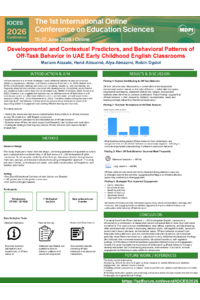
This study investigates the developmental and contextual predictors and behavioral patterns of off-task behavior among kindergarten students in public-school English classrooms in the United Arab Emirates, while also examining teachers’ perspectives on these behaviors within early childhood learning contexts. Adopting a mixed-methods design, data were collected over an eight-week period through teacher interviews, surveys, anecdotal records, and systematic time-sampling observations involving 78 KG1 and 82 KG2 students, alongside 7KG English teachers. Findings revealed consistent behavioral patterns, with off-task behavior most frequently manifested as talking, wandering, and daydreaming. These behaviors occurred more often during afternoon sessions, extended instructional periods, and activities that lacked movement, interaction, or hands-on engagement. The analysis identified both developmental and contextual predictors shaping these behaviors. Developmental factors included emerging attention span, self-regulation abilities, and age-related learning needs, while contextual influences involved classroom environment, instructional structure, lesson pacing, and emotional climate. Teachers’ perspectives consistently framed off-task behavior as a natural and developmentally appropriate part of early childhood learning rather than intentional disruption. Many viewed these behaviors as indicators of fatigue, limited engagement, or unmet learning needs. In response, targeted strategies inspired by Montessori-informed practices, structured transitions, movement-based activities, and brief self-regulation routines were implemented to support children’s focus and participation. These approaches showed promising effects in improving engagement and reducing the frequency of off-task behaviors. Overall, the findings highlight the importance of understanding off-task behavior through a developmental and contextual lens and underscore the value of responsive, child-centered pedagogical practices in supporting engagement, attention, and wellbeing in early childhood English classrooms.
Keywords
Off-task behavior
Developmental predictors
Contextual factors
Behavioral patterns
Student engagement
Self-regulation
Early childhood education
Classroom environment
Teacher perspectives
UAE kindergarten classrooms
Poster
170681 (1).pdf
A Comparative Analysis of Educational Barriers Between Pakistan and Malaysia
Pedagogy for non-pedagogues: Analysis of the pedagogical impact and training needs in the Diploma in Curriculum Design and Management of the Faculty of Health Sciences-National University of Formosa, 2025. Argentina.