Event submissions
Published
This submission belongs to the session S2. Higher Education of the event The 1st International Online Conference on Education Sciences
Published date
10 Jun, 2026
Academic Editor
'%3e%3cpath%20d='M12.6657%2010.9104C12.4185%2010.325%2012.0599%209.79327%2011.6097%209.34482C11.1609%208.89508%2010.6293%208.5365%2010.0442%208.28888C10.0389%208.28626%2010.0337%208.28495%2010.0285%208.28233C10.8446%207.69279%2011.3752%206.73249%2011.3752%205.64904C11.3752%203.8542%209.92103%202.39999%208.1262%202.39999C6.33136%202.39999%204.87715%203.8542%204.87715%205.64904C4.87715%206.73249%205.40774%207.69279%206.22393%208.28364C6.21869%208.28626%206.21345%208.28757%206.20821%208.29019C5.62129%208.5378%205.09463%208.89284%204.64265%209.34613C4.1929%209.79493%203.83432%2010.3266%203.58671%2010.9117C3.34345%2011.4845%203.21226%2012.0987%203.20023%2012.7209C3.19988%2012.7349%203.20233%2012.7488%203.20744%2012.7619C3.21255%2012.7749%203.22022%2012.7867%203.22998%2012.7968C3.23975%2012.8068%203.25142%2012.8147%203.26431%2012.8202C3.2772%2012.8256%203.29105%2012.8284%203.30504%2012.8284H4.09109C4.14874%2012.8284%204.19459%2012.7825%204.1959%2012.7262C4.2221%2011.7148%204.62823%2010.7676%205.34617%2010.0497C6.08899%209.30683%207.0755%208.89808%208.1262%208.89808C9.17689%208.89808%2010.1634%209.30683%2010.9062%2010.0497C11.6242%2010.7676%2012.0303%2011.7148%2012.0565%2012.7262C12.0578%2012.7838%2012.1037%2012.8284%2012.1613%2012.8284H12.9474C12.9613%2012.8284%2012.9752%2012.8256%2012.9881%2012.8202C13.001%2012.8147%2013.0126%2012.8068%2013.0224%2012.7968C13.0322%2012.7867%2013.0398%2012.7749%2013.0449%2012.7619C13.0501%2012.7488%2013.0525%2012.7349%2013.0522%2012.7209C13.0391%2012.0947%2012.9094%2011.4855%2012.6657%2010.9104ZM8.1262%207.9024C7.52486%207.9024%206.9589%207.6679%206.53312%207.24211C6.10733%206.81633%205.87283%206.25037%205.87283%205.64904C5.87283%205.0477%206.10733%204.48174%206.53312%204.05596C6.9589%203.63018%207.52486%203.39567%208.1262%203.39567C8.72753%203.39567%209.29349%203.63018%209.71927%204.05596C10.1451%204.48174%2010.3796%205.0477%2010.3796%205.64904C10.3796%206.25037%2010.1451%206.81633%209.71927%207.24211C9.29349%207.6679%208.72753%207.9024%208.1262%207.9024Z'%20fill='%235D1EE1'/%3e%3c/g%3e%3c/svg%3e) EMILIO ABAD-SEGURA
EMILIO ABAD-SEGURACitation
Sandra Beatriz Santachita, Vilma Judit Ogaz, Patrica Griselda Rolon, Pedagogy for non-pedagogues: Analysis of the pedagogical impact and training needs in the Diploma in Curriculum Design and Management of the Faculty of Health Sciences-National University of Formosa, 2025. Argentina., in Proceedings of The 1st International Online Conference on Education Sciences, 15 June–17 June 2026, MDPI: Basel, Switzerland
Share
Email
Facebook
Twitter
LinkedIn
Pedagogy for non-pedagogues: Analysis of the pedagogical impact and training needs in the Diploma in Curriculum Design and Management of the Faculty of Health Sciences-National University of Formosa, 2025. Argentina.

Sandra Beatriz Santachita 1
'%3e%3cpath%20d='M12.6647%2010.9104C12.4176%2010.325%2012.0589%209.7933%2011.6088%209.34485C11.16%208.89511%2010.6283%208.53653%2010.0432%208.28891C10.038%208.28629%2010.0327%208.28498%2010.0275%208.28236C10.8437%207.69282%2011.3743%206.73252%2011.3743%205.64907C11.3743%203.85423%209.92005%202.40002%208.12522%202.40002C6.33038%202.40002%204.87618%203.85423%204.87618%205.64907C4.87618%206.73252%205.40677%207.69282%206.22296%208.28367C6.21772%208.28629%206.21248%208.2876%206.20724%208.29022C5.62031%208.53783%205.09365%208.89287%204.64167%209.34616C4.19192%209.79496%203.83334%2010.3266%203.58573%2010.9117C3.34247%2011.4846%203.21128%2012.0987%203.19925%2012.721C3.1989%2012.735%203.20135%2012.7489%203.20646%2012.7619C3.21157%2012.7749%203.21924%2012.7868%203.22901%2012.7968C3.23877%2012.8068%203.25045%2012.8148%203.26334%2012.8202C3.27623%2012.8256%203.29007%2012.8284%203.30406%2012.8284H4.09012C4.14776%2012.8284%204.19362%2012.7825%204.19493%2012.7262C4.22113%2011.7148%204.62726%2010.7676%205.34519%2010.0497C6.08802%209.30686%207.07452%208.89811%208.12522%208.89811C9.17592%208.89811%2010.1624%209.30686%2010.9052%2010.0497C11.6232%2010.7676%2012.0293%2011.7148%2012.0555%2012.7262C12.0568%2012.7839%2012.1027%2012.8284%2012.1603%2012.8284H12.9464C12.9604%2012.8284%2012.9742%2012.8256%2012.9871%2012.8202C13%2012.8148%2013.0117%2012.8068%2013.0214%2012.7968C13.0312%2012.7868%2013.0389%2012.7749%2013.044%2012.7619C13.0491%2012.7489%2013.0515%2012.735%2013.0512%2012.721C13.0381%2012.0947%2012.9084%2011.4856%2012.6647%2010.9104ZM8.12522%207.90243C7.52388%207.90243%206.95792%207.66793%206.53214%207.24215C6.10636%206.81636%205.87185%206.2504%205.87185%205.64907C5.87185%205.04773%206.10636%204.48177%206.53214%204.05599C6.95792%203.63021%207.52388%203.3957%208.12522%203.3957C8.72655%203.3957%209.29252%203.63021%209.7183%204.05599C10.1441%204.48177%2010.3786%205.04773%2010.3786%205.64907C10.3786%206.2504%2010.1441%206.81636%209.7183%207.24215C9.29252%207.66793%208.72655%207.90243%208.12522%207.90243Z'%20fill='%235D1EE1'/%3e%3c/g%3e%3c/svg%3e)
Vilma Judit Ogaz 1
Patrica Griselda Rolon 1
1. Department University Extension Secretariat, Faculty of Health Sciences, National University of Formosa, Formosa, CP 3600, Argentina
Abstract
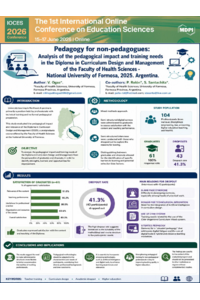
University teaching in Northeast Argentina is primarily a position held by professionals with technical training and no formal pedagogical preparation. This study evaluated the pedagogical impact and relevance of the Diploma in Curriculum Design and Management (2025), a postgraduate course offered by the Faculty of Health Sciences at the National University of Formosa.
The cohort included 104 professionals from various disciplines (engineering, law, accounting, higher education teaching, and health). A mixed-methods approach was used: semi-structured digital surveys were administered to the 61 graduates of the program, with a 100% response rate, to assess satisfaction with the content and teaching performance. Simultaneously, a dropout rate of 41.3% (43 participants) was recorded, and semi-structured interviews were conducted with those who dropped out to explore the reasons for leaving. Distinguishing between graduates and dropouts allowed for the identification of specific barriers to learning and potential selection bias factors in the results.
Graduates expressed satisfaction with the content and teaching; however, the high dropout rate suggests limitations in the suitability of the methodology and course structure to the participants' needs. Among the obstacles identified, the so-called "blank page syndrome" stood out, especially among the heads of practical work, who experienced difficulties in developing curricula. Demands were also noted for the integration of Artificial Intelligence in curriculum design, the use of the CVar (Argentine Curriculum Vitae) system, and the development of a "situated pedagogy" that addresses digital fatigue and the use of digital tools in hybrid and distance learning modalities.
The results suggest the need to make administrative structures more flexible and adapt pedagogical methodologies to the characteristics of the participating professionals, incorporating emerging technologies and strengthening pedagogical training. The findings are specific to the context of the evaluated program and should not be generalized to other institutions or regions without complementary studies.
Keywords
Teacher training
Curriculum design
Academic dropout
Higher education.
Poster
Poster-2026-formosa.pdf
Developmental and Contextual Predictors, and Behavioral Patterns of Off-Task Behavior in UAE Early Childhood English Classrooms
From Architects to Constructors: How AI Undermines Architectural Thinking