Event submissions
Published
This submission belongs to the session S1. Technology Enhanced Education of the event The 1st International Online Conference on Education Sciences
Published date
10 Jun, 2026
Academic Editor
'%3e%3cpath%20d='M12.6657%2010.9104C12.4185%2010.325%2012.0599%209.79327%2011.6097%209.34482C11.1609%208.89508%2010.6293%208.5365%2010.0442%208.28888C10.0389%208.28626%2010.0337%208.28495%2010.0285%208.28233C10.8446%207.69279%2011.3752%206.73249%2011.3752%205.64904C11.3752%203.8542%209.92103%202.39999%208.1262%202.39999C6.33136%202.39999%204.87715%203.8542%204.87715%205.64904C4.87715%206.73249%205.40774%207.69279%206.22393%208.28364C6.21869%208.28626%206.21345%208.28757%206.20821%208.29019C5.62129%208.5378%205.09463%208.89284%204.64265%209.34613C4.1929%209.79493%203.83432%2010.3266%203.58671%2010.9117C3.34345%2011.4845%203.21226%2012.0987%203.20023%2012.7209C3.19988%2012.7349%203.20233%2012.7488%203.20744%2012.7619C3.21255%2012.7749%203.22022%2012.7867%203.22998%2012.7968C3.23975%2012.8068%203.25142%2012.8147%203.26431%2012.8202C3.2772%2012.8256%203.29105%2012.8284%203.30504%2012.8284H4.09109C4.14874%2012.8284%204.19459%2012.7825%204.1959%2012.7262C4.2221%2011.7148%204.62823%2010.7676%205.34617%2010.0497C6.08899%209.30683%207.0755%208.89808%208.1262%208.89808C9.17689%208.89808%2010.1634%209.30683%2010.9062%2010.0497C11.6242%2010.7676%2012.0303%2011.7148%2012.0565%2012.7262C12.0578%2012.7838%2012.1037%2012.8284%2012.1613%2012.8284H12.9474C12.9613%2012.8284%2012.9752%2012.8256%2012.9881%2012.8202C13.001%2012.8147%2013.0126%2012.8068%2013.0224%2012.7968C13.0322%2012.7867%2013.0398%2012.7749%2013.0449%2012.7619C13.0501%2012.7488%2013.0525%2012.7349%2013.0522%2012.7209C13.0391%2012.0947%2012.9094%2011.4855%2012.6657%2010.9104ZM8.1262%207.9024C7.52486%207.9024%206.9589%207.6679%206.53312%207.24211C6.10733%206.81633%205.87283%206.25037%205.87283%205.64904C5.87283%205.0477%206.10733%204.48174%206.53312%204.05596C6.9589%203.63018%207.52486%203.39567%208.1262%203.39567C8.72753%203.39567%209.29349%203.63018%209.71927%204.05596C10.1451%204.48174%2010.3796%205.0477%2010.3796%205.64904C10.3796%206.25037%2010.1451%206.81633%209.71927%207.24211C9.29349%207.6679%208.72753%207.9024%208.1262%207.9024Z'%20fill='%235D1EE1'/%3e%3c/g%3e%3c/svg%3e) Mike Joy
Mike JoyCitation
Iván Miguel García-López, Jessica Nájera Ochoa, Maria Stella Castillo Perea, Open Large Language Models in Higher Education: A Framework for Technology-Enhanced Sustainable Learning, in Proceedings of The 1st International Online Conference on Education Sciences, 15 June–17 June 2026, MDPI: Basel, Switzerland
Share
Email
Facebook
Twitter
LinkedIn
Open Large Language Models in Higher Education: A Framework for Technology-Enhanced Sustainable Learning
Open Large Language Models in Higher Education: A Framework for Technology-Enhanced Sustainable Learning
'%3e%3cpath%20d='M12.6647%2010.9104C12.4176%2010.325%2012.0589%209.7933%2011.6088%209.34485C11.16%208.89511%2010.6283%208.53653%2010.0432%208.28891C10.038%208.28629%2010.0327%208.28498%2010.0275%208.28236C10.8437%207.69282%2011.3743%206.73252%2011.3743%205.64907C11.3743%203.85423%209.92005%202.40002%208.12522%202.40002C6.33038%202.40002%204.87618%203.85423%204.87618%205.64907C4.87618%206.73252%205.40677%207.69282%206.22296%208.28367C6.21772%208.28629%206.21248%208.2876%206.20724%208.29022C5.62031%208.53783%205.09365%208.89287%204.64167%209.34616C4.19192%209.79496%203.83334%2010.3266%203.58573%2010.9117C3.34247%2011.4846%203.21128%2012.0987%203.19925%2012.721C3.1989%2012.735%203.20135%2012.7489%203.20646%2012.7619C3.21157%2012.7749%203.21924%2012.7868%203.22901%2012.7968C3.23877%2012.8068%203.25045%2012.8148%203.26334%2012.8202C3.27623%2012.8256%203.29007%2012.8284%203.30406%2012.8284H4.09012C4.14776%2012.8284%204.19362%2012.7825%204.19493%2012.7262C4.22113%2011.7148%204.62726%2010.7676%205.34519%2010.0497C6.08802%209.30686%207.07452%208.89811%208.12522%208.89811C9.17592%208.89811%2010.1624%209.30686%2010.9052%2010.0497C11.6232%2010.7676%2012.0293%2011.7148%2012.0555%2012.7262C12.0568%2012.7839%2012.1027%2012.8284%2012.1603%2012.8284H12.9464C12.9604%2012.8284%2012.9742%2012.8256%2012.9871%2012.8202C13%2012.8148%2013.0117%2012.8068%2013.0214%2012.7968C13.0312%2012.7868%2013.0389%2012.7749%2013.044%2012.7619C13.0491%2012.7489%2013.0515%2012.735%2013.0512%2012.721C13.0381%2012.0947%2012.9084%2011.4856%2012.6647%2010.9104ZM8.12522%207.90243C7.52388%207.90243%206.95792%207.66793%206.53214%207.24215C6.10636%206.81636%205.87185%206.2504%205.87185%205.64907C5.87185%205.04773%206.10636%204.48177%206.53214%204.05599C6.95792%203.63021%207.52388%203.3957%208.12522%203.3957C8.72655%203.3957%209.29252%203.63021%209.7183%204.05599C10.1441%204.48177%2010.3786%205.04773%2010.3786%205.64907C10.3786%206.2504%2010.1441%206.81636%209.7183%207.24215C9.29252%207.66793%208.72655%207.90243%208.12522%207.90243Z'%20fill='%235D1EE1'/%3e%3c/g%3e%3c/svg%3e)
Iván Miguel García-López 1
Jessica Nájera Ochoa 1
Maria Stella Castillo Perea 2
1. Business Faculty, Universidad La Salle, Mexico City, 06170, México
2. Facultad de Educación, Universidad de Salamanca USAL, Salamanca, España, 37001, Spain
Abstract
The rapid expansion of generative artificial intelligence is transforming higher education by reshaping decision-making processes, institutional governance, and technology-enhanced learning ecosystems. Among these technologies, Open Large Language Models (OLLMs) have emerged as accessible infrastructures capable of supporting scalable, inclusive, and sustainable innovation in educational contexts. Despite their growing adoption, there remains limited systematic evidence regarding their organizational impact and governance implications in higher education. This study conducts a systematic literature review (SLR) to analyze the role of OLLMs in educational management and technology-enhanced learning environments. A structured and replicable search was carried out in Scopus and Web of Science, identifying an initial corpus of 616 articles published between 2020 and 2025. After applying inclusion and exclusion criteria, a final sample of 551 peer-reviewed studies was analyzed through a structured qualitative content analysis based on five research questions addressing managerial domains, governance models, levels of adoption, organizational outcomes, and associated risks. The findings reveal that OLLMs are primarily conceptualized as cognitive infrastructures that augment institutional decision-making rather than replace it, with predominant applications in strategic planning, performance evaluation, and administrative optimization. The results also show a concentration of adoption at exploratory and unit levels, indicating an emerging but uneven institutional integration. Governance discussions emphasize transparency, accountability, and risk management, particularly regarding bias, data protection, and over-reliance on automated systems. Additionally, the analysis highlights that organizational value derived from OLLMs is strongly contingent on institutional digital maturity and managerial capabilities. This study contributes to the field by providing an evidence-based framework that positions OLLMs as key components of technology-enhanced sustainable learning ecosystems, linking their adoption to governance structures and institutional capacity building. The findings offer practical implications for higher education institutions seeking to balance innovation, accessibility, and responsible AI deployment in increasingly complex educational environments.
Keywords
Open AI
Large Language Models
Higher Education
Technology-Enhanced Learning
Generative AI
Digital Sustainability.
Poster
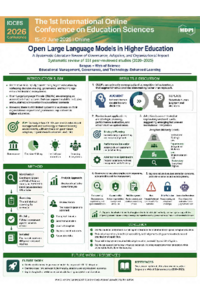
sciforum-173700_Poster.pdf
Could AI serve as an accelerator in the English language learning process? Or a walking stick?
Metaverse Adoption in Built Environment Education: A Kirkpatrick Model-Based Evaluation of Educator Training Outcomes