Event submissions
Published
This submission belongs to the session S1. Technology Enhanced Education of the event The 1st International Online Conference on Education Sciences
Published date
10 Jun, 2026
Academic Editor
'%3e%3cpath%20d='M12.6657%2010.9104C12.4185%2010.325%2012.0599%209.79327%2011.6097%209.34482C11.1609%208.89508%2010.6293%208.5365%2010.0442%208.28888C10.0389%208.28626%2010.0337%208.28495%2010.0285%208.28233C10.8446%207.69279%2011.3752%206.73249%2011.3752%205.64904C11.3752%203.8542%209.92103%202.39999%208.1262%202.39999C6.33136%202.39999%204.87715%203.8542%204.87715%205.64904C4.87715%206.73249%205.40774%207.69279%206.22393%208.28364C6.21869%208.28626%206.21345%208.28757%206.20821%208.29019C5.62129%208.5378%205.09463%208.89284%204.64265%209.34613C4.1929%209.79493%203.83432%2010.3266%203.58671%2010.9117C3.34345%2011.4845%203.21226%2012.0987%203.20023%2012.7209C3.19988%2012.7349%203.20233%2012.7488%203.20744%2012.7619C3.21255%2012.7749%203.22022%2012.7867%203.22998%2012.7968C3.23975%2012.8068%203.25142%2012.8147%203.26431%2012.8202C3.2772%2012.8256%203.29105%2012.8284%203.30504%2012.8284H4.09109C4.14874%2012.8284%204.19459%2012.7825%204.1959%2012.7262C4.2221%2011.7148%204.62823%2010.7676%205.34617%2010.0497C6.08899%209.30683%207.0755%208.89808%208.1262%208.89808C9.17689%208.89808%2010.1634%209.30683%2010.9062%2010.0497C11.6242%2010.7676%2012.0303%2011.7148%2012.0565%2012.7262C12.0578%2012.7838%2012.1037%2012.8284%2012.1613%2012.8284H12.9474C12.9613%2012.8284%2012.9752%2012.8256%2012.9881%2012.8202C13.001%2012.8147%2013.0126%2012.8068%2013.0224%2012.7968C13.0322%2012.7867%2013.0398%2012.7749%2013.0449%2012.7619C13.0501%2012.7488%2013.0525%2012.7349%2013.0522%2012.7209C13.0391%2012.0947%2012.9094%2011.4855%2012.6657%2010.9104ZM8.1262%207.9024C7.52486%207.9024%206.9589%207.6679%206.53312%207.24211C6.10733%206.81633%205.87283%206.25037%205.87283%205.64904C5.87283%205.0477%206.10733%204.48174%206.53312%204.05596C6.9589%203.63018%207.52486%203.39567%208.1262%203.39567C8.72753%203.39567%209.29349%203.63018%209.71927%204.05596C10.1451%204.48174%2010.3796%205.0477%2010.3796%205.64904C10.3796%206.25037%2010.1451%206.81633%209.71927%207.24211C9.29349%207.6679%208.72753%207.9024%208.1262%207.9024Z'%20fill='%235D1EE1'/%3e%3c/g%3e%3c/svg%3e) Mike Joy
Mike JoyCitation
Maurice Dawson, Samson Quaye, Integrating Artificial Intelligence into Irregular Warfare Education: A Framework for Military Learning and Training, in Proceedings of The 1st International Online Conference on Education Sciences, 15 June–17 June 2026, MDPI: Basel, Switzerland
Share
Email
Facebook
Twitter
LinkedIn
Integrating Artificial Intelligence into Irregular Warfare Education: A Framework for Military Learning and Training

Maurice Dawson 1

Samson Quaye 1
1. Center for Cybersecurity and Forensic Education (C2SAFE), Illinois Institute of Technology, Chicago, IL 60616, USA
Abstract
Artificial Intelligence is increasingly embedded in contemporary military operations, yet its effective and ethical integration depends largely on how defense institutions educate and prepare personnel. While technological advancements receive significant attention, the pedagogical systems that enable responsible adoption remain underexamined. This study examines how AI can be systematically incorporated into professional military education and training for irregular warfare. Using qualitative doctrinal analysis and thematic synthesis of United States and NATO policy documents, scholarly literature, and recent operational practices, the research develops a five layer instructional framework linking strategic alignment, doctrinal integration, operational learning, data driven intelligence education, and human AI governance. The framework demonstrates how AI competencies can be embedded within curricula, training programs, simulations, and institutional learning systems in a structured and scalable manner. Findings indicate that successful AI adoption requires coordinated reforms in doctrine, instructional design, leadership development, and ethical oversight rather than isolated technical training initiatives. The study further emphasizes the importance of experiential learning environments, interdisciplinary collaboration, scenario based exercises, and continuous professional development in cultivating AI literacy and adaptive decision making among military personnel. By reframing AI integration as a comprehensive pedagogical transformation rather than a purely technical upgrade, this research contributes to education sciences by illustrating how emerging technologies reshape professional learning ecosystems. The proposed model offers practical guidance for educators, policymakers, and training institutions seeking to enhance operational readiness while maintaining transparency, accountability, and principled human judgment.
Keywords
Artificial Intelligence
Military Education
Professional Military Education
Irregular Warfare Training
Curriculum Development
Instructional Design
Experiential Learning
Human AI Teaming
Ethical Governance
Defense Workforce Development
Poster
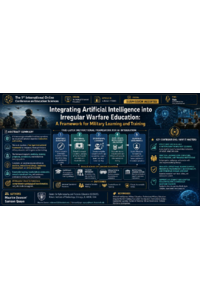
sciforum_173300_dawson.pdf
USE OF RETRIEVAL-AUGMENTED GENERATION FOR THE EVALUATION OF ORIGINALITY IN ENGINEERING SUBJECTS WITH A PROJECT-BASED LEARNING SYSTEM.
Evaluating ChatGPT and DeepSeek in AI-Assisted English-Chinese News Translation within Technology-Enhanced Education