Event submissions
Published
This submission belongs to the session S1. Technology Enhanced Education of the event The 1st International Online Conference on Education Sciences
Published date
10 Jun, 2026
Academic Editor
'%3e%3cpath%20d='M12.6657%2010.9104C12.4185%2010.325%2012.0599%209.79327%2011.6097%209.34482C11.1609%208.89508%2010.6293%208.5365%2010.0442%208.28888C10.0389%208.28626%2010.0337%208.28495%2010.0285%208.28233C10.8446%207.69279%2011.3752%206.73249%2011.3752%205.64904C11.3752%203.8542%209.92103%202.39999%208.1262%202.39999C6.33136%202.39999%204.87715%203.8542%204.87715%205.64904C4.87715%206.73249%205.40774%207.69279%206.22393%208.28364C6.21869%208.28626%206.21345%208.28757%206.20821%208.29019C5.62129%208.5378%205.09463%208.89284%204.64265%209.34613C4.1929%209.79493%203.83432%2010.3266%203.58671%2010.9117C3.34345%2011.4845%203.21226%2012.0987%203.20023%2012.7209C3.19988%2012.7349%203.20233%2012.7488%203.20744%2012.7619C3.21255%2012.7749%203.22022%2012.7867%203.22998%2012.7968C3.23975%2012.8068%203.25142%2012.8147%203.26431%2012.8202C3.2772%2012.8256%203.29105%2012.8284%203.30504%2012.8284H4.09109C4.14874%2012.8284%204.19459%2012.7825%204.1959%2012.7262C4.2221%2011.7148%204.62823%2010.7676%205.34617%2010.0497C6.08899%209.30683%207.0755%208.89808%208.1262%208.89808C9.17689%208.89808%2010.1634%209.30683%2010.9062%2010.0497C11.6242%2010.7676%2012.0303%2011.7148%2012.0565%2012.7262C12.0578%2012.7838%2012.1037%2012.8284%2012.1613%2012.8284H12.9474C12.9613%2012.8284%2012.9752%2012.8256%2012.9881%2012.8202C13.001%2012.8147%2013.0126%2012.8068%2013.0224%2012.7968C13.0322%2012.7867%2013.0398%2012.7749%2013.0449%2012.7619C13.0501%2012.7488%2013.0525%2012.7349%2013.0522%2012.7209C13.0391%2012.0947%2012.9094%2011.4855%2012.6657%2010.9104ZM8.1262%207.9024C7.52486%207.9024%206.9589%207.6679%206.53312%207.24211C6.10733%206.81633%205.87283%206.25037%205.87283%205.64904C5.87283%205.0477%206.10733%204.48174%206.53312%204.05596C6.9589%203.63018%207.52486%203.39567%208.1262%203.39567C8.72753%203.39567%209.29349%203.63018%209.71927%204.05596C10.1451%204.48174%2010.3796%205.0477%2010.3796%205.64904C10.3796%206.25037%2010.1451%206.81633%209.71927%207.24211C9.29349%207.6679%208.72753%207.9024%208.1262%207.9024Z'%20fill='%235D1EE1'/%3e%3c/g%3e%3c/svg%3e) Mike Joy
Mike JoyCitation
Diego Vergara, Pablo Fernández-Arias, Álvaro Antón-Sancho, Antonio del Bosque, Perceptions of Virtual Reality as a Training Tool in Engineering Education, in Proceedings of The 1st International Online Conference on Education Sciences, 15 June–17 June 2026, MDPI: Basel, Switzerland
Share
Email
Facebook
Twitter
LinkedIn
Perceptions of Virtual Reality as a Training Tool in Engineering Education

Diego Vergara 1

Pablo Fernández-Arias 1

Álvaro Antón-Sancho 1

Antonio del Bosque 1
1. Technology, Instruction and Design in Engineering and Education Research Group (TiDEE.rg), Catholic University of Ávila, C/Canteros, s/n, 05005 Ávila, Spain
Abstract
Introduction: Virtual reality (VR) has increasingly been explored as a pedagogical innovation in higher education. While its benefits for enhancing motivation, visualization, and practical training are widely acknowledged, the perceptions of engineering in faculties remain less documented, particularly when comparing different institutional contexts.
Methods: A survey instrument comprising 22 validated items grouped into six dimensions (competence, usability, technical aspects, drawbacks, didactic employability, and future projection) was administered to 279 engineering professors from 15 Latin American countries. Responses were analyzed using descriptive statistics, t-tests, and MANOVA to identify differences according to university type (public vs. private), gender, age, and teaching experience.
Results: Professors valued VR highly in terms of usability, technical potential, and teaching utility. However, low self-assessment of competence and lack of formal training highlighted a gap between perceived usefulness and readiness for classroom implementation. Significant differences emerged according to institutional ownership: professors in private universities tended to provide more favorable and consistent evaluations of VR’s educational benefits compared to those in public universities. Gender, age, and teaching experience also influenced perceptions, although these effects varied depending on the subscale analyzed.
Conclusions: The principal results indicate that engineering faculties recognize VR as a promising resource for higher education but still lack sufficient training for its effective use. This institutional divide suggests that private universities may be more proactive in adopting immersive technologies, whereas public universities show greater skepticism. Addressing this imbalance through targeted training and resource allocation could accelerate the integration of VR into engineering education across Latin America.
Keywords
Virtual reality
Engineering
Education
Training Tool
Higher education
Poster
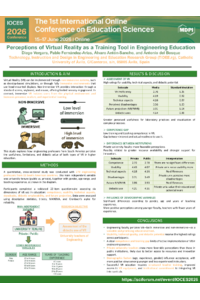
2026. IOCES. VR as a Training Tool in Eng.pdf
An Artificial Intelligence Competency Taxonomy: Mapping User Integration Levels and Progression Pathways
Transforming Digital Pedagogy with Agentic AI and Secure Cloud Systems