Event submissions
Published
This submission belongs to the session S2. Higher Education of the event The 1st International Online Conference on Education Sciences
Published date
10 Jun, 2026
Academic Editor
'%3e%3cpath%20d='M12.6657%2010.9104C12.4185%2010.325%2012.0599%209.79327%2011.6097%209.34482C11.1609%208.89508%2010.6293%208.5365%2010.0442%208.28888C10.0389%208.28626%2010.0337%208.28495%2010.0285%208.28233C10.8446%207.69279%2011.3752%206.73249%2011.3752%205.64904C11.3752%203.8542%209.92103%202.39999%208.1262%202.39999C6.33136%202.39999%204.87715%203.8542%204.87715%205.64904C4.87715%206.73249%205.40774%207.69279%206.22393%208.28364C6.21869%208.28626%206.21345%208.28757%206.20821%208.29019C5.62129%208.5378%205.09463%208.89284%204.64265%209.34613C4.1929%209.79493%203.83432%2010.3266%203.58671%2010.9117C3.34345%2011.4845%203.21226%2012.0987%203.20023%2012.7209C3.19988%2012.7349%203.20233%2012.7488%203.20744%2012.7619C3.21255%2012.7749%203.22022%2012.7867%203.22998%2012.7968C3.23975%2012.8068%203.25142%2012.8147%203.26431%2012.8202C3.2772%2012.8256%203.29105%2012.8284%203.30504%2012.8284H4.09109C4.14874%2012.8284%204.19459%2012.7825%204.1959%2012.7262C4.2221%2011.7148%204.62823%2010.7676%205.34617%2010.0497C6.08899%209.30683%207.0755%208.89808%208.1262%208.89808C9.17689%208.89808%2010.1634%209.30683%2010.9062%2010.0497C11.6242%2010.7676%2012.0303%2011.7148%2012.0565%2012.7262C12.0578%2012.7838%2012.1037%2012.8284%2012.1613%2012.8284H12.9474C12.9613%2012.8284%2012.9752%2012.8256%2012.9881%2012.8202C13.001%2012.8147%2013.0126%2012.8068%2013.0224%2012.7968C13.0322%2012.7867%2013.0398%2012.7749%2013.0449%2012.7619C13.0501%2012.7488%2013.0525%2012.7349%2013.0522%2012.7209C13.0391%2012.0947%2012.9094%2011.4855%2012.6657%2010.9104ZM8.1262%207.9024C7.52486%207.9024%206.9589%207.6679%206.53312%207.24211C6.10733%206.81633%205.87283%206.25037%205.87283%205.64904C5.87283%205.0477%206.10733%204.48174%206.53312%204.05596C6.9589%203.63018%207.52486%203.39567%208.1262%203.39567C8.72753%203.39567%209.29349%203.63018%209.71927%204.05596C10.1451%204.48174%2010.3796%205.0477%2010.3796%205.64904C10.3796%206.25037%2010.1451%206.81633%209.71927%207.24211C9.29349%207.6679%208.72753%207.9024%208.1262%207.9024Z'%20fill='%235D1EE1'/%3e%3c/g%3e%3c/svg%3e) EMILIO ABAD-SEGURA
EMILIO ABAD-SEGURACitation
Azahah Abu Hassan Shaari, Fauziah Ibrahim, Sarmila Md Sum, Nor Jana Saim, Norshafidah Abu Shafian, Pedagogical Innovation in Higher Education: Integrating Social Entrepreneurship Frameworks to Address Substance Use and Social Harm, in Proceedings of The 1st International Online Conference on Education Sciences, 15 June–17 June 2026, MDPI: Basel, Switzerland
Share
Email
Facebook
Twitter
LinkedIn
Pedagogical Innovation in Higher Education: Integrating Social Entrepreneurship Frameworks to Address Substance Use and Social Harm

Azahah Abu Hassan Shaari 1
'%3e%3cpath%20d='M12.6647%2010.9104C12.4176%2010.325%2012.0589%209.7933%2011.6088%209.34485C11.16%208.89511%2010.6283%208.53653%2010.0432%208.28891C10.038%208.28629%2010.0327%208.28498%2010.0275%208.28236C10.8437%207.69282%2011.3743%206.73252%2011.3743%205.64907C11.3743%203.85423%209.92005%202.40002%208.12522%202.40002C6.33038%202.40002%204.87618%203.85423%204.87618%205.64907C4.87618%206.73252%205.40677%207.69282%206.22296%208.28367C6.21772%208.28629%206.21248%208.2876%206.20724%208.29022C5.62031%208.53783%205.09365%208.89287%204.64167%209.34616C4.19192%209.79496%203.83334%2010.3266%203.58573%2010.9117C3.34247%2011.4846%203.21128%2012.0987%203.19925%2012.721C3.1989%2012.735%203.20135%2012.7489%203.20646%2012.7619C3.21157%2012.7749%203.21924%2012.7868%203.22901%2012.7968C3.23877%2012.8068%203.25045%2012.8148%203.26334%2012.8202C3.27623%2012.8256%203.29007%2012.8284%203.30406%2012.8284H4.09012C4.14776%2012.8284%204.19362%2012.7825%204.19493%2012.7262C4.22113%2011.7148%204.62726%2010.7676%205.34519%2010.0497C6.08802%209.30686%207.07452%208.89811%208.12522%208.89811C9.17592%208.89811%2010.1624%209.30686%2010.9052%2010.0497C11.6232%2010.7676%2012.0293%2011.7148%2012.0555%2012.7262C12.0568%2012.7839%2012.1027%2012.8284%2012.1603%2012.8284H12.9464C12.9604%2012.8284%2012.9742%2012.8256%2012.9871%2012.8202C13%2012.8148%2013.0117%2012.8068%2013.0214%2012.7968C13.0312%2012.7868%2013.0389%2012.7749%2013.044%2012.7619C13.0491%2012.7489%2013.0515%2012.735%2013.0512%2012.721C13.0381%2012.0947%2012.9084%2011.4856%2012.6647%2010.9104ZM8.12522%207.90243C7.52388%207.90243%206.95792%207.66793%206.53214%207.24215C6.10636%206.81636%205.87185%206.2504%205.87185%205.64907C5.87185%205.04773%206.10636%204.48177%206.53214%204.05599C6.95792%203.63021%207.52388%203.3957%208.12522%203.3957C8.72655%203.3957%209.29252%203.63021%209.7183%204.05599C10.1441%204.48177%2010.3786%205.04773%2010.3786%205.64907C10.3786%206.2504%2010.1441%206.81636%209.7183%207.24215C9.29252%207.66793%208.72655%207.90243%208.12522%207.90243Z'%20fill='%235D1EE1'/%3e%3c/g%3e%3c/svg%3e)
Fauziah Ibrahim 1

Sarmila Md Sum 1
Nor Jana Saim 1
Norshafidah Abu Shafian 2
1. Faculty of Social Sciences and Humanities, The National University of Malaysia, Bangi, 43600, Malaysia
2. Solar Energy Research Institute, The National University of Malaysia, Bangi, 43600, Malaysia
Abstract
Higher education institutions increasingly face pressure to demonstrate social relevance while navigating growing oversight, epistemic policing, and constraints on academic freedom. There remains limited empirical research on how Collaborative Online International Learning (COIL), when integrated with social entrepreneurship frameworks, facilitates critical engagement with socially sensitive issues such as addiction, stigma, and reintegration. Grounded in transformative learning theory and global citizenship education, this qualitative study examines student reflections from a COIL module involving students from Malaysian and United States universities. The module integrated social entrepreneurship tools; Mission Model Canvas into coursework focused on real-world social problems such as substance use disorder and HIV-related stigma. Data were drawn from 30 student discussion board reflections collected over a five week COIL module. Reflections were guided by structured prompts focusing on problem analysis, intercultural learning, and solution design. Using thematic analysis, following a systematic coding process involving multiple coders, three key themes emerged. First, structured problem analysis, where students reported that frameworks such as the Mission Model Canvas enabled them to transform abstract social issues into structured intervention strategies. Second, global perspective and contextual awareness, as exposure to cross-cultural discussions highlighted how substance abuse and crime-related harms are shaped by cultural and institutional contexts. Third, pedagogical challenges in digital collaboration, including time-zone barriers and unfamiliarity with digital platforms, limited deeper international engagement but still facilitated indirect intercultural learning. The findings suggest that structured innovation tools can act as mediating pedagogical mechanisms that translate critical reflection into applied problem-solving, supporting deeper transformative learning processes. This study contributes theoretically by bridging COIL pedagogy with social entrepreneurship and transformative learning frameworks, offering a more integrated model of intercultural, practice-oriented education. Practically, it highlights key design considerations for implementing COIL modules across institutional contexts, including the need for culturally responsive, and strategies to mitigate digital collaboration constraints.
Keywords
higher education
substance use disorder
crime prevention education
social entrepreneurship pedagogy
COIL learning
Poster
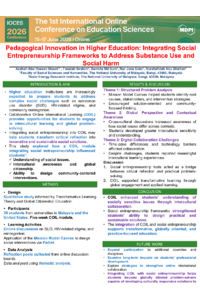
15.6.26_IOCES POSTER.pdf
Quality improvement and innovation in higher education systems
Teachers’ Interest, Self-Confidence, and Ability to Integrate Historical Scientific Instruments into Their Teaching