Event submissions
Published
This submission belongs to the session S2. Higher Education of the event The 1st International Online Conference on Education Sciences
Published date
10 Jun, 2026
Academic Editor
'%3e%3cpath%20d='M12.6657%2010.9104C12.4185%2010.325%2012.0599%209.79327%2011.6097%209.34482C11.1609%208.89508%2010.6293%208.5365%2010.0442%208.28888C10.0389%208.28626%2010.0337%208.28495%2010.0285%208.28233C10.8446%207.69279%2011.3752%206.73249%2011.3752%205.64904C11.3752%203.8542%209.92103%202.39999%208.1262%202.39999C6.33136%202.39999%204.87715%203.8542%204.87715%205.64904C4.87715%206.73249%205.40774%207.69279%206.22393%208.28364C6.21869%208.28626%206.21345%208.28757%206.20821%208.29019C5.62129%208.5378%205.09463%208.89284%204.64265%209.34613C4.1929%209.79493%203.83432%2010.3266%203.58671%2010.9117C3.34345%2011.4845%203.21226%2012.0987%203.20023%2012.7209C3.19988%2012.7349%203.20233%2012.7488%203.20744%2012.7619C3.21255%2012.7749%203.22022%2012.7867%203.22998%2012.7968C3.23975%2012.8068%203.25142%2012.8147%203.26431%2012.8202C3.2772%2012.8256%203.29105%2012.8284%203.30504%2012.8284H4.09109C4.14874%2012.8284%204.19459%2012.7825%204.1959%2012.7262C4.2221%2011.7148%204.62823%2010.7676%205.34617%2010.0497C6.08899%209.30683%207.0755%208.89808%208.1262%208.89808C9.17689%208.89808%2010.1634%209.30683%2010.9062%2010.0497C11.6242%2010.7676%2012.0303%2011.7148%2012.0565%2012.7262C12.0578%2012.7838%2012.1037%2012.8284%2012.1613%2012.8284H12.9474C12.9613%2012.8284%2012.9752%2012.8256%2012.9881%2012.8202C13.001%2012.8147%2013.0126%2012.8068%2013.0224%2012.7968C13.0322%2012.7867%2013.0398%2012.7749%2013.0449%2012.7619C13.0501%2012.7488%2013.0525%2012.7349%2013.0522%2012.7209C13.0391%2012.0947%2012.9094%2011.4855%2012.6657%2010.9104ZM8.1262%207.9024C7.52486%207.9024%206.9589%207.6679%206.53312%207.24211C6.10733%206.81633%205.87283%206.25037%205.87283%205.64904C5.87283%205.0477%206.10733%204.48174%206.53312%204.05596C6.9589%203.63018%207.52486%203.39567%208.1262%203.39567C8.72753%203.39567%209.29349%203.63018%209.71927%204.05596C10.1451%204.48174%2010.3796%205.0477%2010.3796%205.64904C10.3796%206.25037%2010.1451%206.81633%209.71927%207.24211C9.29349%207.6679%208.72753%207.9024%208.1262%207.9024Z'%20fill='%235D1EE1'/%3e%3c/g%3e%3c/svg%3e) EMILIO ABAD-SEGURA
EMILIO ABAD-SEGURACitation
Murat Almukhambetov, Elmira Almukhambetova, Multilingual Educational Environment as a Factor of Communication Quality and Teamwork Efficiency in Emergency Medical Training, in Proceedings of The 1st International Online Conference on Education Sciences, 15 June–17 June 2026, MDPI: Basel, Switzerland
Share
Email
Facebook
Twitter
LinkedIn
Multilingual Educational Environment as a Factor of Communication Quality and Teamwork Efficiency in Emergency Medical Training
'%3e%3cpath%20d='M12.6647%2010.9104C12.4176%2010.325%2012.0589%209.7933%2011.6088%209.34485C11.16%208.89511%2010.6283%208.53653%2010.0432%208.28891C10.038%208.28629%2010.0327%208.28498%2010.0275%208.28236C10.8437%207.69282%2011.3743%206.73252%2011.3743%205.64907C11.3743%203.85423%209.92005%202.40002%208.12522%202.40002C6.33038%202.40002%204.87618%203.85423%204.87618%205.64907C4.87618%206.73252%205.40677%207.69282%206.22296%208.28367C6.21772%208.28629%206.21248%208.2876%206.20724%208.29022C5.62031%208.53783%205.09365%208.89287%204.64167%209.34616C4.19192%209.79496%203.83334%2010.3266%203.58573%2010.9117C3.34247%2011.4846%203.21128%2012.0987%203.19925%2012.721C3.1989%2012.735%203.20135%2012.7489%203.20646%2012.7619C3.21157%2012.7749%203.21924%2012.7868%203.22901%2012.7968C3.23877%2012.8068%203.25045%2012.8148%203.26334%2012.8202C3.27623%2012.8256%203.29007%2012.8284%203.30406%2012.8284H4.09012C4.14776%2012.8284%204.19362%2012.7825%204.19493%2012.7262C4.22113%2011.7148%204.62726%2010.7676%205.34519%2010.0497C6.08802%209.30686%207.07452%208.89811%208.12522%208.89811C9.17592%208.89811%2010.1624%209.30686%2010.9052%2010.0497C11.6232%2010.7676%2012.0293%2011.7148%2012.0555%2012.7262C12.0568%2012.7839%2012.1027%2012.8284%2012.1603%2012.8284H12.9464C12.9604%2012.8284%2012.9742%2012.8256%2012.9871%2012.8202C13%2012.8148%2013.0117%2012.8068%2013.0214%2012.7968C13.0312%2012.7868%2013.0389%2012.7749%2013.044%2012.7619C13.0491%2012.7489%2013.0515%2012.735%2013.0512%2012.721C13.0381%2012.0947%2012.9084%2011.4856%2012.6647%2010.9104ZM8.12522%207.90243C7.52388%207.90243%206.95792%207.66793%206.53214%207.24215C6.10636%206.81636%205.87185%206.2504%205.87185%205.64907C5.87185%205.04773%206.10636%204.48177%206.53214%204.05599C6.95792%203.63021%207.52388%203.3957%208.12522%203.3957C8.72655%203.3957%209.29252%203.63021%209.7183%204.05599C10.1441%204.48177%2010.3786%205.04773%2010.3786%205.64907C10.3786%206.2504%2010.1441%206.81636%209.7183%207.24215C9.29252%207.66793%208.72655%207.90243%208.12522%207.90243Z'%20fill='%235D1EE1'/%3e%3c/g%3e%3c/svg%3e)
Murat Almukhambetov 1
Elmira Almukhambetova 1
1. Department of Emergency and Urgent Medical Care, S.D. Asfendiyarov Kazakh National Medical University, Almaty, Kazakhstan
Abstract
Background:
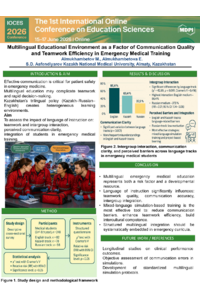
In emergency and urgent care, communication errors can jeopardize patient safety. Multilingual educational settings may intensify these risks by complicating teamwork and rapid clinical decision‑making. Kazakhstan’s trilingual higher‑education policy (Kazakh–Russian–English) provides a relevant context to examine how the language of instruction shapes students’ interactions and perceived communication clarity.
Aim:
This study examined how different language tracks influence teamwork, perceived communication barriers, and intergroup integration among emergency medical students.
Methods: A descriptive cross-sectional survey was conducted among 248 third- to fifth-year medical students enrolled in English (n=82), Kazakh (n=78), and Russian (n=88) programs at a university emergency care department. A structured questionnaire (10-point Likert items plus one open-ended question) demonstrated good internal consistency (Cronbach’s α=0.82). Group differences were tested using χ² with Cramer’s V, and relative risks (RRs) were calculated (p<0.05).
Results:
Intergroup interactions differed by language track (χ²=42.90, p<0.001; V=0.416). English‑medium students showed the highest interaction (86.4%) compared with Russian‑medium students (37.5%; RR=2.31, 95% CI: 1.74–3.06). Communication clarity also varied (p<0.001): misunderstandings were more common in English‑ and Kazakh‑medium groups, while Russian‑medium students more often reported none. Barriers differed—language difficulties dominated in English/Kazakh tracks, whereas low motivation was typical for Russian‑medium students. Mixed‑team simulations and project‑based learning were viewed as the most effective integration methods.
Conclusion:
Multilingual emergency medicine education is both a challenge and a resource. Structured intergroup activities—especially mixed‑language simulation training—can improve teamwork, communication accuracy, and intercultural competence, while also reinforcing students’ readiness to work in linguistically diverse clinical settings.
Keywords
emergency medical education
multilingualism
intercultural competence
patient safety
simulation-based training
Poster
постер по образован про IOCES 2026.pdf
From Needs Assessment to Training Design: A Project-Based Learning Case Study on University–Community Engagement in Higher Education.
Foreign Language Education for Specific Purposes in the Context of Sustainable Development