Event submissions
Published
This submission belongs to the session S5. STEM Education of the event The 1st International Online Conference on Education Sciences
Published date
10 Jun, 2026
Academic Editor
'%3e%3cpath%20d='M12.6657%2010.9104C12.4185%2010.325%2012.0599%209.79327%2011.6097%209.34482C11.1609%208.89508%2010.6293%208.5365%2010.0442%208.28888C10.0389%208.28626%2010.0337%208.28495%2010.0285%208.28233C10.8446%207.69279%2011.3752%206.73249%2011.3752%205.64904C11.3752%203.8542%209.92103%202.39999%208.1262%202.39999C6.33136%202.39999%204.87715%203.8542%204.87715%205.64904C4.87715%206.73249%205.40774%207.69279%206.22393%208.28364C6.21869%208.28626%206.21345%208.28757%206.20821%208.29019C5.62129%208.5378%205.09463%208.89284%204.64265%209.34613C4.1929%209.79493%203.83432%2010.3266%203.58671%2010.9117C3.34345%2011.4845%203.21226%2012.0987%203.20023%2012.7209C3.19988%2012.7349%203.20233%2012.7488%203.20744%2012.7619C3.21255%2012.7749%203.22022%2012.7867%203.22998%2012.7968C3.23975%2012.8068%203.25142%2012.8147%203.26431%2012.8202C3.2772%2012.8256%203.29105%2012.8284%203.30504%2012.8284H4.09109C4.14874%2012.8284%204.19459%2012.7825%204.1959%2012.7262C4.2221%2011.7148%204.62823%2010.7676%205.34617%2010.0497C6.08899%209.30683%207.0755%208.89808%208.1262%208.89808C9.17689%208.89808%2010.1634%209.30683%2010.9062%2010.0497C11.6242%2010.7676%2012.0303%2011.7148%2012.0565%2012.7262C12.0578%2012.7838%2012.1037%2012.8284%2012.1613%2012.8284H12.9474C12.9613%2012.8284%2012.9752%2012.8256%2012.9881%2012.8202C13.001%2012.8147%2013.0126%2012.8068%2013.0224%2012.7968C13.0322%2012.7867%2013.0398%2012.7749%2013.0449%2012.7619C13.0501%2012.7488%2013.0525%2012.7349%2013.0522%2012.7209C13.0391%2012.0947%2012.9094%2011.4855%2012.6657%2010.9104ZM8.1262%207.9024C7.52486%207.9024%206.9589%207.6679%206.53312%207.24211C6.10733%206.81633%205.87283%206.25037%205.87283%205.64904C5.87283%205.0477%206.10733%204.48174%206.53312%204.05596C6.9589%203.63018%207.52486%203.39567%208.1262%203.39567C8.72753%203.39567%209.29349%203.63018%209.71927%204.05596C10.1451%204.48174%2010.3796%205.0477%2010.3796%205.64904C10.3796%206.25037%2010.1451%206.81633%209.71927%207.24211C9.29349%207.6679%208.72753%207.9024%208.1262%207.9024Z'%20fill='%235D1EE1'/%3e%3c/g%3e%3c/svg%3e) Daniel Muijs
Daniel MuijsCitation
Ana Serradó Bayés, Maria Meletiou-Mavrotheris, Dionysia Bakogianni, Michalis Gravrielides, María Lucia Vargas, Learning Scenarios as Boundary Objects: A Multi-Country Study on Integrating Data Science, STEAM, and Social Justice in Teacher Education, in Proceedings of The 1st International Online Conference on Education Sciences, 15 June–17 June 2026, MDPI: Basel, Switzerland
Share
Email
Facebook
Twitter
LinkedIn
Learning Scenarios as Boundary Objects: A Multi-Country Study on Integrating Data Science, STEAM, and Social Justice in Teacher Education
'%3e%3cpath%20d='M12.6647%2010.9104C12.4176%2010.325%2012.0589%209.7933%2011.6088%209.34485C11.16%208.89511%2010.6283%208.53653%2010.0432%208.28891C10.038%208.28629%2010.0327%208.28498%2010.0275%208.28236C10.8437%207.69282%2011.3743%206.73252%2011.3743%205.64907C11.3743%203.85423%209.92005%202.40002%208.12522%202.40002C6.33038%202.40002%204.87618%203.85423%204.87618%205.64907C4.87618%206.73252%205.40677%207.69282%206.22296%208.28367C6.21772%208.28629%206.21248%208.2876%206.20724%208.29022C5.62031%208.53783%205.09365%208.89287%204.64167%209.34616C4.19192%209.79496%203.83334%2010.3266%203.58573%2010.9117C3.34247%2011.4846%203.21128%2012.0987%203.19925%2012.721C3.1989%2012.735%203.20135%2012.7489%203.20646%2012.7619C3.21157%2012.7749%203.21924%2012.7868%203.22901%2012.7968C3.23877%2012.8068%203.25045%2012.8148%203.26334%2012.8202C3.27623%2012.8256%203.29007%2012.8284%203.30406%2012.8284H4.09012C4.14776%2012.8284%204.19362%2012.7825%204.19493%2012.7262C4.22113%2011.7148%204.62726%2010.7676%205.34519%2010.0497C6.08802%209.30686%207.07452%208.89811%208.12522%208.89811C9.17592%208.89811%2010.1624%209.30686%2010.9052%2010.0497C11.6232%2010.7676%2012.0293%2011.7148%2012.0555%2012.7262C12.0568%2012.7839%2012.1027%2012.8284%2012.1603%2012.8284H12.9464C12.9604%2012.8284%2012.9742%2012.8256%2012.9871%2012.8202C13%2012.8148%2013.0117%2012.8068%2013.0214%2012.7968C13.0312%2012.7868%2013.0389%2012.7749%2013.044%2012.7619C13.0491%2012.7489%2013.0515%2012.735%2013.0512%2012.721C13.0381%2012.0947%2012.9084%2011.4856%2012.6647%2010.9104ZM8.12522%207.90243C7.52388%207.90243%206.95792%207.66793%206.53214%207.24215C6.10636%206.81636%205.87185%206.2504%205.87185%205.64907C5.87185%205.04773%206.10636%204.48177%206.53214%204.05599C6.95792%203.63021%207.52388%203.3957%208.12522%203.3957C8.72655%203.3957%209.29252%203.63021%209.7183%204.05599C10.1441%204.48177%2010.3786%205.04773%2010.3786%205.64907C10.3786%206.2504%2010.1441%206.81636%209.7183%207.24215C9.29252%207.66793%208.72655%207.90243%208.12522%207.90243Z'%20fill='%235D1EE1'/%3e%3c/g%3e%3c/svg%3e)
Ana Serradó Bayés 1

Maria Meletiou-Mavrotheris 2
Dionysia Bakogianni 3
Michalis Gravrielides 4
María Lucia Vargas 5
1. STEM department, Colegio La Salle-Buen Consejo, Puerto Real, 11510, Spain
2. Department of Education Sciences, School of Humanities, Social & Education Sciences, European University of Cypus (EUC), 6, Diogenes Str., Engomi, 1516 Nicosia, Cyprus
3. Deparment of Mathematics and Computer Science, Karlstad University, Karlstad, 65188, Sweden
4. Mathematics Department, The English School, 1684, Nicosia, Cyprus
5. Department of Erasmus Projects, Colegio La Salle-Buen Consejo, 11510 Puerto Real, Cádiz
Abstract
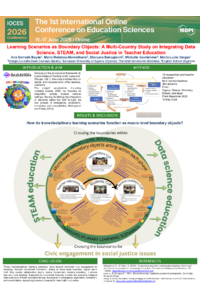
Drawing on the sociocultural framework of Communities of Practice, this study analizes the co-design and implementation of ten learning scenarios within the DataScEd4CiEn project. The research investigates how transdisciplinary learning scenarios function as macro-level boundaray objects that facilitate the reification of practice among researchers, teacher-educators, and in-service teachers from Cyprus, Germany, Greece, Ireland and Spain. Using a mixed-methods approach, the study traces how micro-level boundary objects—such as social justice problems, datasets, design templates, and inquiry questions—support collaboration across professional boundaries and curriculum subject areas. The analysis follows the trajectory of scenario integration across four phases: emergence, exploration, immersion, and consolidation. During the emergence and exploration phases, the study examines how these boundary objects were employed by researchers and teacher-educators, acting as brokers supporting teachers in navigating the disciplinary "silo effect" and coordinating the co-design of scenarios aimed at advancing data science education within STEAM for civic engagement. In the immersion phase, the focus shifted to classroom enactment, analyzing how in-service teachers and students use these boundary objects to connect complex social justice issues with curricular learning goals and to transition from descriptive to exploratory data practices while fostering civic engagement. Finally, the consolidation phase, informed by teacher reflection sheets and focus group discussions, examines how these practices became integrated into the teachers' shared repertoire. The findings suggest that learning scenarios grounded in meaningful social justice contexts can function as generative mediating structures in in-service teacher education, supporting the integration of data science within STEAM while promoting collaborative inquiry and civic engagement.
Keywords
Communities of practice
Boundary-objects
STEAM education
Data-Science
Social-Justice-Issues
Civic-Engagement
Poster
DataScEd4CiEn_IOCES poster.pdf
Between Barriers and Possibilities: The Medical Experience in Communication with Non-Verbal Autistic Children
ArInLi Erasmus+ Project: Open, Accessibility‑First AI Literacy for Inclusive Secondary Education