Event submissions
Published
This submission belongs to the session S4. Special and Inclusive Education of the event The 1st International Online Conference on Education Sciences
Published date
10 Jun, 2026
Academic Editor
'%3e%3cpath%20d='M12.6657%2010.9104C12.4185%2010.325%2012.0599%209.79327%2011.6097%209.34482C11.1609%208.89508%2010.6293%208.5365%2010.0442%208.28888C10.0389%208.28626%2010.0337%208.28495%2010.0285%208.28233C10.8446%207.69279%2011.3752%206.73249%2011.3752%205.64904C11.3752%203.8542%209.92103%202.39999%208.1262%202.39999C6.33136%202.39999%204.87715%203.8542%204.87715%205.64904C4.87715%206.73249%205.40774%207.69279%206.22393%208.28364C6.21869%208.28626%206.21345%208.28757%206.20821%208.29019C5.62129%208.5378%205.09463%208.89284%204.64265%209.34613C4.1929%209.79493%203.83432%2010.3266%203.58671%2010.9117C3.34345%2011.4845%203.21226%2012.0987%203.20023%2012.7209C3.19988%2012.7349%203.20233%2012.7488%203.20744%2012.7619C3.21255%2012.7749%203.22022%2012.7867%203.22998%2012.7968C3.23975%2012.8068%203.25142%2012.8147%203.26431%2012.8202C3.2772%2012.8256%203.29105%2012.8284%203.30504%2012.8284H4.09109C4.14874%2012.8284%204.19459%2012.7825%204.1959%2012.7262C4.2221%2011.7148%204.62823%2010.7676%205.34617%2010.0497C6.08899%209.30683%207.0755%208.89808%208.1262%208.89808C9.17689%208.89808%2010.1634%209.30683%2010.9062%2010.0497C11.6242%2010.7676%2012.0303%2011.7148%2012.0565%2012.7262C12.0578%2012.7838%2012.1037%2012.8284%2012.1613%2012.8284H12.9474C12.9613%2012.8284%2012.9752%2012.8256%2012.9881%2012.8202C13.001%2012.8147%2013.0126%2012.8068%2013.0224%2012.7968C13.0322%2012.7867%2013.0398%2012.7749%2013.0449%2012.7619C13.0501%2012.7488%2013.0525%2012.7349%2013.0522%2012.7209C13.0391%2012.0947%2012.9094%2011.4855%2012.6657%2010.9104ZM8.1262%207.9024C7.52486%207.9024%206.9589%207.6679%206.53312%207.24211C6.10733%206.81633%205.87283%206.25037%205.87283%205.64904C5.87283%205.0477%206.10733%204.48174%206.53312%204.05596C6.9589%203.63018%207.52486%203.39567%208.1262%203.39567C8.72753%203.39567%209.29349%203.63018%209.71927%204.05596C10.1451%204.48174%2010.3796%205.0477%2010.3796%205.64904C10.3796%206.25037%2010.1451%206.81633%209.71927%207.24211C9.29349%207.6679%208.72753%207.9024%208.1262%207.9024Z'%20fill='%235D1EE1'/%3e%3c/g%3e%3c/svg%3e) Garry Hornby
Garry HornbyCitation
Sahas bhandari, Training Effectiveness of Individual Education Plan for Children with Neurodiverse Conditions in Community School of Kathmandu Metropolitan City, in Proceedings of The 1st International Online Conference on Education Sciences, 15 June–17 June 2026, MDPI: Basel, Switzerland
Share
Email
Facebook
Twitter
LinkedIn
Training Effectiveness of Individual Education Plan for Children with Neurodiverse Conditions in Community School of Kathmandu Metropolitan City

Sahas bhandari 1
1. Department of Inclusive Education, Early Childhood Development and Professional Studies, Kathmandu University School of Education Hattiban Lalitpur Nepal, Kathmandu, Nepal, 44605 (Dillibazar Post Code), Nepal.
Abstract
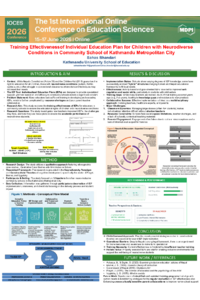
This paper poses some research questions against which it studies the execution and efficacy of Individualized Education Programs (IEPs) in neuro-inclusive schools in Kathmandu Metropolitan area with reference to different individual needs, such as autism, ADHD, cerebral palsy and deaf–blindness. The research is informed by the neurodiversity paradigm and shaped through the Piaget, Bruner, and Vygotsky cognitive developmental theories, and the study is applied under ethnographic approaches and qualitative case studies in four neuro-inclusive schools. The results indicate different degrees of knowledge and use of IEPs in institutions. While certain schools evolve hybrid forms of Korean and Nepali structure, others face challenges such as ineffective instruction of teachers, absence of resources, and poor maintenance of parental interest. According to teachers, IEPs provide a wonderful background in helping them achieve their learning outcomes, but the constraints are usually confined to space limits, teacher shortages and the intricacy of addressing various learners' needs on the same platform (classroom). Notwithstanding these difficulties, there exists evidence of better self-regulation and developing social skills, especially in students with mild cases of autism, with the adaptive, activity-based IEPs playing a role. To improve inclusive education processes, the study reinforces the importance of lifelong professional learning, cross-culturally sensitive parent collaborations, and culturally contextual education-related resources. It finds that the flexible, developmentally-based and child-centered approach, rooted in the developmental theories, is critical to the sound implementation of the IEP in the neurodiverse ecology of learning settings.
Keywords
Inclusive Education Book Free Friday IEP Training
Poster
SAHAS BHANDARI SCIENCE FORUM 2026 POSTER ppt.pdf
From Teaching Model to Success Model: Active Learning in a Core Engineering Course
Exploring Topology in Secondary Education through Game-Based Learning