Event submissions
Published
This submission belongs to the session S5. STEM Education of the event The 1st International Online Conference on Education Sciences
Published date
10 Jun, 2026
Academic Editor
'%3e%3cpath%20d='M12.6657%2010.9104C12.4185%2010.325%2012.0599%209.79327%2011.6097%209.34482C11.1609%208.89508%2010.6293%208.5365%2010.0442%208.28888C10.0389%208.28626%2010.0337%208.28495%2010.0285%208.28233C10.8446%207.69279%2011.3752%206.73249%2011.3752%205.64904C11.3752%203.8542%209.92103%202.39999%208.1262%202.39999C6.33136%202.39999%204.87715%203.8542%204.87715%205.64904C4.87715%206.73249%205.40774%207.69279%206.22393%208.28364C6.21869%208.28626%206.21345%208.28757%206.20821%208.29019C5.62129%208.5378%205.09463%208.89284%204.64265%209.34613C4.1929%209.79493%203.83432%2010.3266%203.58671%2010.9117C3.34345%2011.4845%203.21226%2012.0987%203.20023%2012.7209C3.19988%2012.7349%203.20233%2012.7488%203.20744%2012.7619C3.21255%2012.7749%203.22022%2012.7867%203.22998%2012.7968C3.23975%2012.8068%203.25142%2012.8147%203.26431%2012.8202C3.2772%2012.8256%203.29105%2012.8284%203.30504%2012.8284H4.09109C4.14874%2012.8284%204.19459%2012.7825%204.1959%2012.7262C4.2221%2011.7148%204.62823%2010.7676%205.34617%2010.0497C6.08899%209.30683%207.0755%208.89808%208.1262%208.89808C9.17689%208.89808%2010.1634%209.30683%2010.9062%2010.0497C11.6242%2010.7676%2012.0303%2011.7148%2012.0565%2012.7262C12.0578%2012.7838%2012.1037%2012.8284%2012.1613%2012.8284H12.9474C12.9613%2012.8284%2012.9752%2012.8256%2012.9881%2012.8202C13.001%2012.8147%2013.0126%2012.8068%2013.0224%2012.7968C13.0322%2012.7867%2013.0398%2012.7749%2013.0449%2012.7619C13.0501%2012.7488%2013.0525%2012.7349%2013.0522%2012.7209C13.0391%2012.0947%2012.9094%2011.4855%2012.6657%2010.9104ZM8.1262%207.9024C7.52486%207.9024%206.9589%207.6679%206.53312%207.24211C6.10733%206.81633%205.87283%206.25037%205.87283%205.64904C5.87283%205.0477%206.10733%204.48174%206.53312%204.05596C6.9589%203.63018%207.52486%203.39567%208.1262%203.39567C8.72753%203.39567%209.29349%203.63018%209.71927%204.05596C10.1451%204.48174%2010.3796%205.0477%2010.3796%205.64904C10.3796%206.25037%2010.1451%206.81633%209.71927%207.24211C9.29349%207.6679%208.72753%207.9024%208.1262%207.9024Z'%20fill='%235D1EE1'/%3e%3c/g%3e%3c/svg%3e) Kelum Gamage
Kelum GamageCitation
María Sánchez-Jiménez, Diego Vergara, Antonio Del Bosque, Pablo Férnandez-Arias, Understanding the gender gap in STEAM from a teaching perspective, in Proceedings of The 1st International Online Conference on Education Sciences, 15 June–17 June 2026, MDPI: Basel, Switzerland
Share
Email
Facebook
Twitter
LinkedIn
Understanding the gender gap in STEAM from a teaching perspective

María Sánchez-Jiménez 1

Diego Vergara 1

Antonio Del Bosque 1

Pablo Férnandez-Arias 1
1. Technology, Instruction and Design in Engineering and Education Research Group (TiDEE.rg), Catholic University of Ávila, C/Canteros s/n, 05005 Ávila, Spain.
Abstract
Introduction:
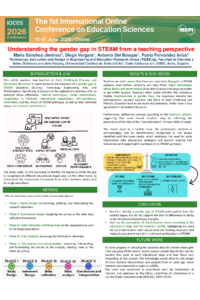
This paper examines the perceptions of early childhood, primary, and secondary school teachers in Spain regarding the existence of a gender gap in subjects related to STEAM (Science, Technology, Engineering, Arts, and Mathematics) disciplines. The main objective is to identify how teachers interpret these inequalities and to what extent they consider them to influence students' academic performance.
Method:
A descriptive study was conducted based on the collection and analysis of responses from teachers at different educational levels in Spain. The questionnaire addressed aspects related to the perception of gender stereotypes, student confidence and motivation in STEAM subjects, and the differential expectations and attitudes between girls and boys.
Results:
The results show that most teachers recognize the existence of perceptible gender differences from the early stages of education. These perceptions suggest that girls tend to show less confidence and motivation in subjects related to technology and engineering, while boys are perceived as more inclined to participate in them. This situation could be influencing future university and professional studies, contributing to the persistence of inequality in these traditionally masculinized STEAM fields.
Conclusions:
The study concludes by highlighting the need to delve deeper into the factors that create and sustain this gap, such as role models, implicit messages in the classroom, and the influence of the social and family environment. It also underscores the importance of designing and implementing pedagogical strategies that promote equal opportunities and spark interest in STEAM disciplines among all students from an early age.
Keywords
gender gap
STEAM education
teachers,
Poster
IOCES. Gender gap in STEAM (4).pdf
Empowering Teachers to Foster Data Science Literacy for Civic Engagement and Social Justice: Design-Based Approach
Smartphone-Assisted Pocket Experiments in Teacher Education for Promoting Inquiry-Based Science Learning