Event submissions
Published
This submission belongs to the session S6. Teacher Education of the event The 1st International Online Conference on Education Sciences
Published date
10 Jun, 2026
Academic Editor
'%3e%3cpath%20d='M12.6657%2010.9104C12.4185%2010.325%2012.0599%209.79327%2011.6097%209.34482C11.1609%208.89508%2010.6293%208.5365%2010.0442%208.28888C10.0389%208.28626%2010.0337%208.28495%2010.0285%208.28233C10.8446%207.69279%2011.3752%206.73249%2011.3752%205.64904C11.3752%203.8542%209.92103%202.39999%208.1262%202.39999C6.33136%202.39999%204.87715%203.8542%204.87715%205.64904C4.87715%206.73249%205.40774%207.69279%206.22393%208.28364C6.21869%208.28626%206.21345%208.28757%206.20821%208.29019C5.62129%208.5378%205.09463%208.89284%204.64265%209.34613C4.1929%209.79493%203.83432%2010.3266%203.58671%2010.9117C3.34345%2011.4845%203.21226%2012.0987%203.20023%2012.7209C3.19988%2012.7349%203.20233%2012.7488%203.20744%2012.7619C3.21255%2012.7749%203.22022%2012.7867%203.22998%2012.7968C3.23975%2012.8068%203.25142%2012.8147%203.26431%2012.8202C3.2772%2012.8256%203.29105%2012.8284%203.30504%2012.8284H4.09109C4.14874%2012.8284%204.19459%2012.7825%204.1959%2012.7262C4.2221%2011.7148%204.62823%2010.7676%205.34617%2010.0497C6.08899%209.30683%207.0755%208.89808%208.1262%208.89808C9.17689%208.89808%2010.1634%209.30683%2010.9062%2010.0497C11.6242%2010.7676%2012.0303%2011.7148%2012.0565%2012.7262C12.0578%2012.7838%2012.1037%2012.8284%2012.1613%2012.8284H12.9474C12.9613%2012.8284%2012.9752%2012.8256%2012.9881%2012.8202C13.001%2012.8147%2013.0126%2012.8068%2013.0224%2012.7968C13.0322%2012.7867%2013.0398%2012.7749%2013.0449%2012.7619C13.0501%2012.7488%2013.0525%2012.7349%2013.0522%2012.7209C13.0391%2012.0947%2012.9094%2011.4855%2012.6657%2010.9104ZM8.1262%207.9024C7.52486%207.9024%206.9589%207.6679%206.53312%207.24211C6.10733%206.81633%205.87283%206.25037%205.87283%205.64904C5.87283%205.0477%206.10733%204.48174%206.53312%204.05596C6.9589%203.63018%207.52486%203.39567%208.1262%203.39567C8.72753%203.39567%209.29349%203.63018%209.71927%204.05596C10.1451%204.48174%2010.3796%205.0477%2010.3796%205.64904C10.3796%206.25037%2010.1451%206.81633%209.71927%207.24211C9.29349%207.6679%208.72753%207.9024%208.1262%207.9024Z'%20fill='%235D1EE1'/%3e%3c/g%3e%3c/svg%3e) Daniel Muijs
Daniel MuijsCitation
Emese Beáta Berei, Supportive Behavior of Senior University Teachers Aged Over 45, in Proceedings of The 1st International Online Conference on Education Sciences, 15 June–17 June 2026, MDPI: Basel, Switzerland
Share
Email
Facebook
Twitter
LinkedIn
Supportive Behavior of Senior University Teachers Aged Over 45

Emese Beáta Berei 1
1. Social Work and Family Counseling in the Community MA Program, Emanuel University of Oradea, 410597 Oradea, România.
Abstract
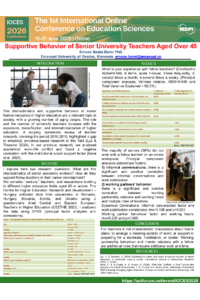
The characteristics and supportive behaviour of senior human resources in higher education are a relevant topic in society, with a growing number of aging people. The role and the number of university teachers increase with the expansion, massification, and internationalization of higher education. A scoping systematic review of teacher research, covering the period 2010-2019, highlighted a gap in empirical, evidence-based research in this field. In our previous research, we analysed academics' work–life conflict and found a negative correlation with the institutional social support factor. I explore here two research questions: What are the characteristics of senior academic workers? How do they support fellow teachers in their career development? We consider “seniors,” teachers, and researchers working in different higher education fields aged 45 or above. The Centre for Higher Education Research and Development – Hungary collected data from universities in Romania, Hungary, Slovakia, Serbia, and Ukraine using a questionnaire titled Central and Eastern European Teachers in Higher Education (CEETHE 2023). We analysed the data using SPSS (principal factor analyses and correlations). A total of 432 respondents were seniors aged 45 and older. More than half of the teachers discussed educational, scientific, or other topics with a fellow teacher or worked as a co-author in a research group, not characteristic discussions about future plans; to arrange a meeting outside of work; or support in preparing for a doctorate, habilitation, or tender. The majority of seniors (56%) did not work with a fellow teacher on an online workspace. Principal component analyses yielded two factors: 1) informal conversations and 2) working partners' behaviour. There is a significant and positive correlation between informal conversations and work satisfaction; working partnership relations with working hours; and multiple roles of teachers. Working partnership behaviour and mentor relations with a fellow are additional roles that require additional work and time.
Keywords
supporting behavior
work satisfaction
aging teachers
partnerships
cross border analyses
Poster
PosterBereiE (2).pdf
Proposals for science education in early years: implications for teacher training
From Trash to Class: Teaching Kindergarten Mathematics Using Child-authored Repurposed Materials.