Event submissions
Published
This submission belongs to the session S6. Teacher Education of the event The 1st International Online Conference on Education Sciences
Published date
10 Jun, 2026
Academic Editor
'%3e%3cpath%20d='M12.6657%2010.9104C12.4185%2010.325%2012.0599%209.79327%2011.6097%209.34482C11.1609%208.89508%2010.6293%208.5365%2010.0442%208.28888C10.0389%208.28626%2010.0337%208.28495%2010.0285%208.28233C10.8446%207.69279%2011.3752%206.73249%2011.3752%205.64904C11.3752%203.8542%209.92103%202.39999%208.1262%202.39999C6.33136%202.39999%204.87715%203.8542%204.87715%205.64904C4.87715%206.73249%205.40774%207.69279%206.22393%208.28364C6.21869%208.28626%206.21345%208.28757%206.20821%208.29019C5.62129%208.5378%205.09463%208.89284%204.64265%209.34613C4.1929%209.79493%203.83432%2010.3266%203.58671%2010.9117C3.34345%2011.4845%203.21226%2012.0987%203.20023%2012.7209C3.19988%2012.7349%203.20233%2012.7488%203.20744%2012.7619C3.21255%2012.7749%203.22022%2012.7867%203.22998%2012.7968C3.23975%2012.8068%203.25142%2012.8147%203.26431%2012.8202C3.2772%2012.8256%203.29105%2012.8284%203.30504%2012.8284H4.09109C4.14874%2012.8284%204.19459%2012.7825%204.1959%2012.7262C4.2221%2011.7148%204.62823%2010.7676%205.34617%2010.0497C6.08899%209.30683%207.0755%208.89808%208.1262%208.89808C9.17689%208.89808%2010.1634%209.30683%2010.9062%2010.0497C11.6242%2010.7676%2012.0303%2011.7148%2012.0565%2012.7262C12.0578%2012.7838%2012.1037%2012.8284%2012.1613%2012.8284H12.9474C12.9613%2012.8284%2012.9752%2012.8256%2012.9881%2012.8202C13.001%2012.8147%2013.0126%2012.8068%2013.0224%2012.7968C13.0322%2012.7867%2013.0398%2012.7749%2013.0449%2012.7619C13.0501%2012.7488%2013.0525%2012.7349%2013.0522%2012.7209C13.0391%2012.0947%2012.9094%2011.4855%2012.6657%2010.9104ZM8.1262%207.9024C7.52486%207.9024%206.9589%207.6679%206.53312%207.24211C6.10733%206.81633%205.87283%206.25037%205.87283%205.64904C5.87283%205.0477%206.10733%204.48174%206.53312%204.05596C6.9589%203.63018%207.52486%203.39567%208.1262%203.39567C8.72753%203.39567%209.29349%203.63018%209.71927%204.05596C10.1451%204.48174%2010.3796%205.0477%2010.3796%205.64904C10.3796%206.25037%2010.1451%206.81633%209.71927%207.24211C9.29349%207.6679%208.72753%207.9024%208.1262%207.9024Z'%20fill='%235D1EE1'/%3e%3c/g%3e%3c/svg%3e) Daniel Muijs
Daniel MuijsCitation
Thulani Andrew Chauke, Educational stakeholders’ perceptions of factors contributing to resistance to pedagogical and policy changes in rural schools, in Proceedings of The 1st International Online Conference on Education Sciences, 15 June–17 June 2026, MDPI: Basel, Switzerland
Share
Email
Facebook
Twitter
LinkedIn
Educational stakeholders’ perceptions of factors contributing to resistance to pedagogical and policy changes in rural schools

Thulani Andrew Chauke 1
1. Department of Adult Community and Continuing Education, School of Educational Studies, College of Education, University of South Africa, Pretoria 0003, South Africa.
Abstract
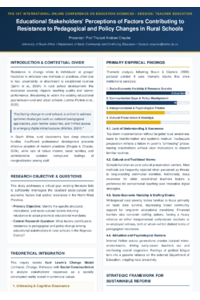
The aim of this study is to explore the factors that contribute to educational stakeholders' resistance to pedagogical and policy changes in rural schools in the Bojanala District, South Africa. In this qualitative study, fifteen volunteers comprising five members of the School Governing Body (SGB), five members of the School Management Team (SMT), and five Grade 12 learners were purposively sampled to participate in this study to share their lived experience concerning the phenomenon under investigation. The findings revealed various factors contributing to resistance to pedagogical and policy changes among educational stakeholders in rural schools. These factors included lack of understanding and awareness, cultural and traditional beliefs, socioeconomic challenges, and attitudinal and psychological barriers. In relation to the study at hand, Lewin’s Change Model was adopted, and actors, context, and opportunities were organized to examine the factors facilitating resistance to change among major stakeholders in rural schools in Bojanala District. The study showed that the quality of teaching is being affected with regard to limited implementation of curriculum innovations, learner disengagement and low motivation, and erosion of school culture and morale. To mitigate resistance, the study advocates for a multi-tiered integration strategy: establishing transparent stakeholder communication frameworks to align policy with local realities; institutionalizing sustained, context-specific professional development; and fostering transformational leadership capable of modelling pedagogical shifts within the unique socio-economic constraints of rural environments.
Keywords
Curriculum innovations
educational stakeholders
leadership support
resistance to change
rural schools.
Poster
educational_stakeholders resistance CHAUKE TA Poster.pdf
Implementing culturally responsive and sustaining teaching practice through primary science in Aotearoa New Zealand
Creative thinking skills: The perceptions, practices, and challenges of Moroccan English first-language teachers