Event submissions
Published
This submission belongs to the session S5. STEM Education of the event The 1st International Online Conference on Education Sciences
Published date
10 Jun, 2026
Academic Editor
'%3e%3cpath%20d='M12.6657%2010.9104C12.4185%2010.325%2012.0599%209.79327%2011.6097%209.34482C11.1609%208.89508%2010.6293%208.5365%2010.0442%208.28888C10.0389%208.28626%2010.0337%208.28495%2010.0285%208.28233C10.8446%207.69279%2011.3752%206.73249%2011.3752%205.64904C11.3752%203.8542%209.92103%202.39999%208.1262%202.39999C6.33136%202.39999%204.87715%203.8542%204.87715%205.64904C4.87715%206.73249%205.40774%207.69279%206.22393%208.28364C6.21869%208.28626%206.21345%208.28757%206.20821%208.29019C5.62129%208.5378%205.09463%208.89284%204.64265%209.34613C4.1929%209.79493%203.83432%2010.3266%203.58671%2010.9117C3.34345%2011.4845%203.21226%2012.0987%203.20023%2012.7209C3.19988%2012.7349%203.20233%2012.7488%203.20744%2012.7619C3.21255%2012.7749%203.22022%2012.7867%203.22998%2012.7968C3.23975%2012.8068%203.25142%2012.8147%203.26431%2012.8202C3.2772%2012.8256%203.29105%2012.8284%203.30504%2012.8284H4.09109C4.14874%2012.8284%204.19459%2012.7825%204.1959%2012.7262C4.2221%2011.7148%204.62823%2010.7676%205.34617%2010.0497C6.08899%209.30683%207.0755%208.89808%208.1262%208.89808C9.17689%208.89808%2010.1634%209.30683%2010.9062%2010.0497C11.6242%2010.7676%2012.0303%2011.7148%2012.0565%2012.7262C12.0578%2012.7838%2012.1037%2012.8284%2012.1613%2012.8284H12.9474C12.9613%2012.8284%2012.9752%2012.8256%2012.9881%2012.8202C13.001%2012.8147%2013.0126%2012.8068%2013.0224%2012.7968C13.0322%2012.7867%2013.0398%2012.7749%2013.0449%2012.7619C13.0501%2012.7488%2013.0525%2012.7349%2013.0522%2012.7209C13.0391%2012.0947%2012.9094%2011.4855%2012.6657%2010.9104ZM8.1262%207.9024C7.52486%207.9024%206.9589%207.6679%206.53312%207.24211C6.10733%206.81633%205.87283%206.25037%205.87283%205.64904C5.87283%205.0477%206.10733%204.48174%206.53312%204.05596C6.9589%203.63018%207.52486%203.39567%208.1262%203.39567C8.72753%203.39567%209.29349%203.63018%209.71927%204.05596C10.1451%204.48174%2010.3796%205.0477%2010.3796%205.64904C10.3796%206.25037%2010.1451%206.81633%209.71927%207.24211C9.29349%207.6679%208.72753%207.9024%208.1262%207.9024Z'%20fill='%235D1EE1'/%3e%3c/g%3e%3c/svg%3e) Daniel Muijs
Daniel MuijsCitation
Asma' Khoirunnisa', Heri Retnawati, Edi Istiyono, Widihastuti Widihastuti, Hanifah Mar'atush Shalihah, Is Self-Perceived Data Literacy Psychometrically Defensible? Evidence from Data Literacy Self-Perception Questionnaire Validation, in Proceedings of The 1st International Online Conference on Education Sciences, 15 June–17 June 2026, MDPI: Basel, Switzerland
Share
Email
Facebook
Twitter
LinkedIn
Is Self-Perceived Data Literacy Psychometrically Defensible? Evidence from Data Literacy Self-Perception Questionnaire Validation

Asma' Khoirunnisa' 1
'%3e%3cpath%20d='M12.6647%2010.9104C12.4176%2010.325%2012.0589%209.7933%2011.6088%209.34485C11.16%208.89511%2010.6283%208.53653%2010.0432%208.28891C10.038%208.28629%2010.0327%208.28498%2010.0275%208.28236C10.8437%207.69282%2011.3743%206.73252%2011.3743%205.64907C11.3743%203.85423%209.92005%202.40002%208.12522%202.40002C6.33038%202.40002%204.87618%203.85423%204.87618%205.64907C4.87618%206.73252%205.40677%207.69282%206.22296%208.28367C6.21772%208.28629%206.21248%208.2876%206.20724%208.29022C5.62031%208.53783%205.09365%208.89287%204.64167%209.34616C4.19192%209.79496%203.83334%2010.3266%203.58573%2010.9117C3.34247%2011.4846%203.21128%2012.0987%203.19925%2012.721C3.1989%2012.735%203.20135%2012.7489%203.20646%2012.7619C3.21157%2012.7749%203.21924%2012.7868%203.22901%2012.7968C3.23877%2012.8068%203.25045%2012.8148%203.26334%2012.8202C3.27623%2012.8256%203.29007%2012.8284%203.30406%2012.8284H4.09012C4.14776%2012.8284%204.19362%2012.7825%204.19493%2012.7262C4.22113%2011.7148%204.62726%2010.7676%205.34519%2010.0497C6.08802%209.30686%207.07452%208.89811%208.12522%208.89811C9.17592%208.89811%2010.1624%209.30686%2010.9052%2010.0497C11.6232%2010.7676%2012.0293%2011.7148%2012.0555%2012.7262C12.0568%2012.7839%2012.1027%2012.8284%2012.1603%2012.8284H12.9464C12.9604%2012.8284%2012.9742%2012.8256%2012.9871%2012.8202C13%2012.8148%2013.0117%2012.8068%2013.0214%2012.7968C13.0312%2012.7868%2013.0389%2012.7749%2013.044%2012.7619C13.0491%2012.7489%2013.0515%2012.735%2013.0512%2012.721C13.0381%2012.0947%2012.9084%2011.4856%2012.6647%2010.9104ZM8.12522%207.90243C7.52388%207.90243%206.95792%207.66793%206.53214%207.24215C6.10636%206.81636%205.87185%206.2504%205.87185%205.64907C5.87185%205.04773%206.10636%204.48177%206.53214%204.05599C6.95792%203.63021%207.52388%203.3957%208.12522%203.3957C8.72655%203.3957%209.29252%203.63021%209.7183%204.05599C10.1441%204.48177%2010.3786%205.04773%2010.3786%205.64907C10.3786%206.2504%2010.1441%206.81636%209.7183%207.24215C9.29252%207.66793%208.72655%207.90243%208.12522%207.90243Z'%20fill='%235D1EE1'/%3e%3c/g%3e%3c/svg%3e)
Heri Retnawati 1
Edi Istiyono 1
Widihastuti Widihastuti 1
Hanifah Mar'atush Shalihah 1
1. Department of Educational Research and Evaluation, Graduate School, Universitas Negeri Yogyakarta, Yogyakarta, 55281, Indonesia
Abstract
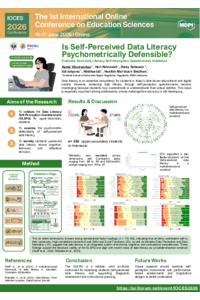
Data literacy has become an essential competency for navigating the demands of modern education and a data-driven society. However, the psychometric defensibility of self-perceived data literacy remains unclear, particularly among adolescents whose metacognitive accuracy is still developing. This study aimed to validate the Data Literacy Self-Perception Questionnaire (DLSPQ) and examine the structure of students’ perceived data literacy across cognitive, technical, and attitudinal domains. Using a quantitative psychometric design, content validity was evaluated through Aiken’s V, followed by item-level diagnostics, polychoric Exploratory Factor Analysis (EFA), reliability estimation, and Confirmatory Factor Analysis (CFA). A sample of 354 upper-secondary students completed the 53-item DLSPQ. Results showed high content validity, strong corrected item–total correlations, and excellent internal consistency (α = .88–.95; ω = .90–.97). EFA supported a six-factor solution consistent with the theoretical model, while CFA indicated good model fit, confirming the multidimensional structure of data literacy. Descriptive findings revealed strong operational spreadsheet skills and positive attitudes toward data, alongside weaker mastery of conceptual statistical reasoning and complex Excel functions. Gender comparisons indicated minor yet interpretable differences favoring males in technical domains and females in attitudinal dimensions. Overall, the DLSPQ demonstrates strong psychometric defensibility as an assessment tool for mapping students’ perceived data literacy. Its validated structure holds practical value for curriculum development, diagnostic assessment, and the design of instructional interventions targeting data reasoning, spreadsheet competency, and student engagement with data. Future studies are encouraged to complement self-perception measures with performance-based assessments and longitudinal designs to better understand developmental trajectories of data literacy.
Keywords
data literacy
self-perception
psychometric validation
factor analysis
reliability
Poster
A_Poster Design sciforum-178529.pdf
Between policy mandate and institutional autonomy: A collaborative reflective analysis of CCMAS implementation in a Nigerian public university
Perception of the use of ChatGPT in academic work among undergraduate students in Obafemi Awolowo University, Ile-Ife, Nigeria