Event submissions
Published
This submission belongs to the session S1. Cancer Stem Cells of the event The 5th International Electronic Conference on Cancers
Published date
15 Jun, 2026
Academic Editor
'%3e%3cpath%20d='M12.6657%2010.9104C12.4185%2010.325%2012.0599%209.79327%2011.6097%209.34482C11.1609%208.89508%2010.6293%208.5365%2010.0442%208.28888C10.0389%208.28626%2010.0337%208.28495%2010.0285%208.28233C10.8446%207.69279%2011.3752%206.73249%2011.3752%205.64904C11.3752%203.8542%209.92103%202.39999%208.1262%202.39999C6.33136%202.39999%204.87715%203.8542%204.87715%205.64904C4.87715%206.73249%205.40774%207.69279%206.22393%208.28364C6.21869%208.28626%206.21345%208.28757%206.20821%208.29019C5.62129%208.5378%205.09463%208.89284%204.64265%209.34613C4.1929%209.79493%203.83432%2010.3266%203.58671%2010.9117C3.34345%2011.4845%203.21226%2012.0987%203.20023%2012.7209C3.19988%2012.7349%203.20233%2012.7488%203.20744%2012.7619C3.21255%2012.7749%203.22022%2012.7867%203.22998%2012.7968C3.23975%2012.8068%203.25142%2012.8147%203.26431%2012.8202C3.2772%2012.8256%203.29105%2012.8284%203.30504%2012.8284H4.09109C4.14874%2012.8284%204.19459%2012.7825%204.1959%2012.7262C4.2221%2011.7148%204.62823%2010.7676%205.34617%2010.0497C6.08899%209.30683%207.0755%208.89808%208.1262%208.89808C9.17689%208.89808%2010.1634%209.30683%2010.9062%2010.0497C11.6242%2010.7676%2012.0303%2011.7148%2012.0565%2012.7262C12.0578%2012.7838%2012.1037%2012.8284%2012.1613%2012.8284H12.9474C12.9613%2012.8284%2012.9752%2012.8256%2012.9881%2012.8202C13.001%2012.8147%2013.0126%2012.8068%2013.0224%2012.7968C13.0322%2012.7867%2013.0398%2012.7749%2013.0449%2012.7619C13.0501%2012.7488%2013.0525%2012.7349%2013.0522%2012.7209C13.0391%2012.0947%2012.9094%2011.4855%2012.6657%2010.9104ZM8.1262%207.9024C7.52486%207.9024%206.9589%207.6679%206.53312%207.24211C6.10733%206.81633%205.87283%206.25037%205.87283%205.64904C5.87283%205.0477%206.10733%204.48174%206.53312%204.05596C6.9589%203.63018%207.52486%203.39567%208.1262%203.39567C8.72753%203.39567%209.29349%203.63018%209.71927%204.05596C10.1451%204.48174%2010.3796%205.0477%2010.3796%205.64904C10.3796%206.25037%2010.1451%206.81633%209.71927%207.24211C9.29349%207.6679%208.72753%207.9024%208.1262%207.9024Z'%20fill='%235D1EE1'/%3e%3c/g%3e%3c/svg%3e) Angeliki Magklara
Angeliki MagklaraCitation
Olga Pershina, Angelina Pakhomova, Lubov Sandrikina, Lena Kogai, Age-related features of cancer stem cell and T-cell response to therapy in a lung cancer model in aged mice, in Proceedings of The 5th International Electronic Conference on Cancers, 10 June–12 June 2026, MDPI: Basel, Switzerland
Share
Email
Facebook
Twitter
LinkedIn
Age-related features of cancer stem cell and T-cell response to therapy in a lung cancer model in aged mice
'%3e%3cpath%20d='M12.6647%2010.9104C12.4176%2010.325%2012.0589%209.7933%2011.6088%209.34485C11.16%208.89511%2010.6283%208.53653%2010.0432%208.28891C10.038%208.28629%2010.0327%208.28498%2010.0275%208.28236C10.8437%207.69282%2011.3743%206.73252%2011.3743%205.64907C11.3743%203.85423%209.92005%202.40002%208.12522%202.40002C6.33038%202.40002%204.87618%203.85423%204.87618%205.64907C4.87618%206.73252%205.40677%207.69282%206.22296%208.28367C6.21772%208.28629%206.21248%208.2876%206.20724%208.29022C5.62031%208.53783%205.09365%208.89287%204.64167%209.34616C4.19192%209.79496%203.83334%2010.3266%203.58573%2010.9117C3.34247%2011.4846%203.21128%2012.0987%203.19925%2012.721C3.1989%2012.735%203.20135%2012.7489%203.20646%2012.7619C3.21157%2012.7749%203.21924%2012.7868%203.22901%2012.7968C3.23877%2012.8068%203.25045%2012.8148%203.26334%2012.8202C3.27623%2012.8256%203.29007%2012.8284%203.30406%2012.8284H4.09012C4.14776%2012.8284%204.19362%2012.7825%204.19493%2012.7262C4.22113%2011.7148%204.62726%2010.7676%205.34519%2010.0497C6.08802%209.30686%207.07452%208.89811%208.12522%208.89811C9.17592%208.89811%2010.1624%209.30686%2010.9052%2010.0497C11.6232%2010.7676%2012.0293%2011.7148%2012.0555%2012.7262C12.0568%2012.7839%2012.1027%2012.8284%2012.1603%2012.8284H12.9464C12.9604%2012.8284%2012.9742%2012.8256%2012.9871%2012.8202C13%2012.8148%2013.0117%2012.8068%2013.0214%2012.7968C13.0312%2012.7868%2013.0389%2012.7749%2013.044%2012.7619C13.0491%2012.7489%2013.0515%2012.735%2013.0512%2012.721C13.0381%2012.0947%2012.9084%2011.4856%2012.6647%2010.9104ZM8.12522%207.90243C7.52388%207.90243%206.95792%207.66793%206.53214%207.24215C6.10636%206.81636%205.87185%206.2504%205.87185%205.64907C5.87185%205.04773%206.10636%204.48177%206.53214%204.05599C6.95792%203.63021%207.52388%203.3957%208.12522%203.3957C8.72655%203.3957%209.29252%203.63021%209.7183%204.05599C10.1441%204.48177%2010.3786%205.04773%2010.3786%205.64907C10.3786%206.2504%2010.1441%206.81636%209.7183%207.24215C9.29252%207.66793%208.72655%207.90243%208.12522%207.90243Z'%20fill='%235D1EE1'/%3e%3c/g%3e%3c/svg%3e)
Olga Pershina 1,2
Angelina Pakhomova 1,3
Lubov Sandrikina 1,3
Lena Kogai 1
1. Laboratory of Regenerative Pharmacology, Goldberg ED Research Institute of Pharmacology and Regenerative Medicine, Tomsk National Research Medical Centre of the Russian Academy of Sciences, 634028, Tomsk, Russia
2. Department of Pathophysiology, Siberian State Medical University, Ministry of Health of the Russian Federation, 634050, Tomsk, Russia
3. Department of Normal Physiology, Siberian State Medical University, Ministry of Health of the Russian Federation, 634050, Tomsk, Russia
Abstract
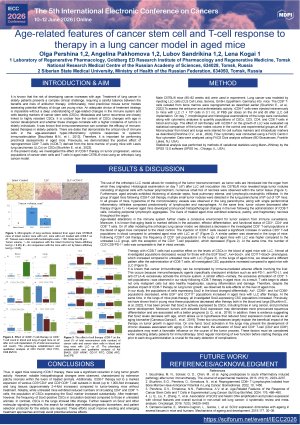
Metastasis and tumor recurrence are closely linked to highly resistant cancer stem cells (CSCs). It is unclear how the content of CSCs changes with age in cancer development and whether these changes correlate with a higher incidence of tumors in elderly individuals. Previously, we demonstrated the positive effect of reprogrammed CD8+ T-cells (rCD8-T) derived from the bone marrow of young mice with Lewis lung carcinomas (LLCs) on CSCs.
Lung cancer was modeled by injecting LLC cells into C57/BL6 mice (aged 80–82 weeks). On day 7, morphological and histological examinations of the lungs were conducted, along with cytometric analyses to quantify populations of CSCs, CD4, and CD8 T-cells in blood and lungs.
In aged mice receiving rCD8-T therapy, there was a significant reduction in lung tumor growth activity. However, notable histopathological changes were observed, characterized by extensive patchy necrosis within the livers of treated animals. Additionally, rCD8-T therapy led to a marked expansion of various CD4+ and CD8+ T-cell subsets in blood (up to 1,000-fold increases) and lung tissues (approximately 2-4-fold increases) compared to tumor-bearing mice without treatment. Notably, while untreated mice exhibited reduced numbers of circulating CD4+ and CD8+ T-cells, the population of CSCs expressing the Sox2 marker - associated with more aggressive tumor phenotypes increased substantially. After treatment, however, the frequency of Sox2-positive CSCs in circulation declined compared to those in untreated animals. In contrast, CSCs in the lungs showed little change.
Therefore, rCD8-T therapy in aged mice, although beneficial for reducing tumor growth and eliminating CSCs, induces hyperactivation of the immune system. To enhance therapeutic efficacy and ensure safety in elderly patients with lung cancer, targeted approaches against Sox2 expressing CSCs may prove effective. Combining these strategies with conventional chemotherapeutic regimens holds promise for improving overall survival outcomes in this patient population.
Keywords
cancer stem cells
lung cancer
T-cells
reprogramming
Poster
Pershina-5-2026.pdf
Vimentin facilitates ubiquitination and degradation of NCOA4 to promote resistance to olaparib-induced ferroptosis in glioblastoma
Tumor-associated miR-124 and miR-137 in post-transcriptional regulation of ovarian cancer