Event submissions
Published
This submission belongs to the session S2. Nanotoxicology and Targeted Pharmacology of Nanomaterials of the event The 1st International Online Conference on Xenobiotics
Published date
17 Jun, 2026
Academic Editor
'%3e%3cpath%20d='M12.6657%2010.9104C12.4185%2010.325%2012.0599%209.79327%2011.6097%209.34482C11.1609%208.89508%2010.6293%208.5365%2010.0442%208.28888C10.0389%208.28626%2010.0337%208.28495%2010.0285%208.28233C10.8446%207.69279%2011.3752%206.73249%2011.3752%205.64904C11.3752%203.8542%209.92103%202.39999%208.1262%202.39999C6.33136%202.39999%204.87715%203.8542%204.87715%205.64904C4.87715%206.73249%205.40774%207.69279%206.22393%208.28364C6.21869%208.28626%206.21345%208.28757%206.20821%208.29019C5.62129%208.5378%205.09463%208.89284%204.64265%209.34613C4.1929%209.79493%203.83432%2010.3266%203.58671%2010.9117C3.34345%2011.4845%203.21226%2012.0987%203.20023%2012.7209C3.19988%2012.7349%203.20233%2012.7488%203.20744%2012.7619C3.21255%2012.7749%203.22022%2012.7867%203.22998%2012.7968C3.23975%2012.8068%203.25142%2012.8147%203.26431%2012.8202C3.2772%2012.8256%203.29105%2012.8284%203.30504%2012.8284H4.09109C4.14874%2012.8284%204.19459%2012.7825%204.1959%2012.7262C4.2221%2011.7148%204.62823%2010.7676%205.34617%2010.0497C6.08899%209.30683%207.0755%208.89808%208.1262%208.89808C9.17689%208.89808%2010.1634%209.30683%2010.9062%2010.0497C11.6242%2010.7676%2012.0303%2011.7148%2012.0565%2012.7262C12.0578%2012.7838%2012.1037%2012.8284%2012.1613%2012.8284H12.9474C12.9613%2012.8284%2012.9752%2012.8256%2012.9881%2012.8202C13.001%2012.8147%2013.0126%2012.8068%2013.0224%2012.7968C13.0322%2012.7867%2013.0398%2012.7749%2013.0449%2012.7619C13.0501%2012.7488%2013.0525%2012.7349%2013.0522%2012.7209C13.0391%2012.0947%2012.9094%2011.4855%2012.6657%2010.9104ZM8.1262%207.9024C7.52486%207.9024%206.9589%207.6679%206.53312%207.24211C6.10733%206.81633%205.87283%206.25037%205.87283%205.64904C5.87283%205.0477%206.10733%204.48174%206.53312%204.05596C6.9589%203.63018%207.52486%203.39567%208.1262%203.39567C8.72753%203.39567%209.29349%203.63018%209.71927%204.05596C10.1451%204.48174%2010.3796%205.0477%2010.3796%205.64904C10.3796%206.25037%2010.1451%206.81633%209.71927%207.24211C9.29349%207.6679%208.72753%207.9024%208.1262%207.9024Z'%20fill='%235D1EE1'/%3e%3c/g%3e%3c/svg%3e) Keith Brunt
Keith BruntCitation
Federico Ferretti, Chiara Perrone, Massimo Bortolotti, Francesco Biscotti, Sara Ragucci, Nicola Landi, Antimo Di Maro, Andrea Bolognesi, Letizia Polito, Impact of Dietary Xenobiotics on the Intestinal Activity of Sodin 5: Implications for RIP-Based Nanotherapeutics, in Proceedings of The 1st International Online Conference on Xenobiotics, 22 June–23 June 2026, MDPI: Basel, Switzerland
Share
Email
Facebook
Twitter
LinkedIn
Impact of Dietary Xenobiotics on the Intestinal Activity of Sodin 5: Implications for RIP-Based Nanotherapeutics

Federico Ferretti 1
'%3e%3cpath%20d='M12.6647%2010.9104C12.4176%2010.325%2012.0589%209.7933%2011.6088%209.34485C11.16%208.89511%2010.6283%208.53653%2010.0432%208.28891C10.038%208.28629%2010.0327%208.28498%2010.0275%208.28236C10.8437%207.69282%2011.3743%206.73252%2011.3743%205.64907C11.3743%203.85423%209.92005%202.40002%208.12522%202.40002C6.33038%202.40002%204.87618%203.85423%204.87618%205.64907C4.87618%206.73252%205.40677%207.69282%206.22296%208.28367C6.21772%208.28629%206.21248%208.2876%206.20724%208.29022C5.62031%208.53783%205.09365%208.89287%204.64167%209.34616C4.19192%209.79496%203.83334%2010.3266%203.58573%2010.9117C3.34247%2011.4846%203.21128%2012.0987%203.19925%2012.721C3.1989%2012.735%203.20135%2012.7489%203.20646%2012.7619C3.21157%2012.7749%203.21924%2012.7868%203.22901%2012.7968C3.23877%2012.8068%203.25045%2012.8148%203.26334%2012.8202C3.27623%2012.8256%203.29007%2012.8284%203.30406%2012.8284H4.09012C4.14776%2012.8284%204.19362%2012.7825%204.19493%2012.7262C4.22113%2011.7148%204.62726%2010.7676%205.34519%2010.0497C6.08802%209.30686%207.07452%208.89811%208.12522%208.89811C9.17592%208.89811%2010.1624%209.30686%2010.9052%2010.0497C11.6232%2010.7676%2012.0293%2011.7148%2012.0555%2012.7262C12.0568%2012.7839%2012.1027%2012.8284%2012.1603%2012.8284H12.9464C12.9604%2012.8284%2012.9742%2012.8256%2012.9871%2012.8202C13%2012.8148%2013.0117%2012.8068%2013.0214%2012.7968C13.0312%2012.7868%2013.0389%2012.7749%2013.044%2012.7619C13.0491%2012.7489%2013.0515%2012.735%2013.0512%2012.721C13.0381%2012.0947%2012.9084%2011.4856%2012.6647%2010.9104ZM8.12522%207.90243C7.52388%207.90243%206.95792%207.66793%206.53214%207.24215C6.10636%206.81636%205.87185%206.2504%205.87185%205.64907C5.87185%205.04773%206.10636%204.48177%206.53214%204.05599C6.95792%203.63021%207.52388%203.3957%208.12522%203.3957C8.72655%203.3957%209.29252%203.63021%209.7183%204.05599C10.1441%204.48177%2010.3786%205.04773%2010.3786%205.64907C10.3786%206.2504%2010.1441%206.81636%209.7183%207.24215C9.29252%207.66793%208.72655%207.90243%208.12522%207.90243Z'%20fill='%235D1EE1'/%3e%3c/g%3e%3c/svg%3e)
Chiara Perrone 1

Massimo Bortolotti 1

Francesco Biscotti 1

Sara Ragucci 2

Nicola Landi 2

Antimo Di Maro 2

Andrea Bolognesi 1

Letizia Polito 1
1. Department of Medical and Surgical Sciences (DIMEC), Alma Mater Studiorum, University of Bologna, Bologna 40138, Italy
2. Department of Environmental, Biological and Pharmaceutical Sciences and Technologies (DiSTABiF), University of Campania ‘Luigi Vanvitelli’, Caserta 81100, Italy
Abstract
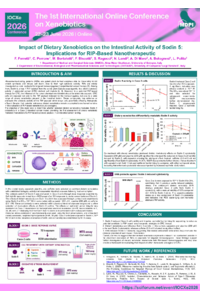
Introduction: Ribosome-inactivating proteins (RIPs) are potent plant-derived enzymes widely investigated for experimental cancer therapy, particularly as toxic payloads in targeted nanoconjugates. Among RIPs, sodin 5, from the edible plant Salsola soda, has recently demonstrated significant cytotoxicity in colon cancer models. However, the impact of dietary xenobiotics, commonly present in the intestinal environment, on RIP activity remains poorly understood. This study aimed to evaluate whether selected dietary xenobiotics can modulate sodin 5-induced cytotoxicity in Caco-2 colon adenocarcinoma cells.
Methods: The cytotoxic effects of sodin 5 were assessed in Caco-2 cells through dose- and time-dependent experiments. Cell viability was measured using the MTS assay following treatment with sodin 5 alone or in combination with selected dietary xenobiotics (butylated hydroxyanisole, BHA; capsaicin; piperine; and caffeine). In parallel, the integrity of the epithelial monolayer was evaluated by measuring transepithelial electrical resistance (TEER) in Caco-2 monocultures.
Results: Sodin 5 significantly reduced Caco-2 cell viability starting from 10⁻⁸ M after 24h. At 72h, a pronounced reduction was already evident at 10⁻⁹ M, with an EC₅₀ in the 10⁻⁷ M range. Co-treatment with dietary xenobiotics produced distinct modulatory effects. Capsaicin and piperine enhanced sodin 5 cytotoxicity, indicating a synergistic interaction, which was particularly marked for capsaicin. In contrast, caffeine did not significantly alter sodin 5 activity. Notably, BHA exerted a strong protective effect, reducing sodin 5-induced cytotoxicity from approximately 60% to 15%, supporting a role of oxidative stress in the mechanism of cell death. TEER measurements were consistent with viability data.
Conclusions: Dietary xenobiotics significantly influence sodin 5 cytotoxicity in intestinal cells, either enhancing or attenuating its effects. These findings highlight the importance of considering diet-derived compounds in the development of RIP-based nanotherapeutics and provide new insights into factors affecting their intestinal safety and efficacy.
Keywords
cytotoxicity
dietary xenobiotics
oxidative stress
ribosome-inactivating proteins
sodin 5
Poster
Ferretti_IOCXe2026_Poster.pdf
AI-Guided Nanotoxicological and Immunopharmacological Evaluation of Ligand-Functionalized Polymeric Nanoparticles in Targeted Cancer Therapy
Turmeric Phyto-NanoParticle (TPNP) enhances cellular bioavailability and anti-inflammatory effect of curcuminoids in human monocytes/macrophages