Event submissions
Published
This submission belongs to the session S3. Emerging Chemicals: Environment Risks and Health Effects of the event The 1st International Online Conference on Xenobiotics
Published date
17 Jun, 2026
Academic Editor
'%3e%3cpath%20d='M12.6657%2010.9104C12.4185%2010.325%2012.0599%209.79327%2011.6097%209.34482C11.1609%208.89508%2010.6293%208.5365%2010.0442%208.28888C10.0389%208.28626%2010.0337%208.28495%2010.0285%208.28233C10.8446%207.69279%2011.3752%206.73249%2011.3752%205.64904C11.3752%203.8542%209.92103%202.39999%208.1262%202.39999C6.33136%202.39999%204.87715%203.8542%204.87715%205.64904C4.87715%206.73249%205.40774%207.69279%206.22393%208.28364C6.21869%208.28626%206.21345%208.28757%206.20821%208.29019C5.62129%208.5378%205.09463%208.89284%204.64265%209.34613C4.1929%209.79493%203.83432%2010.3266%203.58671%2010.9117C3.34345%2011.4845%203.21226%2012.0987%203.20023%2012.7209C3.19988%2012.7349%203.20233%2012.7488%203.20744%2012.7619C3.21255%2012.7749%203.22022%2012.7867%203.22998%2012.7968C3.23975%2012.8068%203.25142%2012.8147%203.26431%2012.8202C3.2772%2012.8256%203.29105%2012.8284%203.30504%2012.8284H4.09109C4.14874%2012.8284%204.19459%2012.7825%204.1959%2012.7262C4.2221%2011.7148%204.62823%2010.7676%205.34617%2010.0497C6.08899%209.30683%207.0755%208.89808%208.1262%208.89808C9.17689%208.89808%2010.1634%209.30683%2010.9062%2010.0497C11.6242%2010.7676%2012.0303%2011.7148%2012.0565%2012.7262C12.0578%2012.7838%2012.1037%2012.8284%2012.1613%2012.8284H12.9474C12.9613%2012.8284%2012.9752%2012.8256%2012.9881%2012.8202C13.001%2012.8147%2013.0126%2012.8068%2013.0224%2012.7968C13.0322%2012.7867%2013.0398%2012.7749%2013.0449%2012.7619C13.0501%2012.7488%2013.0525%2012.7349%2013.0522%2012.7209C13.0391%2012.0947%2012.9094%2011.4855%2012.6657%2010.9104ZM8.1262%207.9024C7.52486%207.9024%206.9589%207.6679%206.53312%207.24211C6.10733%206.81633%205.87283%206.25037%205.87283%205.64904C5.87283%205.0477%206.10733%204.48174%206.53312%204.05596C6.9589%203.63018%207.52486%203.39567%208.1262%203.39567C8.72753%203.39567%209.29349%203.63018%209.71927%204.05596C10.1451%204.48174%2010.3796%205.0477%2010.3796%205.64904C10.3796%206.25037%2010.1451%206.81633%209.71927%207.24211C9.29349%207.6679%208.72753%207.9024%208.1262%207.9024Z'%20fill='%235D1EE1'/%3e%3c/g%3e%3c/svg%3e) A. P. Pinto
A. P. PintoCitation
Wyllia Khati, Yousria Gasmi, AbdelHakim Hadj Moussa, In vivo effect of metals in clams Ruditapes decussatus: A multi-marker approach, in Proceedings of The 1st International Online Conference on Xenobiotics, 22 June–23 June 2026, MDPI: Basel, Switzerland
Share
Email
Facebook
Twitter
LinkedIn
In vivo effect of metals in clams Ruditapes decussatus: A multi-marker approach
'%3e%3cpath%20d='M12.6647%2010.9104C12.4176%2010.325%2012.0589%209.7933%2011.6088%209.34485C11.16%208.89511%2010.6283%208.53653%2010.0432%208.28891C10.038%208.28629%2010.0327%208.28498%2010.0275%208.28236C10.8437%207.69282%2011.3743%206.73252%2011.3743%205.64907C11.3743%203.85423%209.92005%202.40002%208.12522%202.40002C6.33038%202.40002%204.87618%203.85423%204.87618%205.64907C4.87618%206.73252%205.40677%207.69282%206.22296%208.28367C6.21772%208.28629%206.21248%208.2876%206.20724%208.29022C5.62031%208.53783%205.09365%208.89287%204.64167%209.34616C4.19192%209.79496%203.83334%2010.3266%203.58573%2010.9117C3.34247%2011.4846%203.21128%2012.0987%203.19925%2012.721C3.1989%2012.735%203.20135%2012.7489%203.20646%2012.7619C3.21157%2012.7749%203.21924%2012.7868%203.22901%2012.7968C3.23877%2012.8068%203.25045%2012.8148%203.26334%2012.8202C3.27623%2012.8256%203.29007%2012.8284%203.30406%2012.8284H4.09012C4.14776%2012.8284%204.19362%2012.7825%204.19493%2012.7262C4.22113%2011.7148%204.62726%2010.7676%205.34519%2010.0497C6.08802%209.30686%207.07452%208.89811%208.12522%208.89811C9.17592%208.89811%2010.1624%209.30686%2010.9052%2010.0497C11.6232%2010.7676%2012.0293%2011.7148%2012.0555%2012.7262C12.0568%2012.7839%2012.1027%2012.8284%2012.1603%2012.8284H12.9464C12.9604%2012.8284%2012.9742%2012.8256%2012.9871%2012.8202C13%2012.8148%2013.0117%2012.8068%2013.0214%2012.7968C13.0312%2012.7868%2013.0389%2012.7749%2013.044%2012.7619C13.0491%2012.7489%2013.0515%2012.735%2013.0512%2012.721C13.0381%2012.0947%2012.9084%2011.4856%2012.6647%2010.9104ZM8.12522%207.90243C7.52388%207.90243%206.95792%207.66793%206.53214%207.24215C6.10636%206.81636%205.87185%206.2504%205.87185%205.64907C5.87185%205.04773%206.10636%204.48177%206.53214%204.05599C6.95792%203.63021%207.52388%203.3957%208.12522%203.3957C8.72655%203.3957%209.29252%203.63021%209.7183%204.05599C10.1441%204.48177%2010.3786%205.04773%2010.3786%205.64907C10.3786%206.2504%2010.1441%206.81636%209.7183%207.24215C9.29252%207.66793%208.72655%207.90243%208.12522%207.90243Z'%20fill='%235D1EE1'/%3e%3c/g%3e%3c/svg%3e)
Wyllia Khati 1
Yousria Gasmi 2
AbdelHakim Hadj Moussa 3
1. Marine Science Department, Biodiversity and Biodiversité pollution, Tarf University, El Tarf 36000, Algeria
2. Marine department, biodiversity and ecosystems pollution laboratory. El Tarf University, El Tarf 36000, Algeria
3. Toxicology laboratory, Biology Department, Badji Mokhtar University, Annaba, Algeria
Abstract
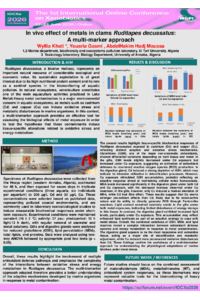
This study aimed to evaluate the differential biochemical responses of the clam Ruditapes decussatus exposed to cadmium (Cd) and copper (Cu), testing the hypothesis that these contaminants induce tissue-specific alterations in oxidative stress and energy metabolism.
Materials and methods: Specimens of Ruditapes decussatus were collected from the Hnaya region (western Annaba, Algeria), acclimated for 48 h, and then exposed for seven days in triplicate experimental conditions (three aquaria, six individuals per aquarium) to 200 µg/L Cd and 30 µg/L Cu. These concentrations were selected based on published data, representing polluted coastal environments, and are commonly used in laboratory ecotoxicological studies to induce measurable biochemical responses under short-term exposure. Experimental conditions were maintained constant (16 ± 2 °C; salinity: 37 psu; photoperiod: 12 h light/12 h dark), with regular renewal of seawater and metal solutions. Gills and digestive glands were analysed for reduced glutathione (GSH), lipid peroxidation (MDA), total lipids, and proteins. Data were analysed using two-way ANOVA followed by appropriate post hoc tests (p < 0.05).
Results and discussion: Cadmium exposure induced a significant increase in MDA associated with a decrease in GSH, indicating marked oxidative stress, particularly in the digestive gland. This suggests enhanced utilisation of GSH in detoxification processes. Copper exposure induced tissue-dependent responses, including an increase in GSH in some cases, suggesting the activation of antioxidant defence mechanisms potentially related to oxidative stress. Variations in lipid and protein contents indicate disturbances in energy metabolism under metal exposure. The digestive gland appeared more sensitive than gills, consistent with its role in detoxification and storage functions.
Conclusion: Overall, these results highlight the involvement of multiple antioxidant defence pathways and underline the complexity of the relationship between oxidative stress and energy metabolism in Ruditapes decussatus exposed to trace metals. The multi-biomarker approach provides valuable insights for ecotoxicological assessment of contaminated coastal environments.
Keywords
Metals
clams
oxidative stress
biomarkeurs
Poster
KHATI W .pdf
Maternal Bisphenol S exposure impairs testicular function in adult Wistar rat offspring via thyroid axis disruption
Emerging Chemical Exposure Risks in Afghanistan: The Role of INGOs in Health Protection and Environmental Education