Event submissions
Published
This submission belongs to the session S3. Emerging Chemicals: Environment Risks and Health Effects of the event The 1st International Online Conference on Xenobiotics
Published date
17 Jun, 2026
Academic Editor
'%3e%3cpath%20d='M12.6657%2010.9104C12.4185%2010.325%2012.0599%209.79327%2011.6097%209.34482C11.1609%208.89508%2010.6293%208.5365%2010.0442%208.28888C10.0389%208.28626%2010.0337%208.28495%2010.0285%208.28233C10.8446%207.69279%2011.3752%206.73249%2011.3752%205.64904C11.3752%203.8542%209.92103%202.39999%208.1262%202.39999C6.33136%202.39999%204.87715%203.8542%204.87715%205.64904C4.87715%206.73249%205.40774%207.69279%206.22393%208.28364C6.21869%208.28626%206.21345%208.28757%206.20821%208.29019C5.62129%208.5378%205.09463%208.89284%204.64265%209.34613C4.1929%209.79493%203.83432%2010.3266%203.58671%2010.9117C3.34345%2011.4845%203.21226%2012.0987%203.20023%2012.7209C3.19988%2012.7349%203.20233%2012.7488%203.20744%2012.7619C3.21255%2012.7749%203.22022%2012.7867%203.22998%2012.7968C3.23975%2012.8068%203.25142%2012.8147%203.26431%2012.8202C3.2772%2012.8256%203.29105%2012.8284%203.30504%2012.8284H4.09109C4.14874%2012.8284%204.19459%2012.7825%204.1959%2012.7262C4.2221%2011.7148%204.62823%2010.7676%205.34617%2010.0497C6.08899%209.30683%207.0755%208.89808%208.1262%208.89808C9.17689%208.89808%2010.1634%209.30683%2010.9062%2010.0497C11.6242%2010.7676%2012.0303%2011.7148%2012.0565%2012.7262C12.0578%2012.7838%2012.1037%2012.8284%2012.1613%2012.8284H12.9474C12.9613%2012.8284%2012.9752%2012.8256%2012.9881%2012.8202C13.001%2012.8147%2013.0126%2012.8068%2013.0224%2012.7968C13.0322%2012.7867%2013.0398%2012.7749%2013.0449%2012.7619C13.0501%2012.7488%2013.0525%2012.7349%2013.0522%2012.7209C13.0391%2012.0947%2012.9094%2011.4855%2012.6657%2010.9104ZM8.1262%207.9024C7.52486%207.9024%206.9589%207.6679%206.53312%207.24211C6.10733%206.81633%205.87283%206.25037%205.87283%205.64904C5.87283%205.0477%206.10733%204.48174%206.53312%204.05596C6.9589%203.63018%207.52486%203.39567%208.1262%203.39567C8.72753%203.39567%209.29349%203.63018%209.71927%204.05596C10.1451%204.48174%2010.3796%205.0477%2010.3796%205.64904C10.3796%206.25037%2010.1451%206.81633%209.71927%207.24211C9.29349%207.6679%208.72753%207.9024%208.1262%207.9024Z'%20fill='%235D1EE1'/%3e%3c/g%3e%3c/svg%3e) Stefano Magni
Stefano MagniCitation
Vítor Faria, Agostinho Cruz, Piedade Barros, Individual and Combined Ecotoxicity of Albendazole, Metronidazole and Ibuprofen in Freshwater Algae and Agricultural Plants, in Proceedings of The 1st International Online Conference on Xenobiotics, 22 June–23 June 2026, MDPI: Basel, Switzerland
Share
Email
Facebook
Twitter
LinkedIn
Individual and Combined Ecotoxicity of Albendazole, Metronidazole and Ibuprofen in Freshwater Algae and Agricultural Plants
'%3e%3cpath%20d='M12.6647%2010.9104C12.4176%2010.325%2012.0589%209.7933%2011.6088%209.34485C11.16%208.89511%2010.6283%208.53653%2010.0432%208.28891C10.038%208.28629%2010.0327%208.28498%2010.0275%208.28236C10.8437%207.69282%2011.3743%206.73252%2011.3743%205.64907C11.3743%203.85423%209.92005%202.40002%208.12522%202.40002C6.33038%202.40002%204.87618%203.85423%204.87618%205.64907C4.87618%206.73252%205.40677%207.69282%206.22296%208.28367C6.21772%208.28629%206.21248%208.2876%206.20724%208.29022C5.62031%208.53783%205.09365%208.89287%204.64167%209.34616C4.19192%209.79496%203.83334%2010.3266%203.58573%2010.9117C3.34247%2011.4846%203.21128%2012.0987%203.19925%2012.721C3.1989%2012.735%203.20135%2012.7489%203.20646%2012.7619C3.21157%2012.7749%203.21924%2012.7868%203.22901%2012.7968C3.23877%2012.8068%203.25045%2012.8148%203.26334%2012.8202C3.27623%2012.8256%203.29007%2012.8284%203.30406%2012.8284H4.09012C4.14776%2012.8284%204.19362%2012.7825%204.19493%2012.7262C4.22113%2011.7148%204.62726%2010.7676%205.34519%2010.0497C6.08802%209.30686%207.07452%208.89811%208.12522%208.89811C9.17592%208.89811%2010.1624%209.30686%2010.9052%2010.0497C11.6232%2010.7676%2012.0293%2011.7148%2012.0555%2012.7262C12.0568%2012.7839%2012.1027%2012.8284%2012.1603%2012.8284H12.9464C12.9604%2012.8284%2012.9742%2012.8256%2012.9871%2012.8202C13%2012.8148%2013.0117%2012.8068%2013.0214%2012.7968C13.0312%2012.7868%2013.0389%2012.7749%2013.044%2012.7619C13.0491%2012.7489%2013.0515%2012.735%2013.0512%2012.721C13.0381%2012.0947%2012.9084%2011.4856%2012.6647%2010.9104ZM8.12522%207.90243C7.52388%207.90243%206.95792%207.66793%206.53214%207.24215C6.10636%206.81636%205.87185%206.2504%205.87185%205.64907C5.87185%205.04773%206.10636%204.48177%206.53214%204.05599C6.95792%203.63021%207.52388%203.3957%208.12522%203.3957C8.72655%203.3957%209.29252%203.63021%209.7183%204.05599C10.1441%204.48177%2010.3786%205.04773%2010.3786%205.64907C10.3786%206.2504%2010.1441%206.81636%209.7183%207.24215C9.29252%207.66793%208.72655%207.90243%208.12522%207.90243Z'%20fill='%235D1EE1'/%3e%3c/g%3e%3c/svg%3e)
Vítor Faria 1
Agostinho Cruz 1,2
Piedade Barros 1,2
1. ESS, Polytechnic of Porto, Rua Dr. António Bernardino de Almeida 400, 4200-072 Porto, Portugal
2. LAQV/REQUIMTE, ESS, Polytechnic of Porto, Rua Dr. António Bernardino de Almeida 400, 4200-072 Porto, Portugal
Abstract
Introduction
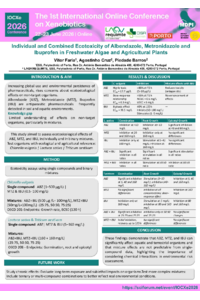
The increasing global use and environmental persistence of pharmaceuticals have raised concerns about their ecotoxicological effects. Albendazole (ABZ), metronidazole (MTZ), and ibuprofen (IBU) are among the most frequently detected compounds in soil and aquatic environments, yet their impacts on non-target organisms, particularly in mixtures, remain poorly understood. This study assessed the ecotoxicological effects of ABZ, MTZ, and IBU, alone and in binary mixtures, on Chlorella vulgaris, Lactuca sativa, and Triticum aestivum, representing ecologically and agriculturally relevant species.
Methods
Ecotoxicity assays were performed using single compounds and binary mixtures. Chlorella was exposed to ABZ (1–500 µg/L), MTZ and IBU (0.5–100 mg/L), and ABZ+IBU and MTZ+IBU mixtures, tested at 25:75, 50:50, and 75:25 ratios. Lactuca and Triticum were exposed to single compounds (5–160 mg/L) and mixtures (160 + 160 mg/L). Algal assays followed OECD guideline 201, with growth rate and EC₅₀ values at 120 h, while plant assays followed OECD208, assessing germination and root and epicotyl growth.
Results
In single-compound tests, C. vulgaris was the most sensitive species (EC₅₀ values of 17.7 µg/L for ABZ, 6.3 mg/L for MTZ, and 78.5 mg/L for IBU). MTZ showed the highest toxicity, inhibiting growth in all organisms. In contrast, ABZ and especially IBU induced hormetic responses, stimulating plant growth at low concentrations and inhibiting it at higher levels. Binary mixtures exhibited complex, non-additive interactions, including reduced toxicity in the ABZ+IBU combination. L. sativa showed both inhibitory and stimulatory responses depending on mixture composition, while T. aestivum was more sensitive to mixtures, particularly at equal proportions.
Conclusions
These findings demonstrate that ABZ, MTZ, and IBU can significantly affect aquatic and terrestrial organisms and that mixture effects are not predictable from single-compound data, highlighting the importance of considering chemical interactions in environmental risk assessment.
Keywords
antiparasitic pharmaceuticals
mixture ecotoxicity
microalgae
agricultural species
Poster
poster 179180.PBarros.pdf
The Impact of Cigarette Filters on Aquatic Ecosystems Using Daphnids as Model Organisms
Hepatorenal Disruption by Alkaloid Xenobiotics from Nauclea diderrichii: Biochemical, Histopathological, and In Silico ADMET Evidence.