Event submissions
Published
This submission belongs to the session S3. Emerging Chemicals: Environment Risks and Health Effects of the event The 1st International Online Conference on Xenobiotics
Published date
17 Jun, 2026
Academic Editor
'%3e%3cpath%20d='M12.6657%2010.9104C12.4185%2010.325%2012.0599%209.79327%2011.6097%209.34482C11.1609%208.89508%2010.6293%208.5365%2010.0442%208.28888C10.0389%208.28626%2010.0337%208.28495%2010.0285%208.28233C10.8446%207.69279%2011.3752%206.73249%2011.3752%205.64904C11.3752%203.8542%209.92103%202.39999%208.1262%202.39999C6.33136%202.39999%204.87715%203.8542%204.87715%205.64904C4.87715%206.73249%205.40774%207.69279%206.22393%208.28364C6.21869%208.28626%206.21345%208.28757%206.20821%208.29019C5.62129%208.5378%205.09463%208.89284%204.64265%209.34613C4.1929%209.79493%203.83432%2010.3266%203.58671%2010.9117C3.34345%2011.4845%203.21226%2012.0987%203.20023%2012.7209C3.19988%2012.7349%203.20233%2012.7488%203.20744%2012.7619C3.21255%2012.7749%203.22022%2012.7867%203.22998%2012.7968C3.23975%2012.8068%203.25142%2012.8147%203.26431%2012.8202C3.2772%2012.8256%203.29105%2012.8284%203.30504%2012.8284H4.09109C4.14874%2012.8284%204.19459%2012.7825%204.1959%2012.7262C4.2221%2011.7148%204.62823%2010.7676%205.34617%2010.0497C6.08899%209.30683%207.0755%208.89808%208.1262%208.89808C9.17689%208.89808%2010.1634%209.30683%2010.9062%2010.0497C11.6242%2010.7676%2012.0303%2011.7148%2012.0565%2012.7262C12.0578%2012.7838%2012.1037%2012.8284%2012.1613%2012.8284H12.9474C12.9613%2012.8284%2012.9752%2012.8256%2012.9881%2012.8202C13.001%2012.8147%2013.0126%2012.8068%2013.0224%2012.7968C13.0322%2012.7867%2013.0398%2012.7749%2013.0449%2012.7619C13.0501%2012.7488%2013.0525%2012.7349%2013.0522%2012.7209C13.0391%2012.0947%2012.9094%2011.4855%2012.6657%2010.9104ZM8.1262%207.9024C7.52486%207.9024%206.9589%207.6679%206.53312%207.24211C6.10733%206.81633%205.87283%206.25037%205.87283%205.64904C5.87283%205.0477%206.10733%204.48174%206.53312%204.05596C6.9589%203.63018%207.52486%203.39567%208.1262%203.39567C8.72753%203.39567%209.29349%203.63018%209.71927%204.05596C10.1451%204.48174%2010.3796%205.0477%2010.3796%205.64904C10.3796%206.25037%2010.1451%206.81633%209.71927%207.24211C9.29349%207.6679%208.72753%207.9024%208.1262%207.9024Z'%20fill='%235D1EE1'/%3e%3c/g%3e%3c/svg%3e) Stefano Magni
Stefano MagniCitation
Vladimir Shipelin, Tatyana Selezneva, Hygienic Assessment of Alimentary Exposure to Stable Strontium in Russia: A Risk Analysis, in Proceedings of The 1st International Online Conference on Xenobiotics, 22 June–23 June 2026, MDPI: Basel, Switzerland
Share
Email
Facebook
Twitter
LinkedIn
Hygienic Assessment of Alimentary Exposure to Stable Strontium in Russia: A Risk Analysis

Vladimir Shipelin 1
'%3e%3cpath%20d='M12.6647%2010.9104C12.4176%2010.325%2012.0589%209.7933%2011.6088%209.34485C11.16%208.89511%2010.6283%208.53653%2010.0432%208.28891C10.038%208.28629%2010.0327%208.28498%2010.0275%208.28236C10.8437%207.69282%2011.3743%206.73252%2011.3743%205.64907C11.3743%203.85423%209.92005%202.40002%208.12522%202.40002C6.33038%202.40002%204.87618%203.85423%204.87618%205.64907C4.87618%206.73252%205.40677%207.69282%206.22296%208.28367C6.21772%208.28629%206.21248%208.2876%206.20724%208.29022C5.62031%208.53783%205.09365%208.89287%204.64167%209.34616C4.19192%209.79496%203.83334%2010.3266%203.58573%2010.9117C3.34247%2011.4846%203.21128%2012.0987%203.19925%2012.721C3.1989%2012.735%203.20135%2012.7489%203.20646%2012.7619C3.21157%2012.7749%203.21924%2012.7868%203.22901%2012.7968C3.23877%2012.8068%203.25045%2012.8148%203.26334%2012.8202C3.27623%2012.8256%203.29007%2012.8284%203.30406%2012.8284H4.09012C4.14776%2012.8284%204.19362%2012.7825%204.19493%2012.7262C4.22113%2011.7148%204.62726%2010.7676%205.34519%2010.0497C6.08802%209.30686%207.07452%208.89811%208.12522%208.89811C9.17592%208.89811%2010.1624%209.30686%2010.9052%2010.0497C11.6232%2010.7676%2012.0293%2011.7148%2012.0555%2012.7262C12.0568%2012.7839%2012.1027%2012.8284%2012.1603%2012.8284H12.9464C12.9604%2012.8284%2012.9742%2012.8256%2012.9871%2012.8202C13%2012.8148%2013.0117%2012.8068%2013.0214%2012.7968C13.0312%2012.7868%2013.0389%2012.7749%2013.044%2012.7619C13.0491%2012.7489%2013.0515%2012.735%2013.0512%2012.721C13.0381%2012.0947%2012.9084%2011.4856%2012.6647%2010.9104ZM8.12522%207.90243C7.52388%207.90243%206.95792%207.66793%206.53214%207.24215C6.10636%206.81636%205.87185%206.2504%205.87185%205.64907C5.87185%205.04773%206.10636%204.48177%206.53214%204.05599C6.95792%203.63021%207.52388%203.3957%208.12522%203.3957C8.72655%203.3957%209.29252%203.63021%209.7183%204.05599C10.1441%204.48177%2010.3786%205.04773%2010.3786%205.64907C10.3786%206.2504%2010.1441%206.81636%209.7183%207.24215C9.29252%207.66793%208.72655%207.90243%208.12522%207.90243Z'%20fill='%235D1EE1'/%3e%3c/g%3e%3c/svg%3e)
Tatyana Selezneva 1,2
1. Laboratory of food toxicology and safety assessment of nanotechnology, Federal Research Centre of Nutrition, Biotechnology and Food Safety, Moscow 109240, Russia
2. Biotechnology and bioorganic synthesis, Federal State Budgetary Educational Institution of Higher Education Russian Biotechnological University, Moscow 125080, Russia
Abstract
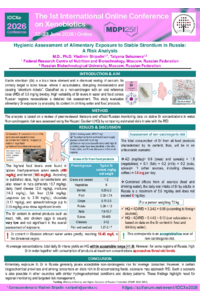
Introduction. Stable strontium (Sr) is a toxic trace element and a chemical analog of calcium. Its primary target is bone tissue, where it accumulates, disrupting mineralization and causing “strontium rickets”. Classified as a non-carcinogen with an oral reference dose (RfD) of 0.6 mg/kg bw/day. High variability of Sr levels in water and food across Russian regions necessitates a detailed risk assessment. This study evaluates alimentary Sr exposure by analyzing its content in drinking water and food products.
Methods. The analysis is based on a review of peer-reviewed literature and official Russian monitoring data on stable Sr concentrations in water. Non-carcinogenic risk was assessed using the Hazard Quotient (HQ) by comparing estimated daily intake with the RfD
Results. Sr content in Russian artesian water varies greatly, reaching 15.45 mg/L in the Smolensk region. The highest food levels were found in spices Trachyspermum ammi seeds (490 mg/kg) and fennel (183 mg/kg). According to published data, high concentrations are also known in nuts (almonds 15.7 mg/kg), dairy (hard cheese 12.0 mg/kg), mollusks (14.3 mg/kg), and fish liver (3.54 mg/kg). Legumes (3.34 mg/kg), chocolate (3.17 mg/kg), and spinach/cabbage (up to 2.65 mg/kg) also show significant levels. At average concentrations, total daily Sr intake yields an HQ within an acceptable range (<1.0). However, for some regions of Russia, high Sr in water together with consumption of products at maximum concentrations approaches threshold levels.
Conclusion. Alimentary exposure to Sr in Russia generally poses an acceptable non-carcinogenic risk for the average consumer. However, in certain biogeochemical provinces and among consumers on diets rich in Sr-accumulating foods, exposure may approach RfD. Such a scenario is also possible in other countries with similar hydrogeochemical conditions and dietary patterns. These findings highlight the need for regional monitoring and targeted risk management.
Funding. Ministry of Science and Higher Education of Russian Federation (FGMF-2025-0004).
Keywords
Stable strontium (Sr)
Alimentary exposure
Dietary intake
Risk assessment
Drinking water
Food safety
Toxic trace element
Hazard quotient (HQ)
Biogeochemical province
Rfd
Poster
Shipelin_Selezneva_Sr.pdf
Monitoring and risk communications of Cyanobacteria Harmful Algal Blooms (CHAB) in Nova Scotia (NS), Canada
Antibiotic Residues In The Environment: Drivers Of Antimicrobial Resistance In Ecosystems—A Systematic Review