Event submissions
Published
This submission belongs to the session S3. Emerging Chemicals: Environment Risks and Health Effects of the event The 1st International Online Conference on Xenobiotics
Published date
17 Jun, 2026
Academic Editor
'%3e%3cpath%20d='M12.6657%2010.9104C12.4185%2010.325%2012.0599%209.79327%2011.6097%209.34482C11.1609%208.89508%2010.6293%208.5365%2010.0442%208.28888C10.0389%208.28626%2010.0337%208.28495%2010.0285%208.28233C10.8446%207.69279%2011.3752%206.73249%2011.3752%205.64904C11.3752%203.8542%209.92103%202.39999%208.1262%202.39999C6.33136%202.39999%204.87715%203.8542%204.87715%205.64904C4.87715%206.73249%205.40774%207.69279%206.22393%208.28364C6.21869%208.28626%206.21345%208.28757%206.20821%208.29019C5.62129%208.5378%205.09463%208.89284%204.64265%209.34613C4.1929%209.79493%203.83432%2010.3266%203.58671%2010.9117C3.34345%2011.4845%203.21226%2012.0987%203.20023%2012.7209C3.19988%2012.7349%203.20233%2012.7488%203.20744%2012.7619C3.21255%2012.7749%203.22022%2012.7867%203.22998%2012.7968C3.23975%2012.8068%203.25142%2012.8147%203.26431%2012.8202C3.2772%2012.8256%203.29105%2012.8284%203.30504%2012.8284H4.09109C4.14874%2012.8284%204.19459%2012.7825%204.1959%2012.7262C4.2221%2011.7148%204.62823%2010.7676%205.34617%2010.0497C6.08899%209.30683%207.0755%208.89808%208.1262%208.89808C9.17689%208.89808%2010.1634%209.30683%2010.9062%2010.0497C11.6242%2010.7676%2012.0303%2011.7148%2012.0565%2012.7262C12.0578%2012.7838%2012.1037%2012.8284%2012.1613%2012.8284H12.9474C12.9613%2012.8284%2012.9752%2012.8256%2012.9881%2012.8202C13.001%2012.8147%2013.0126%2012.8068%2013.0224%2012.7968C13.0322%2012.7867%2013.0398%2012.7749%2013.0449%2012.7619C13.0501%2012.7488%2013.0525%2012.7349%2013.0522%2012.7209C13.0391%2012.0947%2012.9094%2011.4855%2012.6657%2010.9104ZM8.1262%207.9024C7.52486%207.9024%206.9589%207.6679%206.53312%207.24211C6.10733%206.81633%205.87283%206.25037%205.87283%205.64904C5.87283%205.0477%206.10733%204.48174%206.53312%204.05596C6.9589%203.63018%207.52486%203.39567%208.1262%203.39567C8.72753%203.39567%209.29349%203.63018%209.71927%204.05596C10.1451%204.48174%2010.3796%205.0477%2010.3796%205.64904C10.3796%206.25037%2010.1451%206.81633%209.71927%207.24211C9.29349%207.6679%208.72753%207.9024%208.1262%207.9024Z'%20fill='%235D1EE1'/%3e%3c/g%3e%3c/svg%3e) Lin-Chi Wang
Lin-Chi WangCitation
Beatriz Machado, Ricardo Ferraz, Piedade Barros, Ecotoxicological assessment of valproic acid in aquatic organisms, in Proceedings of The 1st International Online Conference on Xenobiotics, 22 June–23 June 2026, MDPI: Basel, Switzerland
Share
Email
Facebook
Twitter
LinkedIn
Ecotoxicological assessment of valproic acid in aquatic organisms
'%3e%3cpath%20d='M12.6647%2010.9104C12.4176%2010.325%2012.0589%209.7933%2011.6088%209.34485C11.16%208.89511%2010.6283%208.53653%2010.0432%208.28891C10.038%208.28629%2010.0327%208.28498%2010.0275%208.28236C10.8437%207.69282%2011.3743%206.73252%2011.3743%205.64907C11.3743%203.85423%209.92005%202.40002%208.12522%202.40002C6.33038%202.40002%204.87618%203.85423%204.87618%205.64907C4.87618%206.73252%205.40677%207.69282%206.22296%208.28367C6.21772%208.28629%206.21248%208.2876%206.20724%208.29022C5.62031%208.53783%205.09365%208.89287%204.64167%209.34616C4.19192%209.79496%203.83334%2010.3266%203.58573%2010.9117C3.34247%2011.4846%203.21128%2012.0987%203.19925%2012.721C3.1989%2012.735%203.20135%2012.7489%203.20646%2012.7619C3.21157%2012.7749%203.21924%2012.7868%203.22901%2012.7968C3.23877%2012.8068%203.25045%2012.8148%203.26334%2012.8202C3.27623%2012.8256%203.29007%2012.8284%203.30406%2012.8284H4.09012C4.14776%2012.8284%204.19362%2012.7825%204.19493%2012.7262C4.22113%2011.7148%204.62726%2010.7676%205.34519%2010.0497C6.08802%209.30686%207.07452%208.89811%208.12522%208.89811C9.17592%208.89811%2010.1624%209.30686%2010.9052%2010.0497C11.6232%2010.7676%2012.0293%2011.7148%2012.0555%2012.7262C12.0568%2012.7839%2012.1027%2012.8284%2012.1603%2012.8284H12.9464C12.9604%2012.8284%2012.9742%2012.8256%2012.9871%2012.8202C13%2012.8148%2013.0117%2012.8068%2013.0214%2012.7968C13.0312%2012.7868%2013.0389%2012.7749%2013.044%2012.7619C13.0491%2012.7489%2013.0515%2012.735%2013.0512%2012.721C13.0381%2012.0947%2012.9084%2011.4856%2012.6647%2010.9104ZM8.12522%207.90243C7.52388%207.90243%206.95792%207.66793%206.53214%207.24215C6.10636%206.81636%205.87185%206.2504%205.87185%205.64907C5.87185%205.04773%206.10636%204.48177%206.53214%204.05599C6.95792%203.63021%207.52388%203.3957%208.12522%203.3957C8.72655%203.3957%209.29252%203.63021%209.7183%204.05599C10.1441%204.48177%2010.3786%205.04773%2010.3786%205.64907C10.3786%206.2504%2010.1441%206.81636%209.7183%207.24215C9.29252%207.66793%208.72655%207.90243%208.12522%207.90243Z'%20fill='%235D1EE1'/%3e%3c/g%3e%3c/svg%3e)
Beatriz Machado 1,2

Ricardo Ferraz 2,3
Piedade Barros 1,2
1. LAQV/REQUIMTE, ESS, Polytechnic of Porto, Rua Dr. António Bernardino de Almeida 400, 4200-072 Porto, Portugal
2. ESS, Polytechnic of Porto, Rua Dr. António Bernardino de Almeida 400, 4200-072 Porto, Portugal
3. LAQV-REQUIMTE, Department of Chemistry and Biochemistry, Faculty of Sciences of the University of Porto, Portugal
Abstract
Introduction
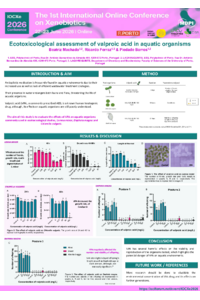
Due to increased use of antiepileptic medications (AEDs) and lack of efficient wastewater treatment strategies, these drugs are frequently found in aquatic environments. Their presence in water endangers both fauna and flora, threatening the life of aquatic organisms. Valproic acid (VPA), a commonly prescribed AED, is a known human teratogenic drug, although its effects on aquatic organisms are still poorly understood.
The aim of this study is to evaluate the effects of VPA on aquatic organisms commonly used in ecotoxicological studies, Lemna minor, Daphnia magna and Chlorella vulgaris.
Methods
The following tests used VPA concentrations ranging from 1 to 100 mg/L. Acute growth inhibition tests were realised on Lemna minor and C.vulgaris. L.minor was exposed to VPA for 7 days and the number of fronds, growth rate and root length were analysed. C.vulgaris was exposed to VPA during 48h and the growth rate and % of inhibition were analysed. A chronic toxicity study was performed to evaluate VPA effects on D.magna. These organisms were exposed to six concentrations of VPA for 21 days and several parameters related to Daphnia’s reproduction and growth were analysed. All tests were performed according to OECD and standard endpoints were quantified, including EC₅₀, NOEC and % inhibition.
Results
VPA decreased the number of fronds, growth rate, root length and pigmentation of L.minor and inhibited C.vulgaris growth. This AED affected the reproduction of D.magna, delaying the age at the first posture and reducing the growth rate of the mothers, as well as affecting the number, viability and length of the offspring.
Conclusion
VPA has several harmful effects on the viability and reproduction of the organisms tested, which highlights the potential danger of VPA on aquatic environments. More research should be done to elucidate the environmental concentration of this drug and eventual removal techniques.
Keywords
Valproic acid
ecotoxicity
Lemna minor
Daphnia magna
Chlorella vulgaris
Poster
Poster MDPI 2026- Beatriz Machado.pdf
Methylimidazolium Ionic Liquids as Persistent Xenobiotics: Mitochondrial Injury and PDC-E2 Modification Relevant to Autoimmune Liver Disease
Predicting the Health Effects of AhR Ligands: Bioinformatic Risk Assessment of Environmental Pollutants and Dietary Compounds